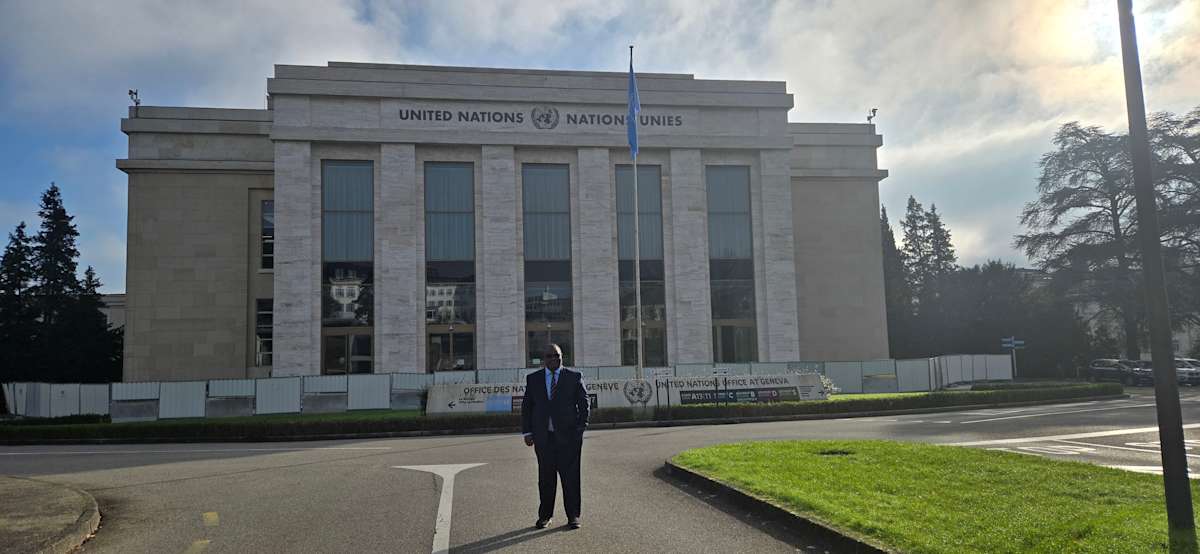
By Dr. Januarius Jingwa Asongu
Stephen Lendman (1934–2023) was not a professional philosopher in the academic sense, yet his life embodied a deeply philosophical commitment: the belief that truth exists, that justice matters, and that intellectuals have a moral duty to confront injustice. Through decades of independent journalism and political analysis, Lendman developed a coherent worldview rooted in moral courage and a relentless pursuit of truth.
At a time when political narratives often dominate public discourse, Lendman insisted that ethical principles must stand above political power. His writings—on U.S. foreign policy, the Iraq War, and the Israeli–Palestinian conflict—were driven by the conviction that right and wrong are not determined by governments or media narratives. Instead, moral truth exists independently of authority, and it is the responsibility of conscientious thinkers to defend it.
From Harvard to a Life of Conscience
Born in Boston in 1934, Lendman graduated from Harvard University in 1956. Although his formal education was in business, his intellectual path would eventually lead him far beyond corporate or managerial concerns. After two years of military service and later earning an MBA from the Wharton School, Lendman developed a sophisticated understanding of economic and political power structures.
This background proved crucial for his later work. His writings demonstrate a keen awareness of how institutions—whether governments, corporations, or media organizations—shape public understanding of global events. Rather than accepting official narratives at face value, Lendman approached political claims with skepticism and rigorous scrutiny. In this sense, his intellectual journey reflects a broader philosophical tradition: the belief that critical inquiry is a moral responsibility.
Truth, Power, and the Critique of Empire
A central theme in Lendman’s work was the critique of imperial power. He argued consistently that political institutions often pursue dominance and strategic advantage while neglecting ethical considerations. His analysis of U.S. foreign policy frequently highlighted what he saw as contradictions between America’s professed commitment to international law and its actual geopolitical behavior.
In examining global conflicts—from Iraq to Ukraine—Lendman pointed out that powerful states often frame their actions in the language of security or humanitarian concern while pursuing strategic interests. For him, the essential philosophical question was whether political power could ever claim moral legitimacy without accountability to universal ethical principles.
This stance places Lendman within a broader intellectual tradition that includes thinkers such as Noam Chomsky and Edward Said. Like them, he believed that intellectuals must remain independent of power and must challenge narratives that justify injustice.
Questioning What We Are Told
One of the most important influences on Lendman’s thinking was Noam Chomsky’s analysis of how institutions shape public perception. Chomsky famously argued that modern media systems often function to “manufacture consent” by filtering information through political and economic interests.
Lendman embraced this insight and applied it consistently in his own work. His articles frequently examined how media coverage can obscure the ethical dimensions of conflicts by simplifying complex realities or by repeating official talking points.
For Lendman, this created a profound ethical obligation: intellectual independence. If public knowledge is mediated by powerful institutions, then thinkers must constantly question, verify, and investigate claims before accepting them. Seeking truth was not merely an intellectual exercise—it was a moral act.
The Iraq War as a Moral Crisis
The 2003 Iraq War represented, for Lendman, one of the most profound ethical failures of modern international politics. In our co-authored book The Iraq Quagmire, we argued that the war could not be justified by appeals to political authority or strategic necessity.
War, Lendman believed, is the most serious action a state can undertake. Because it involves the destruction of lives and societies, it must be judged by universal moral standards rather than by political expediency. The devastating human consequences of the Iraq War—civilian casualties, social collapse, and long-term instability—demonstrated what happens when political decisions ignore ethical principles.
Intellectual Courage and the Defense of Human Dignity
Lendman’s advocacy for Palestinian rights further illustrates his commitment to moral universalism. He argued that ethical principles must apply equally to all people, regardless of nationality or political alignment. In his essays, he criticized the selective use of terms such as “terrorism,” noting how such labels are often applied inconsistently to justify violence or silence criticism.
Taking such positions in American public discourse required considerable courage. Yet Lendman believed that the intellectual vocation demands exactly this kind of integrity: the willingness to defend truth even when it is unpopular.
A Philosophical Perspective: Critical Synthetic Realism
The philosophical framework of Critical Synthetic Realism (CSR) helps explain the deeper foundations of Lendman’s commitments. CSR begins with a simple but powerful premise: reality exists independently of our opinions or political interests. Truth is not created by institutions; it is discovered through careful reasoning, evidence, and intellectual honesty.
This principle—known as ontological realism—provides the basis for moral resistance. If truth were merely a matter of opinion, there would be no stable ground from which to challenge injustice. Lendman’s entire intellectual life presupposed that objective truths exist about war, human dignity, and political responsibility.
At the same time, CSR recognizes human fallibility. Our understanding of reality is always partial and subject to correction. Knowledge therefore advances through a continuous process of questioning, debate, and synthesis. Lendman’s commitment to independent research and critical investigation reflected precisely this spirit.
A Life Lived in Truth
Stephen Lendman’s legacy reminds us that philosophy is not confined to classrooms or academic journals. It is lived through intellectual integrity and moral courage.
His work stands as an example of what it means to take truth seriously in an age of political manipulation and media distortion. By insisting that justice must stand above power, Lendman demonstrated that the pursuit of truth is not merely an intellectual task—it is a moral vocation.
In the end, his life offers a powerful lesson: the responsibility of the intellectual is not simply to interpret the world, but to defend truth within it.