Other Writing

Previous study has assessed patient awareness about management of sickle cell disease (SCD) which indicates that there is a lack of awareness about the disease and possibly a need for more awareness. Therefore, our study aimed at Awareness & Knowledge of Sickle Cell Disease in Rivers State, Nigeria. The study was conducted from October 2018 to February 2019. A questionnaire was distributed among 154 persons selected from among the general public. Most (75.0%) had heard of SCD and 35.0%...

By Professor Januarius Asongu

Part VI: Conclusion—The Future of Catholicism Between Memory and Prophecy

Returning to Fr. Michael Evelyn Galabe

This essay began with the death of Fr. Michael Evelyn Galabe, CMF.

It concludes there as well.

The choice is deliberate.

Galabe's life and death are not merely biographical details. They constitute an interpretive lens through which broader realities become visible. His passing in relative obscurity raises questions that extend far beyond Cameroon, beyond...
By Professor Januarius Asongu

Part V: Epistemic Sovereignty, Institutional Fallibilism, and the Future of Synodality

From Ecclesiology to Epistemology

The preceding sections have argued that the recurring tension between prophets and apologists, critics and guardians of continuity, cannot be adequately explained through ecclesiology alone. The problem is ultimately epistemological. It concerns how individuals and institutions discern truth under conditions of uncertainty, historical limitation,...

By Professor Januarius Asongu

Part IV: Newman, Congar, Ratzinger, Küng, and the Emergence of a Critical Synthetic Ecclesiology

Beyond the Crisis: The Search for an Adequate Ecclesiology

The preceding discussion has identified a recurring pattern within modern Catholicism. Institutions frequently reward continuity while marginalizing critique. Prophetic voices often shape theological discourse while remaining excluded from positions of institutional authority. Synodality, meanwhile, struggles...

By Professor Januarius Asongu

Part III: From Küng to Boff—The Global Pattern and the Formation of an Anti-Synodal Culture

From Küng to Boff: The Global Pattern

The argument developed thus far suggests that the tension between prophecy and institutional advancement is neither accidental nor confined to particular local churches. The cases of Fr. Michael Evelyn Galabe and Archbishop Andrew Nkea provide a local illustration of a much broader phenomenon. Across modern Catholicism, a recurring...

By Professor Januarius Asongu

Part II: Ecclesial Advancement, Institutional Logic, and the Preference for Managers

The Galabe–Nkea Contrast as an Ecclesial Case Study

The questions raised by the life and death of Fr. Michael Evelyn Galabe become more concrete when placed alongside the ecclesial trajectory of Archbishop Andrew Nkea Fuanya. The comparison is not intended as a moral judgment upon either man. Nor does it seek to diminish the genuine pastoral and administrative accomplishments...

By Professor Januarius Asongu

Part I: The Problem of Prophetic Memory

Introduction

"At last, O powerful Master, you give leave to your servant to go in peace according to your word, for my eyes have seen your salvation" (Luke 2:29–30, NRSV).

The death of Rev. Fr. Michael Evelyn Galabe, CMF, in March 2026 prompted an unexpected theological question. It was not merely the death of a priest, scholar, educator, and pioneer. Priests die every day. The Church buries them, remembers them briefly, and...

By Januarius Asongu

Saint Monica University, Buea, Cameroon

Abstract
This article provides a theological and biblical defense of LGBTQ+ inclusion within Christian ethics and ecclesial life. Drawing upon hermeneutical scholarship, Christocentric theology, and historical-critical interpretation, it challenges traditional readings of biblical texts often used to condemn same-sex relationships and gender diversity. The paper argues that the essence of Christian morality—rooted in agape love,...


Januarius J. Asongu, PhD

Abstract

This article develops a constructive theology of the Sacrament of the Anointing of the Sick through the frameworks of Critical Synthetic Realism (CSR) and Synthetic Theological Realism (STR). It argues that the sacrament should not be understood as magical intervention, ritual superstition, or guaranteed physical cure, but as sacramental participation in God's healing, consoling, reconciling, and hope-giving presence amid human fragility, suffering, illness,...


Januarius J. Asongu, PhD

Abstract
This article develops a constructive theology of marriage through the frameworks of Critical Synthetic Realism (CSR) and Synthetic Theological Realism (STR). It argues that marriage should be understood not merely as a legal contract, romantic arrangement, or reproductive institution, but as a sacramental vocation of truthful love, mutual sanctification, self-correction, forgiveness, and shared human flourishing. Building upon the Christian understanding of the...


Januarius J. Asongu, PhD

Abstract
This article develops a constructive theology of Holy Orders through the frameworks of Critical Synthetic Realism (CSR) and Synthetic Theological Realism (STR). It argues that priesthood should be understood as the sacramental fulfillment of epistemic sovereignty within the ecclesial community. In a civilization increasingly characterized by epistemic fracture, ideological polarization, technological manipulation, institutional distrust, and moral...


Januarius J. Asongu, PhD

Abstract

This article develops a constructive sacramental theology of Confirmation through the framework of Synthetic Theological Realism (STR), with its implied philosophical infrastructure of Critical Synthetic Realism (CSR). It argues that Confirmation should be understood not merely as a sacrament of ecclesial maturity or symbolic affirmation of baptismal identity, but as the sacramental strengthening of epistemic, moral, spiritual, and ecclesial agency under the...

By Ed Wallace

In Cameroon's Adamawa Region, the law says the land belongs to the nation. What that means, in practice, is that it belongs to whoever the government decides to give it to.

In May 2022, the Cameroonian government handed 95,000 hectares of land in the Adamawa Region, 3 times the size of the capital Yaoundé, to a single company, Tawfiq Agro Industry, on a long lease. No environmental or social management plan was shared with the communities living and farming there. By August, those...

By Professor Januarius Asongu, Saint Monica University, Buea, Cameroon

Abstract

This article develops a philosophical and developmental analysis of the crisis and future of Lebialem within the broader context of African underdevelopment and civilizational reconstruction. Drawing from Critical Synthetic Realism (CSR), the article argues that persistent underdevelopment cannot be explained solely through colonialism, political instability, or economic dependency. Rather, it introduces the concept...

By George C. N. Lekelefac, University of Munich

Abstract

This article offers a comprehensive analysis of the theological contribution of Januarius Jingwa Asongu to the development and reconstruction of liberation theology for the twenty-first century. While classical liberation theology—as articulated by Gustavo Gutiérrez, Leonardo Boff, and James H. Cone—foregrounded structural injustice and praxis, it lacked a sufficiently developed epistemology capable of accounting for the persistence of...

By Prof. Januarius Asongu, author Forced Unity

Introduction: The Church in Crisis—Prophet or Compromiser?

The Anglophone crisis in Cameroon—often referred to as the Ambazonia struggle—is not only a political and humanitarian catastrophe; it is a profound theological scandal. It reveals the uneasy complicity between ecclesiastical institutions and the post-colonial state, forcing a moral reckoning with the question: What is the role of the Church when God’s people cry out under oppression?

While...

Join us as we explore the journey of Dr. Januarius Jingwa Asongu (holds 3 PhD's), a lifelong learner and author, delving into his insights on continuous learning, critical thinking, and personal growth. Discover practical tips to become a lifelong learner and the philosophical foundations that shape his approach.

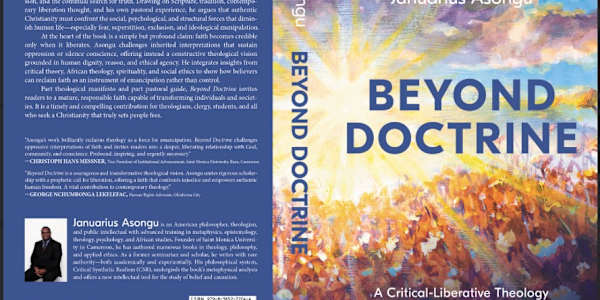
Critical-Liberative Theology: Towards an Understanding of Januarius

By George Chrysostom Nchumbonga Lekelefac, JCL, MCL, President, Nchumbonga Lekelefac Research Institute, Oklahoma City, USA

This article offers a systematic and contextual theological interpretation of Beyond Doctrine: A Critical-Liberative Theology of Faith and Emancipation [1]. Combining close textual analysis with semi-structured interviews conducted with the author between 2022 and 2026, the study reconstructs Asongu’s theological project as an integrated method uniting (i) liberation...

The Heroic Service and Hidden Sanctity of Fr. John Brummelhuis, MHM:

By Januarius Asongu, PhD, author of Beyond Doctrine and Chancellor of Saint Monica University

This article presents an extended historical–theological examination of the life and ministry of Fr. John Brummelhuis, MHM, a Dutch Catholic missionary priest whose work in Cameroon exemplifies the integration of evangelical charity, infrastructural liberation, disciplined prayer, moral integrity, and contemplative surrender. Drawing on peer- reviewed historical research, regional political history,...

Reconciling Agency and Tradition: A Critical-Liberative Theological

By Januarius Asongu, PhD, author of Beyond Doctrine and Chancellor of Saint Monica University


This article employs Critical-Liberative Theology (CLT) to conduct a systematic deconstruction of the two principal theological frameworks used to exclude same-sex relationships from sacramental recognition in Roman Catholic teaching: the contra naturam (against nature) argument from natural law and the complementarian Imago Dei (Image of God) argument from theological anthropology. Building on the...