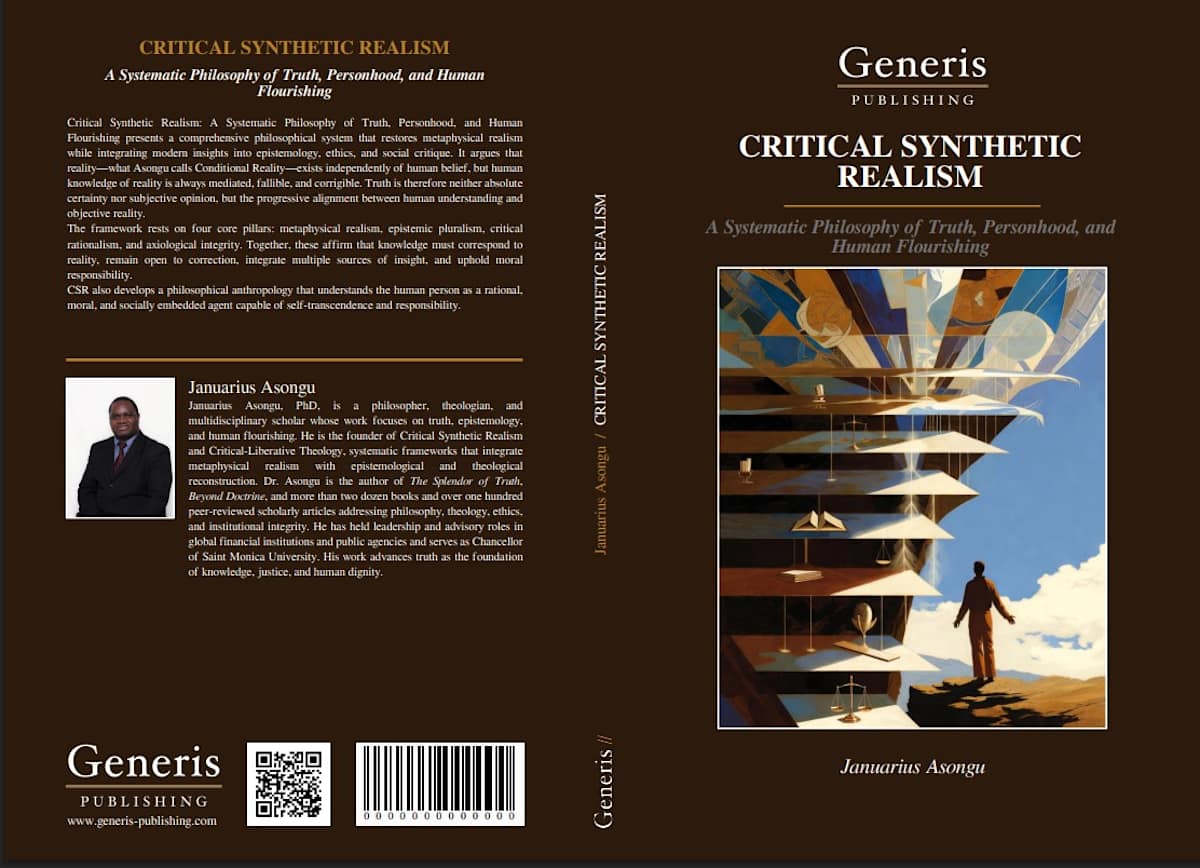
By Januarius Asongu, PhD
At the heart of Critical Synthetic Realism (CSR) lies a central metaphysical idea: Conditional Reality. The concept emerges from a simple observation about human existence—we do not live in an abstract world of pure ideas, nor in a purely subjective universe created by personal perception. Instead, we inhabit a reality that is real, structured, and conditioned.
Conditional Reality refers to the total, multilayered structure of existence that shapes what is possible, meaningful, and sustainable for human life. Reality is not chaotic or arbitrary. It possesses patterns, limits, relationships, and consequences that exist independently of our wishes. Human freedom operates within these conditions, not outside them.
The term “conditional” does not mean uncertain or unreal. Rather, it means that all human experience unfolds within conditions that both enable and constrain us.
Consider a simple example. A seed has the potential to become a tree, but only under certain conditions: soil, water, sunlight, and time. The potential is real, yet its realization depends on alignment with the structures of nature. Human life operates in the same way. Flourishing is not accidental; it emerges when actions align with the conditions of reality.
CSR proposes that reality is layered. Human existence simultaneously unfolds across multiple dimensions:
- Physical reality, governed by natural laws
- Biological reality, shaping health and embodiment
- Psychological reality, influencing perception and emotion
- Social reality, structured by institutions and culture
- Moral reality, involving responsibility and consequence
- Existential reality, concerning meaning and purpose
- Transcendent reality, opening human life toward ultimate questions
These layers are interconnected. Economic decisions affect psychological well-being. Moral failures reshape social institutions. Technological innovation alters culture and even human self-understanding. Conditional Reality recognizes that no single discipline—science, theology, politics, or psychology—can adequately explain the whole.
Modern thought often swings between two extremes. On one side lies reductionism, which attempts to explain everything in terms of one level alone—usually the physical or material. On the other side lies relativism, which treats reality as constructed entirely by culture or interpretation. Conditional Reality rejects both. Reality is objective, yet complex; structured, yet dynamic; independent of us, yet encountered through lived experience.
This framework has important implications for human freedom. Freedom does not mean unlimited choice. True freedom is the capacity to act intelligently within real conditions. A society cannot ignore economic realities indefinitely without collapse. A person cannot neglect psychological or moral truths without suffering consequences. Reality ultimately corrects illusion.
In this sense, Conditional Reality explains why truth matters ethically. Error is not merely intellectual—it is misalignment with the structures that sustain flourishing. When individuals or societies deny reality, the result is fragmentation, injustice, or stagnation. When they align with reality, growth becomes possible.
The concept also bridges realism and interpretation. Human beings never access reality directly or perfectly; our understanding is mediated by language, history, and culture. Yet interpretation does not create reality. Instead, interpretation represents humanity’s ongoing effort to understand the conditions within which life unfolds.
Conditional Reality therefore invites intellectual humility. Knowledge becomes a process of progressive alignment rather than final possession. We learn by correcting errors, refining understanding, and adjusting action to better correspond with the real.
In an age marked by ideological polarization and technological disruption, this insight becomes especially urgent. Many contemporary crises—environmental degradation, political instability, misinformation—arise from attempts to live as if reality were negotiable. CSR insists that it is not. Reality remains patient but uncompromising.
Ultimately, Conditional Reality affirms a hopeful vision. The world is intelligible. Human beings are capable of understanding it. And flourishing becomes possible when truth, responsibility, and freedom converge within the real conditions of existence.
To live wisely, then, is to learn the art of alignment: to think, act, and build institutions in harmony with the structures of reality itself.