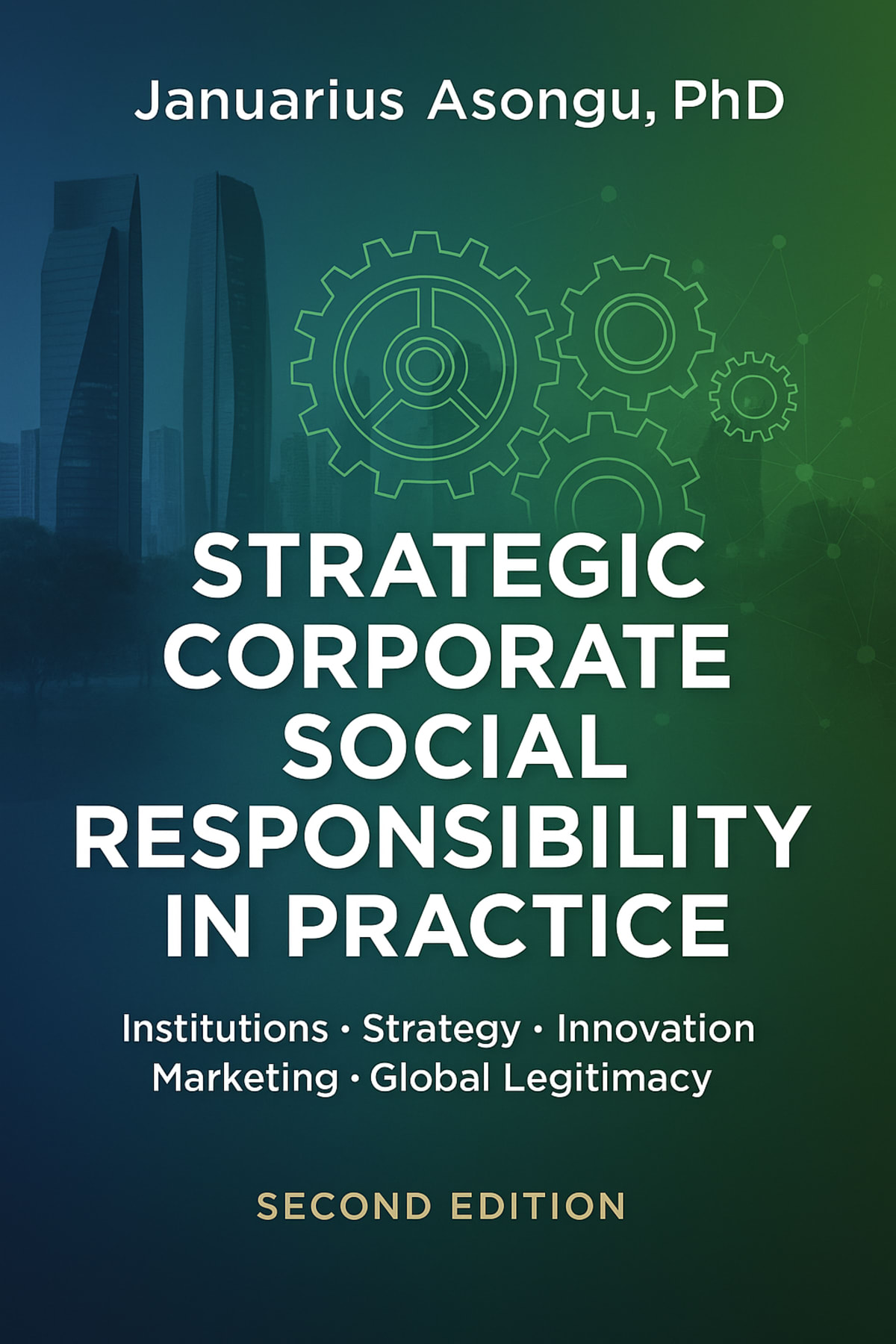
By Januarius Jingwa (JJ) Asongu, PhD, author of Strategic Corporate Social Responsibility in Practice
Corporate Social Responsibility (CSR) has become a central feature of modern corporate discourse. Yet too often, it remains confined to the language of strategy, branding, and regulatory compliance. Many organizations adopt CSR programs to strengthen reputation, mitigate risk, or enhance stakeholder relations. While these objectives are legitimate, they are insufficient. My approach, grounded in my philosophical framework of Critical Synthetic Realism, argues that CSR must be understood not merely as a strategic instrument, but as a moral imperative rooted in truth, accountability, and human dignity.
Beyond Strategy: CSR as Ethical Obligation
Traditional management theory frequently treats CSR as a contingent managerial strategy—a tool deployed when it enhances profitability or competitive advantage. This instrumental view reduces ethical responsibility to a matter of convenience. Critical Synthetic Realism rejects this reduction. It affirms that moral facts exist independently of corporate preference. Ethical obligations are not created by corporations; they are discovered through rational reflection and moral awareness.
Corporations derive their legitimacy not solely from market success, but from their alignment with ethical reality. Profitability, while necessary for institutional survival, does not override moral responsibility. Corporations operate within a social and moral ecosystem. Their actions affect employees, communities, ecosystems, and future generations. Therefore, CSR must be an enduring ethical commitment embedded within the identity of the organization itself.
Truth-Oriented Corporate Responsibility
At the heart of my approach is the principle that CSR must be a truth-oriented ethical practice. This means that corporate responsibility cannot be reduced to symbolic gestures or public relations campaigns. Authentic CSR requires coherence between institutional claims and institutional behavior.
Corporations must confront the reality of their impact. They must acknowledge both their contributions and their harms. Transparency, accountability, and intellectual honesty are essential. When corporations align their actions with truth, they build legitimacy. When they rely on ethical posturing without substantive ethical commitment, they undermine their own institutional credibility.
This truth-oriented approach transforms CSR from a peripheral activity into a central moral discipline guiding corporate decision-making.
Epistemic Humility and Continuous Ethical Reflection
Critical Synthetic Realism also emphasizes epistemic humility—the recognition that human understanding is always incomplete and subject to revision. Ethical responsibility is not fulfilled through static compliance with fixed rules. It requires continuous reflection, learning, and adaptation.
Corporations must remain open to moral critique. They must listen to stakeholders, engage with communities, and refine their practices in response to evolving knowledge. Ethical responsibility is not a destination but a continuous process.
This approach strengthens institutional resilience. Organizations that engage in continuous ethical reflection are better equipped to navigate complex social and technological environments.
CSR as Institutional Legitimacy and Strategic Capability
While CSR is fundamentally ethical, it also has profound strategic implications. Ethical institutions build trust. Trust strengthens legitimacy. Legitimacy reduces risk, enhances resilience, and contributes to long-term sustainability.
CSR must therefore be embedded within corporate governance, operational structures, and organizational culture. It must inform decision-making at every level. When CSR becomes institutionalized, it transforms the corporation from a purely economic entity into a socially legitimate institution.
Publications and Academic Contributions
My approach to CSR has been developed through extensive academic research and publication, including:
• Strategic Corporate Social Responsibility in Practice: Institutions, Strategy, Innovation, Marketing, and Global Legitimacy (2025) – This work presents CSR as a dynamic, institutionally embedded ethical practice shaped by power, regulation, and market forces.
• The Dynamics of Dual Legitimacy: CSR Policy Adaptation in Multinational Corporations (Doctoral Dissertation, 2011) – This research examines how multinational corporations adapt CSR policies to maintain legitimacy across diverse regulatory and cultural environments.
• The Legitimacy of Strategic Corporate Social Responsibility as a Marketing Tool (2007) – This paper critically examines the ethical implications of using CSR primarily as a branding mechanism.
• A Review of the Definition, Practice, and Arguments for Corporate Social Responsibility – This publication expands the conceptual foundation of CSR beyond economic justification to include ethical and social imperatives.
• The Critical Synthetic Realism Framework for Corporate Social Responsibility – This work establishes the philosophical foundation for CSR grounded in objective moral reality and institutional accountability.
CSR in Practice: Institutional Leadership
My leadership at Saint Monica University reflects these principles in practice. The university integrates scholarships for underserved populations, community healthcare initiatives, service-learning programs, and human rights advocacy into its institutional mission. These initiatives are not peripheral activities. They are expressions of institutional identity grounded in ethical responsibility.
Institutions must justify their existence through measurable contributions to human flourishing.
The Future of Corporate Responsibility
The future of CSR depends on its philosophical transformation. Corporations must move beyond compliance and reputation management toward genuine moral accountability. They must recognize that their legitimacy depends not only on economic performance, but on their contribution to human dignity, social justice, and the common good.
Corporate Social Responsibility is not ultimately about marketing. It is about moral truth.
It is about whether institutions will align their power with ethical reality.
And it is about whether corporations will choose legitimacy grounded not in perception, but in justice.