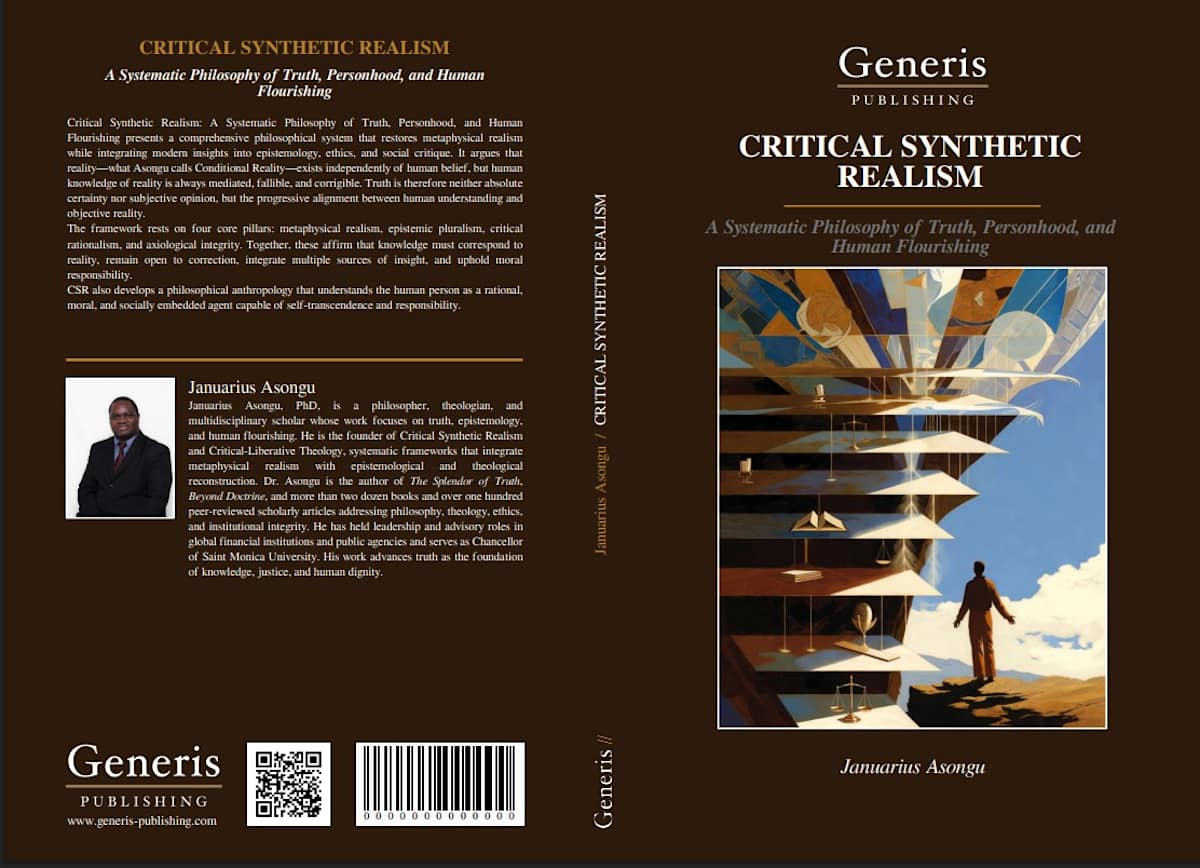
By Januarius Asongu, PhD, author of The Splendor of Truth and Critical Synthetic Realism
Over the past few years, I have often been asked whether my philosophical framework—Critical Synthetic Realism (CSR)—is simply another version of Critical Realism, the influential philosophical system developed by Roy Bhaskar. The question is understandable. There are real similarities between our approaches, and I openly acknowledge an intellectual affinity with Bhaskar’s project. Yet the relationship between CSR and Critical Realism is both deeper and more complicated than simple agreement.
In fact, I only met Bhaskar’s work relatively late—in 2022. I often say, half humorously but entirely seriously, that discovering him when I did was fortunate. Had I encountered his writings earlier, I might have become a victim of what I call the Bushu Syndrome—a condition in which a powerful intellectual influence so closely mirrors one’s developing intuitions that independent articulation becomes difficult. Because I agree with Bhaskar on many foundational points, early exposure might have led observers to assume that my work was derivative rather than independently developed.
By the time I encountered Critical Realism, however, CSR had already begun taking shape through my engagement with Thomistic metaphysics, psychology, theology, and institutional analysis. Reading Bhaskar felt less like conversion and more like recognition. I discovered a philosopher who had courageously defended realism at a time when much of academia had surrendered to relativism.
Bhaskar’s achievement cannot be overstated. Critical Realism restored the legitimacy of ontology within modern philosophy. He argued that reality exists independently of our observations and that scientific inquiry succeeds because the world contains real causal mechanisms beneath observable events. His distinction between the empirical, the actual, and the real remains one of the most important philosophical contributions of the twentieth century. In many ways, he saved realism from the excesses of positivism and postmodern skepticism.
Yet my own philosophical journey was motivated by a different problem.
Bhaskar primarily asked how science can produce objective knowledge despite social conditioning. My concern emerged from observing societies, institutions, and religious communities where truth itself seemed inaccessible—even when evidence was overwhelming. I was less concerned with the philosophy of science than with what I came to describe as the epistemic fracture of civilizations.
Critical Synthetic Realism therefore extends realism beyond scientific explanation into the lived realities of human existence. While Critical Realism emphasizes the social mediation of knowledge, CSR emphasizes psychological and institutional mediation. Human beings do not merely interpret reality through theories; they encounter reality through fear, trauma, ideology, culture, and power structures. Entire communities can become trapped within epistemic environments that prevent them from recognizing truth.
Here lies one of the decisive differences between our approaches. Critical Realism explains how knowledge is produced; CSR seeks to explain why human beings sometimes become unable to know truth even when reality confronts them directly.
Another distinction concerns the human person. Bhaskar’s framework treats individuals largely as social agents operating within structures. CSR draws more explicitly from Thomistic philosophical anthropology, viewing the human person as a metaphysical subject oriented toward truth, freedom, and flourishing. Error is therefore not only intellectual but moral, psychological, and civilizational.
Religion and transcendence also play a more central role in CSR. While Bhaskar later explored spiritual realism, his project remains largely grounded in philosophy of science. CSR argues that civilizations require transcendent grounding to sustain epistemic stability. When transcendence collapses, societies risk drifting into relativism, ideological absolutism, or epistemic chaos.
Despite these differences, I consider Critical Realism an important companion rather than an adversary. My meeting with Bhaskar’s ideas confirmed that the realist impulse remains alive in contemporary philosophy. Where he defended realism against empiricism, I attempt to synthesize realism with metaphysics, psychology, theology, and institutional critique.
If I were to summarize the distinction simply, I would say this: Bhaskar helped philosophy rediscover reality; CSR seeks to understand how persons and civilizations learn—or fail—to live truthfully within it.
And perhaps that is why discovering Bhaskar in 2022 felt providential. I recognized in his work an intellectual ally rather than a master to imitate. The encounter affirmed that realism remains a shared philosophical horizon, even as CSR pursues its own path toward epistemic reconstruction and human flourishing.