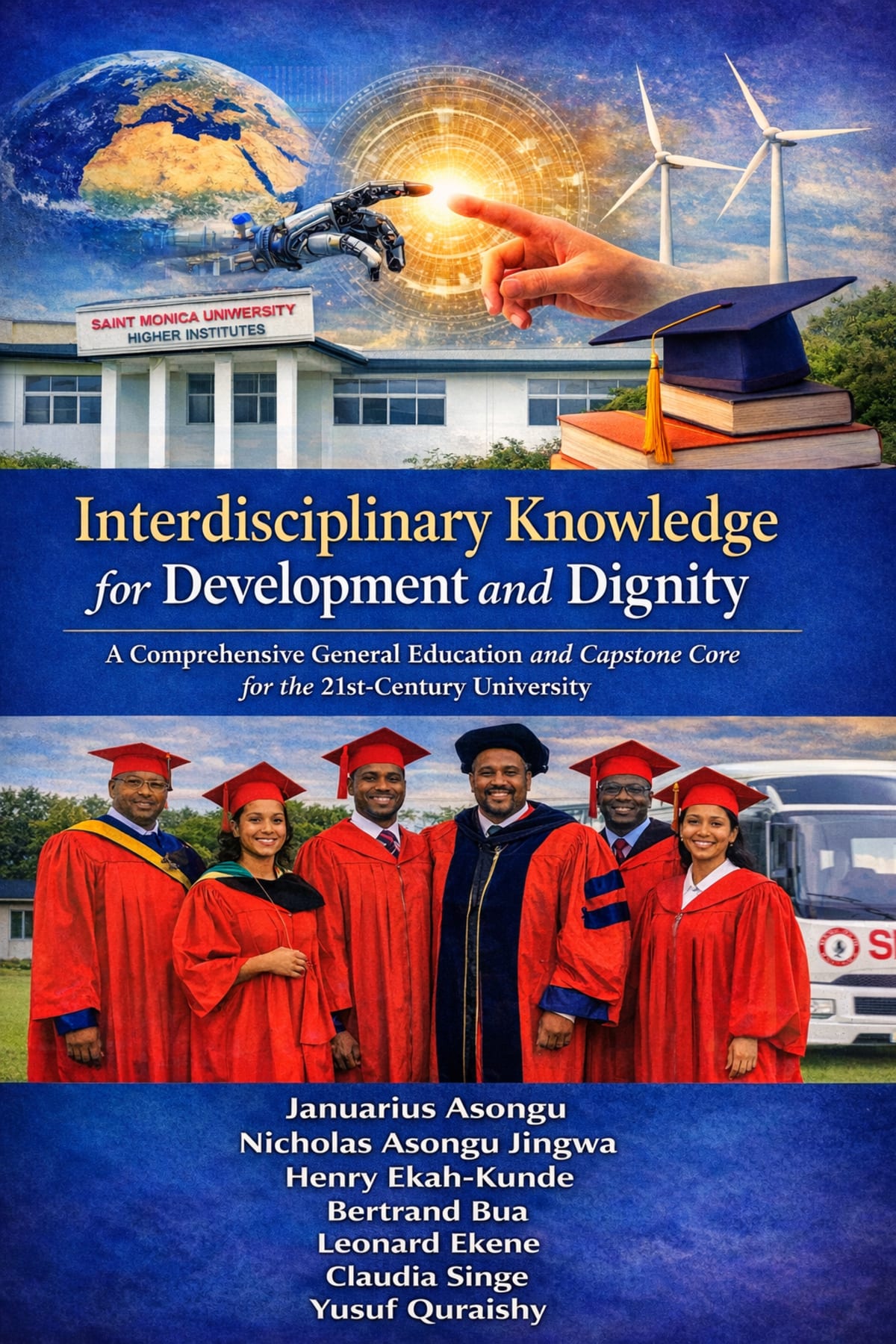
By Januarius Jingwa (JJ) Asongu, PhD, Chancellor of Saint Monica University and author Interdisciplinary Knowledge for Development and Dignity
My philosophy of education, grounded in Critical Synthetic Realism, begins with a conviction both simple and radical: education is not merely the transfer of knowledge, but the liberation of the human mind. Its ultimate purpose is not technical competence alone, but the formation of persons capable of truth-seeking, ethical judgment, and responsible action in the world.
Critical Synthetic Realism affirms that reality exists independently of our beliefs, but our understanding of it develops through disciplined inquiry, reflection, and synthesis. Education must therefore be truth-oriented. It must cultivate in students the intellectual courage to question assumptions, the humility to revise their beliefs, and the capacity to integrate knowledge across disciplines. Education becomes, in this sense, a process of epistemic reconstruction—a restoration of the human capacity to know truthfully and act responsibly.
This philosophy is not merely theoretical. It is institutionalized concretely at Saint Monica University (SMU), where the entire General Education and Capstone Core was designed around the principles of Critical Synthetic Realism. The curriculum recognizes that the most urgent challenges of the twenty-first century—technological disruption, governance crises, economic inequality, and misinformation—cannot be addressed through fragmented knowledge. They require interdisciplinary understanding, ethical reasoning, and integrative thinking.
This vision is articulated systematically in my book , which presents a comprehensive framework for general education grounded in development, dignity, and truth. The book argues that education must move beyond narrow specialization toward interdisciplinary integration. Students are trained in communication, mathematics, science, philosophy, ethics, technology, and civic responsibility—not as isolated subjects, but as interconnected modes of understanding reality.
At Saint Monica University, education is structured as a developmental journey. Students begin by acquiring foundational intellectual tools—logic, communication, and scientific reasoning. They then engage with society, technology, ethics, and governance. Finally, they complete interdisciplinary capstone projects that require them to apply their knowledge to real-world problems. This progression reflects the Critical Synthetic Realist model of knowledge itself: observation, interpretation, critical evaluation, synthesis, and responsible action.
The goal is not merely to produce graduates who possess information, but graduates who possess intellectual agency. Students learn to distinguish truth from falsehood, evidence from assertion, and knowledge from superstition. They are trained to think critically, reason ethically, and act responsibly.
This approach is especially important in societies confronting what I have described elsewhere as an epistemic fracture—a breakdown in the critical, self-correcting systems of knowledge that sustain social progress. Education becomes the primary mechanism of epistemic repair. It restores the habits of disciplined inquiry, intellectual integrity, and rational judgment necessary for human development.
Education, properly understood, is therefore not a commodity. It is a moral and civilizational project. It shapes how individuals understand reality, exercise freedom, and contribute to society.
At Saint Monica University, this conviction guides every aspect of institutional design. The university exists not merely to transmit knowledge, but to cultivate truth-seeking persons capable of transforming their societies through knowledge grounded in reality, guided by ethics, and directed toward human dignity.
Education is, ultimately, the foundation of freedom. And truth is its beginning.