By Januarius Asongu, PhD
Critical Synthetic Realism (CSR)
A philosophical framework affirming that reality exists independently of human perception while recognizing that human knowledge of reality is fallible, historically mediated, and institutionally structured. CSR integrates metaphysical realism, epistemic fallibilism, and interdisciplinary synthesis in order to address the fragmentation of contemporary knowledge systems.
Synthetic Theological Realism (STR)
A theological methodology derived from CSR that preserves the ontological realism of Christian doctrine while acknowledging historical development, intellectual pluralism, and interdisciplinary engagement. STR seeks to reconstruct theology after the fragmentation produced by modern and postmodern theological debates.
Critical-Liberative Theology (CLT)
An extension of liberation theology that incorporates insights from epistemology, institutional analysis, and political philosophy. CLT examines not only economic oppression but also epistemic domination, institutional injustice, and technological forms of power that affect human dignity and social justice.
Epistemic Liberation (EL)
The process by which individuals, institutions, and societies free their knowledge systems from ideological capture, coercion, and structural distortion. Epistemic Liberation restores the conditions necessary for open inquiry, critical debate, and responsible knowledge production.
Epistemic Fracture (EF)
A condition in which the shared epistemic foundations of a society collapse. Epistemic Fracture occurs when institutions responsible for producing and transmitting knowledge—such as universities, scientific communities, media systems, and governance structures—lose their credibility or become captured by ideological or political forces.
Epistemic Sovereignty (ES)
The institutional capacity of a society to sustain resilient, truth-oriented knowledge systems. Epistemic Sovereignty involves protecting intellectual freedom, maintaining epistemic standards, and ensuring that knowledge-producing institutions remain independent, transparent, and accountable.
Epistemic Pluralism
The recognition that multiple perspectives, disciplines, and methodological approaches contribute to the pursuit of truth. Epistemic pluralism does not imply relativism but rather a structured openness in which diverse approaches interact within shared standards of rational inquiry.
Institutional Epistemology
The study of how institutions shape the production, validation, and dissemination of knowledge. Institutional epistemology examines how universities, scientific organizations, media systems, and governance structures influence the reliability and legitimacy of knowledge claims.
Civilizational Intelligence
The collective capacity of a society to generate, preserve, and apply knowledge in ways that sustain social stability, ethical governance, and long-term human flourishing.
Civilizational Flourishing
A condition in which societies sustain ethical institutions, resilient knowledge systems, and social structures that support human dignity, justice, and intellectual freedom across generations.
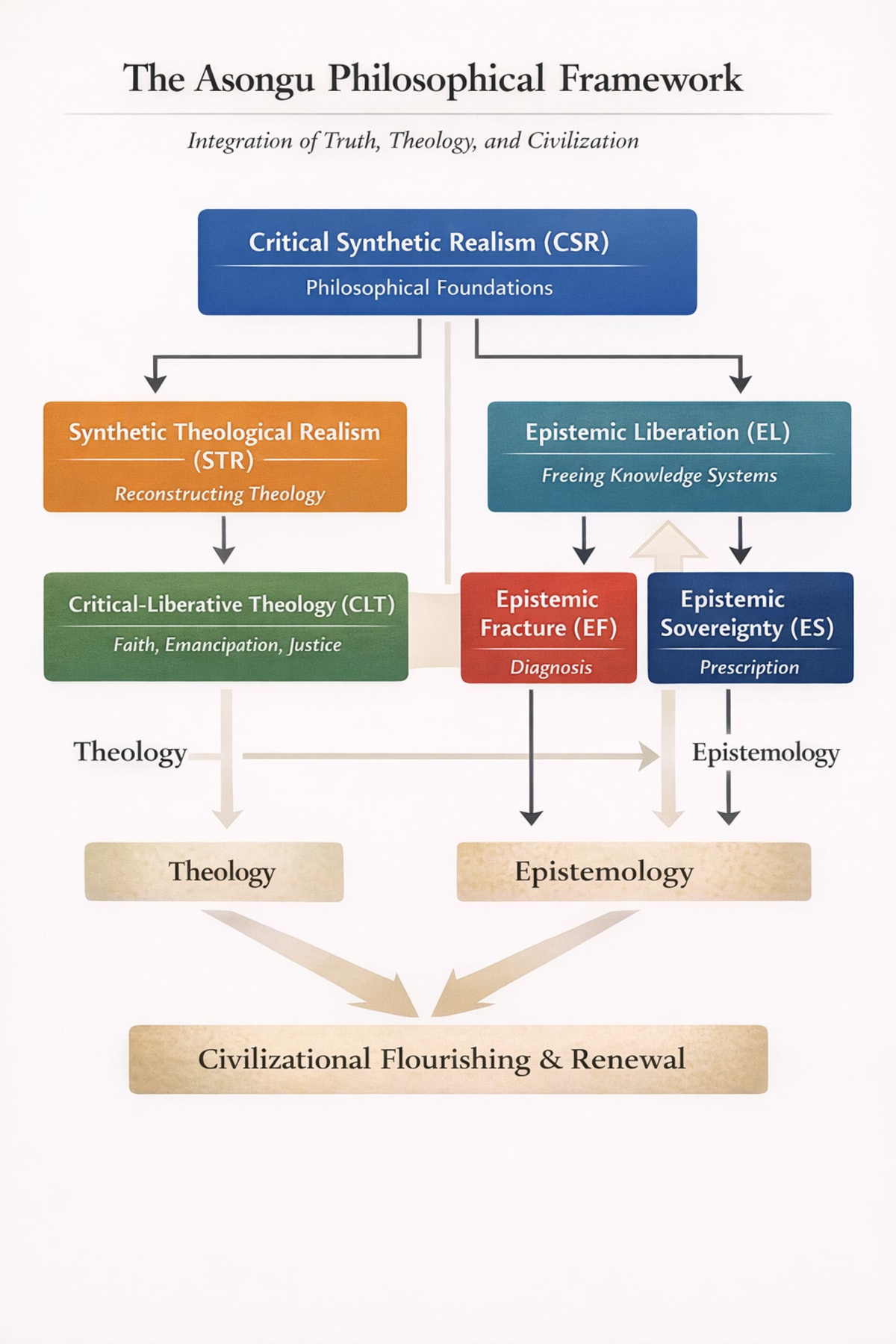
Conceptual Relationship of the Key Concepts
The glossary reflects the broader structure of the Asongu framework:
Philosophical foundation
→ Critical Synthetic Realism (CSR)
Theological development
→ Synthetic Theological Realism (STR)
→ Critical-Liberative Theology (CLT)
Epistemic and institutional analysis
→ Epistemic Liberation (EL)
→ Epistemic Fracture (EF)
→ Epistemic Sovereignty (ES)
Ultimate goal
→ Civilizational Flourishing
Why This Glossary Matters
A glossary like this accomplishes three important goals:
- It ensures terminological precision in discussions of your framework.
- It helps students and scholars quickly grasp the conceptual architecture of your philosophy.
- It facilitates the systematic teaching and scholarly engagement with your work