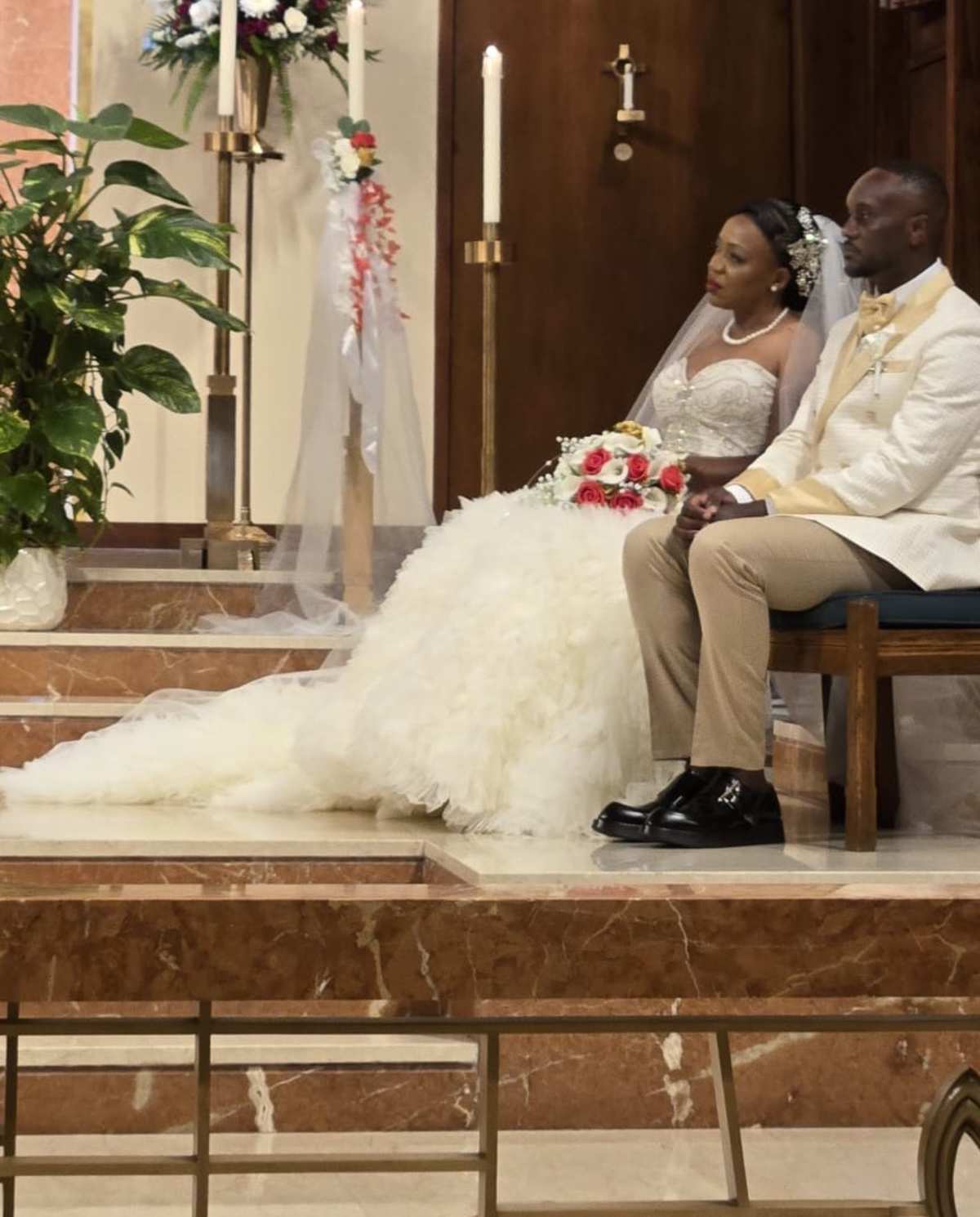
A Reflection at the Convalidation of the Marriage of Dr. Anselm Tintinu and Fiona Bebongchu
Prof. Januarius Asongu, PhD
Let me begin by expressing my heartfelt gratitude to my younger brother, Dr. Anselm Tintinu, and his beloved wife, Fiona Bebongchu, for inviting me to share a few reflections on this joyful occasion. Anselm was the very first of our siblings to stay with us here in the United States, and we’re very proud of who he has become. I also thank every one of you for honouring their invitation with your presence.
This celebration is especially meaningful to me because I have had the privilege of witnessing this story almost from its beginning. I am proud to say that I was the only sibling present at their traditional wedding in Lebang and at the joyful reception that followed in Lewoh. There is, of course, a delightful irony in that memory: Anselm himself was not even there! Yet I witnessed two families come together and celebrate the beginning of a covenant already taking root.
As I look around this church today, I recognise only a handful of those who were present all those years ago. Yet I cannot help giving thanks that what I witnessed then has not merely endured—it has blossomed. What began as hope has become history. What began as a promise has become a family. Today, the Church receives that faithful journey and crowns it with the grace of the Sacrament.
Many speakers today will rightly celebrate Anselm and Fiona's remarkable journey. They will speak of twenty years of faithful companionship, three wonderful children, distinguished careers, sacrifices quietly made, and a home patiently built. Those stories deserve to be told. This afternoon, however, I would like to reflect on something deeper—not simply upon their marriage, but upon the meaning of marriage itself.
Indeed, I hope no one imagines that these reflections belong only to Anselm and Fiona. Every wedding is a mirror in which all of us are invited to see ourselves. Whether we are young or old, married or single, every human life is a lifelong apprenticeship in learning how to love truthfully, forgive generously, speak graciously, and become the kind of person another human being can safely trust. Marriage simply makes those lessons visible in a particularly beautiful way.
The Catholic Church has always insisted that marriage is far more than a contract. Contracts establish rights and responsibilities. They protect justice by asking, "What do I owe?" Marriage speaks a richer language. It is a covenant.
A covenant asks a different question: "How shall I remain faithful?"
A contract lasts only while its conditions are fulfilled. A covenant endures because love refuses to abandon the beloved when life becomes difficult. It is not merely an exchange of promises but the communion of two lives, two people choosing, day after day, to become God's gift to one another.
That is why our Lord declared, "What God has joined together, let no one separate."
Today's celebration, however, presents us with a delightful paradox. After all, Anselm and Fiona have already been husband and wife for twenty years. One is almost tempted to reverse our Lord's words and say, "What man has put together, let no God put asunder."
Fortunately, that is only a joke—and rather poor theology.
For the deeper truth is infinitely more beautiful.
God has never been absent from their story. He was there long before today's liturgy—in every sacrifice no one applauded, every difficult conversation that ended in reconciliation, every burden quietly carried, every whispered prayer, and every ordinary day that slowly became an extraordinary life.
Today's convalidation does not invite God into their marriage. Rather, it proclaims what has always been true: that He has walked with them from the beginning. The Church simply receives what faithful love has patiently built and raises it into the fullness of sacramental life. Grace does not erase history; it perfects it.
This convalidation is therefore not simply a celebration of a wedding. It is a celebration of a successful marriage. That is no small achievement.
In a world where enduring marriages should never be taken for granted, every faithful marriage becomes a quiet testimony of hope. We know that many marriages do not survive. More surprisingly, experience alone does not explain success. In most areas of life we say that experience is the best teacher. Marriage often tells a different story. Even second and subsequent marriages fail with surprising frequency. Experience, by itself, does not teach us how to love.
That raises an important question for every one of us gathered here.
What makes a marriage endure?
Surely the answer is not that successful marriages are made of perfect people, because there are no perfect people. Nor are they made by perfect couples, because there are no perfect couples. Every marriage is the union of two unfinished human beings, each carrying strengths and weaknesses, hopes and fears, virtues and blind spots.
Marriage succeeds not because two perfect people find each other, but because two imperfect people never stop learning how to love each other.
That, I believe, is where the deepest wisdom of marriage begins.
I have come to believe that marriage may well be God's oldest university. It is not a university built of stone, but of hearts. Its classrooms are kitchens and living rooms, hospital corridors and dinner tables, long journeys and late-night conversations. Its lectures are sometimes spoken in words, but more often in silence. Its examinations never appear on a calendar. They arrive unexpectedly—in misunderstanding, disappointment, illness, sacrifice, forgiveness, and hope.
In this university, God Himself is the Chancellor. Grace is the curriculum. Humility is the first lesson. Forgiveness is the daily assignment. Faithfulness is the final examination. No husband or wife ever truly graduates. Every anniversary is another year of learning, another invitation to become a little less selfish and a little more generous. Marriage is not where love comes to rest; it is where love learns to walk.
Perhaps the most difficult lesson in this university can be expressed in three simple words:
"I was wrong."
No sincere apology has ever weakened a good marriage. Every honest apology makes love a little wiser. Every act of forgiveness makes it a little stronger. The happiest marriages are not those in which mistakes never occur; they are those in which self-correction never stops.
There is another lesson that marriage quietly teaches us, one that is often misunderstood.
Marriage is not a relationship between a superior and a subordinate. It is a covenant between equals. Husband and wife possess equal dignity because each bears equally the image of God. Each has gifts the other needs, wisdom the other lacks, and strengths that compensate for the other's weaknesses. Marriage is not about power; it is about partnership.
Over the years I have heard some of my fellow Africans offer a creative solution to an old debate. They say, "The man is the head of the family, but the woman is the neck—and the neck turns the head." It is an amusing image, and I appreciate the humour behind it.
But I must respectfully disagree.
Marriage is neither about heads nor necks. It is about two people standing side by side, looking in the same direction. The great question in marriage is never, "Who is in charge?" The great question is, "How can we help one another become the people God created us to be?" Sometimes one leads because the other is weary. Sometimes one carries because the other is wounded. Sometimes one speaks because the other cannot find the words. But each serves the other, and each receives from the other. Love is not a competition for authority; it is a partnership in service.
As I reflected upon today's celebration, I could not help smiling at the names of the bride and groom, because names often become quiet sermons.
Anselm bears the name of one of Christianity's greatest philosophers, Saint Anselm, whose enduring motto was fides quaerens intellectum—faith seeking understanding. Yet his Nweh name, Tintinu, offers another lesson that may be even more important for marriage. It describes someone who does not allow matters to settle too deeply in the heart; someone who refuses to cling to resentment; someone who lets go and forgives.
What a beautiful vocation.
No marriage survives twenty years because two people never wound one another. Every marriage knows disappointment. Every family experiences misunderstanding. Enduring marriages survive because they refuse to imprison one another in yesterday's failures. They choose, again and again, to forgive, to let go, and to begin anew.
Fiona's name speaks of brightness and radiance. Her Nweh name, Bebongchu, literally means, "Let us have good mouths."
What a profound expression.
It reminds us that homes are built one conversation at a time. They are rarely destroyed by one great catastrophe. More often, they are slowly worn away by thousands of careless words. Beautiful marriages, by contrast, are built through thousands of gracious words—gentle encouragement, patient listening, timely apologies, quiet gratitude, and the simple discipline of speaking life into one another.
If I may be permitted one final poetic observation, today's couple seem almost to embody these two virtues. One reminds us of forgiveness; the other reminds us of gracious speech. Forgiveness heals yesterday. Gracious speech protects tomorrow. And wherever forgiveness and gracious speech dwell together, love finds a home in which it can flourish.
Those lessons are not only for Anselm and Fiona. They are for every one of us. Whether we are married or single, young or old, our homes, our friendships, our workplaces, and indeed our society would all become gentler if we forgave a little more readily and spoke a little more graciously.
Those virtues become even more important when we remember that marriage is never lived in isolation.
Anselm and Fiona have built their lives between two beautiful worlds—Africa and America. Each has given them something precious. America reminds us that when a man and woman marry, they become a new family. They must be free to make decisions together, to dream together, to make mistakes together, and to discover, with God's grace, the unique vocation of their marriage. Every healthy marriage needs the freedom to become itself.
Africa reminds us of another truth that is equally precious. None of us comes into the world alone. We are born into families, stories, traditions, and generations whose sacrifices made our own lives possible. We belong to one another. To forget our families is, in some measure, to forget ourselves.
The wisdom lies not in choosing one tradition against the other, but in allowing each to correct the excesses of the other. Families should never attempt to live a marriage for a husband and wife. Neither should they withdraw from it. They should encourage, support, pray, advise when invited, and possess the wisdom to know when love requires their presence and when love requires their silence.
A marriage is like a young tree. If its roots are cut, it cannot live. But if too many hands constantly pull at its branches, it cannot grow. Healthy families are like healthy roots. They nourish without controlling. They strengthen without suffocating. They make growth possible.
Love needs both roots and wings: roots to remember where it came from, and wings to become everything God calls it to be. Community without freedom becomes control. Freedom without community becomes loneliness. Human flourishing requires both.
That is why the Church speaks so beautifully of the family as the Domestic Church. Long before children understand theology, they understand love. They learn it by watching their parents. They discover forgiveness around the family table. They learn generosity through ordinary acts of kindness. The first cathedral most children ever enter is not built of stone but of faithful parents whose daily lives quietly proclaim the Gospel.
Anselm and Fiona, your professions have brought healing to many. Anselm, through the skilled hands of a surgeon; Fiona, through the compassionate ministry of nursing. Yet I suspect your greatest healing has taken place within your own home. Every faithful marriage becomes a little hospital of the human heart, where invisible wounds are gently healed, hope is restored, and love quietly teaches us how to become more fully human.
My prayer for you, however, is not mine alone. It is a prayer for everyone gathered here. Whether we are married or single, young or old, may we all have the humility to admit when we are wrong, the generosity to forgive, the grace to speak kindly, and the wisdom never to stop learning.
Allow me, then, to end where I began.
Today the Church is not merely celebrating a ceremony. She is celebrating a story—a story patiently written over twenty years through thousands of ordinary acts of fidelity. The God who walked quietly beside you through every joy and every sorrow now seals that journey with sacramental grace. He has always been present. Today, the Church simply proclaims His presence with joy.
Anselm and Fiona, may your marriage always have deep roots and wide wings. May your table always have room for one more guest. May your words always be gracious. May your hearts always be forgiving. And when, many years from now, God writes the final chapter of your earthly pilgrimage, may it be said that here were two pilgrims who discovered the deepest secret of marriage: that its greatest achievement is not simply growing old together, but growing true together—growing wiser together, growing gentler together, and growing more generous together.
May Christ, who has walked with you through these twenty years, continue to walk before you, beside you, and within you until He welcomes you into the eternal wedding feast, where every covenant finds its fulfilment, every promise is perfected, and love shall need no more learning because it shall finally be made perfect.
Amen.