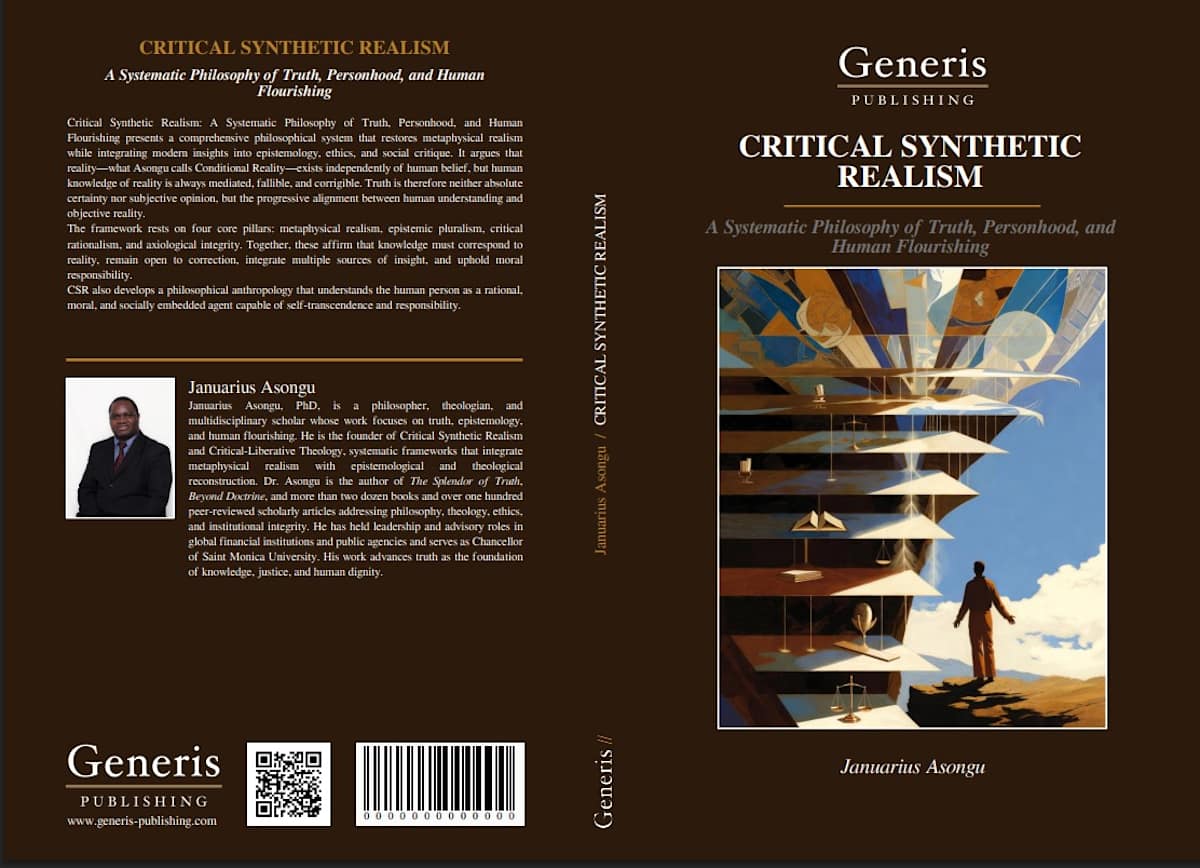
By Januarius Asongu, PhD
One of the central claims of Critical Synthetic Realism (CSR) is deceptively simple: truth corresponds to reality. This position, known as metaphysical realism, may appear obvious at first glance. Yet in contemporary philosophy and public discourse, it has become deeply contested.
Metaphysical realism affirms that reality exists independently of human belief, perception, culture, or opinion. The world does not change simply because we interpret it differently. Mountains existed before humans named them; gravity functioned before scientists described it; moral consequences unfold whether or not societies acknowledge them. Reality precedes interpretation.
This insight stands within the classical philosophical tradition, especially the scholastic realism shaped by Aristotle and Thomas Aquinas. Truth, in this tradition, is defined as adequatio intellectus et rei—the alignment of the intellect with what is. Knowledge is therefore not the construction of reality but participation in it. The human mind does not invent truth; it discovers and progressively approximates it.
Why does this matter today?
Modern intellectual history has gradually shifted away from realism. Enlightenment philosophy emphasized the knowing subject. Later movements highlighted language, culture, power, and interpretation. Postmodern thought went further, suggesting that truth may be socially constructed or reducible to perspective. While these developments contributed important insights—especially about bias, context, and historical conditioning—they sometimes produced an unintended consequence: skepticism about whether objective truth exists at all.
The result is what many now recognize as a crisis of truth. Public debates increasingly treat facts as negotiable, expertise as ideological, and reality itself as optional. In such a climate, disagreement no longer concerns interpretation alone; it concerns whether there is a shared world to interpret.
Metaphysical realism responds to this crisis by restoring a foundational distinction: interpretations vary, but reality remains.
CSR therefore affirms realism without naivety. Human access to reality is always mediated through language, culture, psychology, and historical experience. We never perceive reality from a “view from nowhere.” Our knowledge is partial, fallible, and revisable. Yet mediation does not imply invention. The existence of interpretation presupposes something being interpreted.
To deny realism ultimately undermines science, ethics, and human responsibility. Science depends on the assumption that nature possesses stable structures independent of our theories. Moral judgment depends on the belief that injustice is wrong even when socially accepted. Personal growth depends on the recognition that one can be mistaken about oneself and learn from correction. Without realism, error becomes meaningless—because there would be no independent standard by which beliefs could be judged true or false.
Metaphysical realism thus grounds intellectual humility. If reality exists independently of us, then our beliefs must remain open to revision. Truth-seeking becomes an ethical task rather than an assertion of power. We do not command reality; we submit our understanding to it.
Within Critical Synthetic Realism, this insight develops into the concept of Conditional Reality—the layered structure of existence encompassing physical, psychological, social, moral, and transcendent dimensions. Human flourishing depends on aligning our actions, institutions, and beliefs with these real conditions. When societies deny reality—whether biological, economic, moral, or spiritual—the consequences eventually reveal the mismatch.
Metaphysical realism is therefore not an abstract doctrine. It is the philosophical foundation of responsibility. It reminds us that beliefs have consequences because reality resists illusion. Truth liberates not because it is comforting, but because it connects human understanding to the way things actually are.
In an age of information abundance and epistemic confusion, realism restores philosophy’s most basic conviction: the world is intelligible, truth is meaningful, and the human vocation of reason is to seek alignment with reality. To pursue truth, then, is not merely an intellectual exercise—it is an act of fidelity to the real.