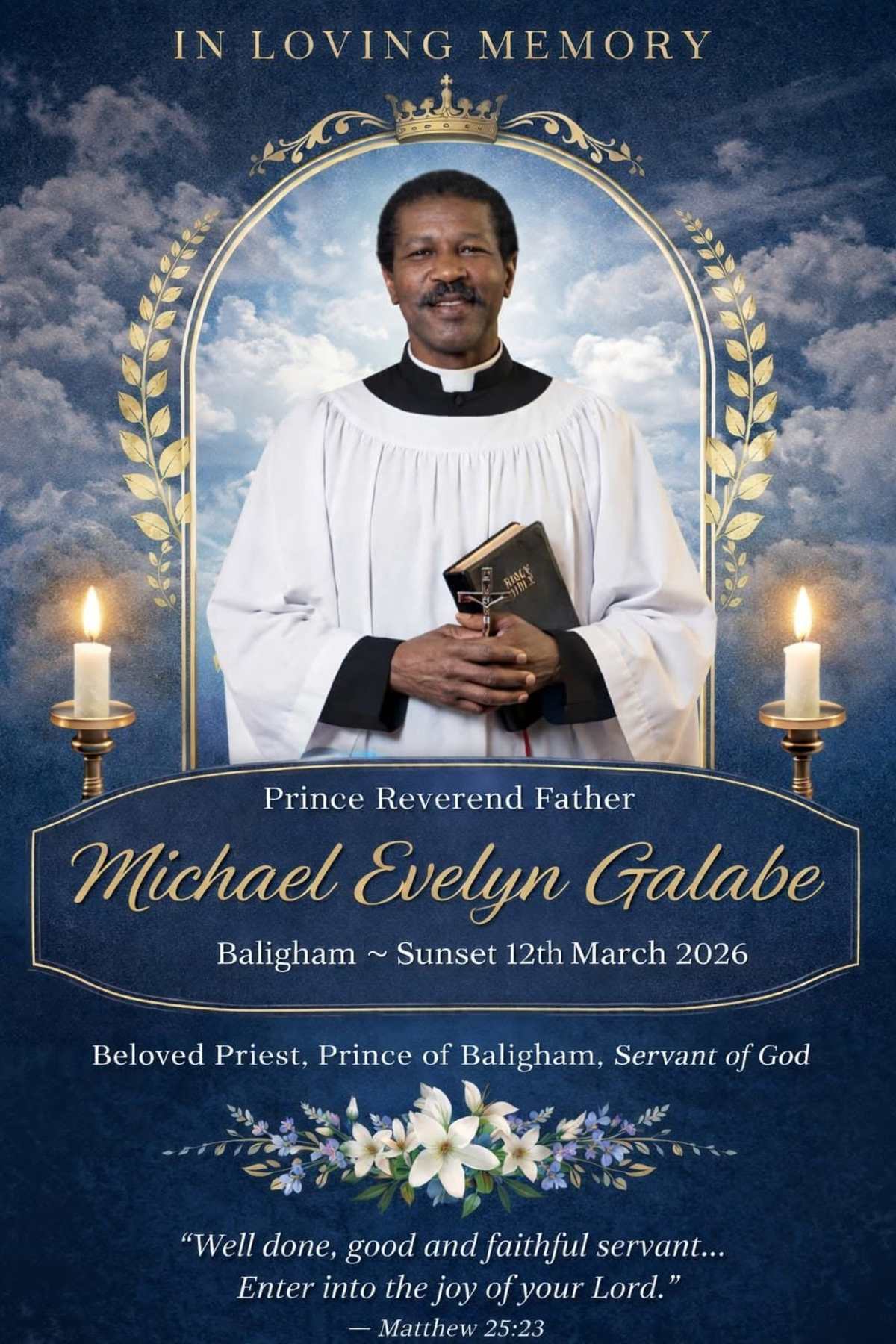
By Prof. Januarius J. Asongu, PhD
Chancellor of Saint Monica University, Buea, Cameroon
"At last, O powerful Master, You give leave to Your servant to go in peace. The pilgrimage is complete. The search has ended. The questions have given way to answers. The truth he sought through faith, reason, and service now stands fully revealed before him."
— Inspired by the Nunc Dimittis (Luke 2:29–30)
Late last night—as the world grew quiet and the early hours of morning bled into the room—I sat before the cold glow of my computer screen, unexpectedly arrested by the memory of Rev. Fr. Michael Evelyn Galabe.
There was no immediate catalyst for this sudden visitation. We had not spoken in years. The visual terrain of our separate lives had diverged long ago. Yet his memory emerged from the deep recesses of time with an architectural force so absolute that it demanded an immediate accounting. I felt an urgent, spirit-led compulsion to seek him out across the digital expanse.
What I found was a profound and shocking silence.
The sum of his earthly exit was reduced to a spare, solitary notice: Fr. Galabe had passed into eternity on March 12, 2026, in Baligham. There was no expansive obituary. No public monument to his final years. No digital echo of a funeral liturgy, nor any record of how the Church, his religious community, his former students, or his family had gathered to commend his soul to the heavens. A man who had spent a lifetime articulating the deep mysteries of the Gospel and ushering others through the thin veil between life and death had seemingly vanished into the quiet earth without a whisper.
Sleep abandoned me. For the remainder of the night, a torrent of memories spanning more than four decades rushed into the void—the legacy of a man who, perhaps without ever fully realizing it, fundamentally altered the trajectory of my own intellectual and spiritual evolution.
The Prophet from Afar: Faith and the National Forum
My initial encounter with Michael Evelyn Galabe occurred long before our paths physically crossed. In the Cameroon of the 1980s, the intellectual landscape was an arid terrain; books were a scarce luxury, academic journals were rare artifacts, and spaces for rigorous systemic critique were fiercely constrained. For those of us hungering for ideas, the Cameroon Tribune was not merely a newspaper—it was our public square, a secular ambo where the nation's public intellectuals tested arguments, deconstructed societal assumptions, and engaged in the dangerous, vital work of thinking aloud about faith, politics, and the human condition.
Among those voices, the name of Michael Evelyn Galabe shone with a distinct, luminous clarity.
At the time, he was in Canada, undergoing formation as a Claretian Missionary. His dispatches from the diaspora were stunning. They were intellectually rigorous, meticulously researched, and delivered with a rare, elegant prose that read like a liturgy of reason. What captivated me was not just the original architecture of his thought, but his absolute intellectual integrity. Even when wading into the most controversial ecclesiastical or social waters, he wrote with a disciplined balance and a profound respect for the dignity of truth.
As a young man standing on the periphery of my own calling, I read his words with a kind of holy emulation. When notices reached us of his ordination to the Catholic priesthood in Canada, it felt like a collective triumph. At a time when I, too, discerned the priesthood and considered the Claretian charism, Fr. Galabe became my mentor from afar—an icon of what was possible when a rigorous mind was set on fire by faith.
To choose the religious life as a university graduate in the late 1970s and early 1980s was an act of radical counter-culturalism. Fr. Galabe belonged to a small, pioneering vanguard. Armed with a degree from the University of Yaoundé, he chose to bypass the well-trodden paths of secular prestige and bureaucratic advancement. He heard a more demanding summons. In entering the Claretian order, he helped redefine the very morphology of the African priesthood for a post-colonial, rapidly shifting world.
He embodied a model of ministry that refused to decouple the mind from the spirit. He was the living refutation of the lie that faith and reason are adversarial forces; to him, they were twin wings of the same ascent. He demonstrated beautifully that one could possess a fierce, unyielding love for Holy Mother Church while simultaneously interrogating her structures and demanding that she live up to her prophetic mandates.
The Restless Pilgrim: Encounters with Complexity
Years later, while studying at St. Thomas Aquinas Major Seminary in Bambui, word reached me that Fr. Galabe was residing at the Capuchin formation house, locked in a deep, agonizing discernment regarding a potential transition from the Claretians to the Capuchins.
I immediately sought him out. For me, it was not an ordinary meeting; it was a pilgrimage to the source of an early inspiration.
I recall leaving that encounter with a complex sense of disappointment—though not for reasons an outsider might assume. He did not offer me easy, superficial encouragement to join his order, nor did he neatly unpack the internal fractures or spiritual shifts driving his own institutional transition. Instead, he gave me something infinitely more precious: a masterclass in honesty.
We spoke of vocation, of the Church, and of the terrifying weight of ideas. In the quiet of that formation house, I discovered that behind the formidable public intellectual lived a deeply searching, beautifully vulnerable human being.
Like all truly gifted souls, Fr. Galabe was burdened by a holy restlessness. He was entirely incapable of settling for easy, pre-packaged answers. He wrestled openly with the tensions of institutional life, holding loyalty and systemic critique in the exact same hand. He loved the Church too deeply to flatter her; he critiqued her precisely because he demanded she remain faithful to her baseline mission to the poor and marginalized.
I remember with striking vividness an article he penned concerning the historical reality of married priests, echoing the grand pastoral theology of Bernard Häring by advocating for optional celibacy. Whether one aligned with his conclusions was irrelevant; what left an indelible mark on my soul was his courage—his willingness to bring taboo questions into the light with academic dignity and pastoral reverence. He never courted controversy for its own sake. He courted truth.
Divergent Paths and the Unfinished Symphony
The currents of life eventually pulled us into different seas. I left the seminary; my own aspirations within the Claretian community did not materialize, and the silence of time and distance settled between us for over twenty years.
Then, around 2015, providence engineered a sudden, brief convergence. Driving through Santa toward Bamenda, I caught sight of the Claretian Mission sign. On a sudden, spirit-driven impulse, I turned the car into the compound. I introduced myself to a resident priest, joking lightheartedly that if my own youth had gone differently, I might have been the second Cameroonian Claretian after the legendary Fr. Galabe.
The priest looked at me with astonishment. "Fr. Galabe is here."
Moments later, we stood face-to-face. The decades had exacted their toll, and his memory initially faltered under the weight of the years. But when recognition finally broke across his face, the warmth of an unbroken kinship flooded the room. We exchanged numbers, instantly resurrecting a bridge across the decades.
When he later shared his desire to move to Buea and seek incardination within the diocese, I was privileged to introduce him to Bishop Immanuel Bushu, my own friend and spiritual guide. Knowing Fr. Galabe had advanced training in pastoral psychology, and seeing a profound systemic need, I invited him to join the faculty of Saint Monica University as our chaplain and a professor of pastoral psychology.
Tragically, that academic synthesis never bore fruit. Canonical technicalities intervened, institutional misunderstandings clouded the horizon, and I ultimately had to withdraw the appointment pending formal episcopal clearance. My only enduring regret is that this intellectual garden was never allowed to bloom; I remain certain his presence would have profoundly enriched the consciousness of our students.
Then, the storm of the Ambazonia conflict broke over our land, and like so many others who spoke truth to power, I was swept into the wilderness of exile. Our paths fractured once more.
In the ensuing years, a senior leader within the Claretian congregation spoke to me quietly of Fr. Galabe. He spoke with immense reverence for the monumental shadow Fr. Galabe had cast as a pioneer, but hinted softly that his later years had been marked by strained relationships and institutional isolation. He offered no details, and out of deep respect for the sacred architecture of a man's life, I sought none.
In my own efforts to piece together the fragments of his final years, I searched. I searched online, hoping to rediscover some of his writings. I found none. I searched for tributes. I found none. I searched for funeral announcements. I found none. I searched for reflections from former students, fellow Claretians, Sacred Heart College alumni, colleagues, bishops, or Church leaders. I found none. Perhaps they exist within local circles. I sincerely hope they do. But the digital world, which preserves so much of our contemporary memory, held nothing of him.
Beyond his contributions to the Cameroon Tribune, I distinctly remember that he published in academic journals. Unfortunately, I can no longer recall their names. Given the fragile nature of academic publishing in Africa during those decades, it is entirely possible that some of those journals have ceased publication or that their archives were never digitized. If that is true, much of his intellectual legacy may now be inaccessible. That possibility saddens me profoundly. The death of a person is painful. The disappearance of a body of ideas is tragic.
I attempted to contact Rev. Dr. Jude Thaddeus Langeh Basebang, CMF, whom I last knew to be among the leaders of the Claretians in Cameroon. The number I possessed was no longer active. I found myself wondering whether Archbishop Andrew Nkea, the Claretians, Sacred Heart College, or others who knew him had found ways to commemorate his life. The echoes of Fr. Galabe's life seemed to recede further with every inquiry.
For this was no ordinary priest. He was one of the early fruits of a distinguished Catholic institution. He was among the pioneer Cameroonian Claretians. He was a priest who dared to think. He was a scholar who dared to believe. He was a man who sought understanding without abandoning faith.
Every prophetic life contains chapters written in a cipher known only to God.
A Brilliant Generation: Contemporaries at the University of Yaoundé
It is impossible to speak of Fr. Galabe's intellectual formation without acknowledging the extraordinary constellation of minds that surrounded him at the University of Yaoundé in the late 1970s. He walked the same halls, breathed the same air, and debated the same urgent questions as some of Africa's most consequential theologians and philosophers.
He would have known Fr. Jean-Marc Ela (1936–2008), the sociologist and theologian who pioneered an African variant of liberation theology, developing a praxis-oriented "shade-tree theology" rooted in the struggles of the poor. He would have encountered Fr. Engelbert Mveng, S.J. (1930–1995), the Jesuit historian, theologian, and artist whose work on inculturation and his theory of "aesthetic creation" left an indelible mark on African Christian thought. And he would have crossed paths with the philosopher Fabien Eboussi Boulaga, the former Jesuit whose critiques of Western philosophy and his influential work on African identity and decolonization challenged an entire generation to think anew.
These were the giants whose shadows fell across the university's lecture halls. They were forging the intellectual infrastructure of a truly African Christianity—one that could speak to the post-colonial condition with authenticity, rigor, and prophetic urgency.
And Fr. Galabe was there, among them, absorbing their questions and sharpening his own.
Yet here we encounter the great tragedy of his legacy. While Frs. Ela and Mveng and Prof. Eboussi Boulaga have become household names in African theology—their works translated, studied, and debated across continents—Fr. Galabe has faded into an almost total oblivion. Search his name today, and you will find next to nothing. No digital archive preserves his essays from the Cameroon Tribune. No scholarly database indexes his contributions. No university library has digitized his writings. The man who once stood shoulder to shoulder with the architects of African liberation theology has been swallowed by the silent earth, his ideas inaccessible to the generation that most needs them.
How does a mind so luminous become so thoroughly erased? The question haunts me.
The Architecture of Memory as Resurrection
What I choose to consecrate in this tribute is not the friction of institutional memory, but an unpayable debt of gratitude.
I remember the brilliant young intellectual whose words crossed oceans to spark the mind of a youth in Cameroon.
I remember the priest who taught me that an intellect fully alive is an act of worship.
I remember the mentor who proved that faith does not require the abdication of reason.
I remember the seeker who showed me that asking the hardest questions is often the truest form of fidelity.
As a psychologist, I have spent a lifetime studying the interior landscapes of gifted individuals. Such minds are often burdened by a profound sensitivity and an existential depth that renders them fundamentally misunderstood by the structures around them. Their questions are too vast for narrow frameworks; their struggles are fought in hidden, interior spaces. Society eagerly consumes their brilliance while recoiling from their complexity.
Fr. Galabe was cast in this exact, prophetic mold. His was a holy restlessness—not the petulant rebellion of a dissident, but the unyielding hunger of a soul that refused to mistake the map for the territory. He wanted to know the Living God, not just the institutional consensus.
In my own theological writing, I have consistently argued that God is the ultimate Horizon of Truth. If this holds, then every relentless, uncompromising search for truth—no matter how unsettling to the status quo—is an explicit search for the face of God. By that metric, Fr. Galabe's entire life was a singular, prolonged liturgy of seeking. He sought God in the rigorous silence of study, in the brokenness of pastoral accompaniment, in the ink of his essays, and through the crucible of his own unanswered questions.
It is precisely for this reason that the absolute digital and institutional amnesia surrounding his passing is so tragic. Fr. Galabe was not merely a cleric; he was a foundational scholar of our ecclesial history. It breaks my heart to realize that because of the fragile, un-digitized nature of African intellectual archiving in the late twentieth century, much of his written legacy may now sleep in decaying newsprint, inaccessible to the generation that needs it most.
The death of a pastor is a grief; the erasure of his ideas is a systemic tragedy.
Yet, if liberation theology teaches us anything, it is that memory itself can be a locus of resurrection. The ideas we plant in the fertile soil of others become monuments that no institutional silence can tear down. Fr. Galabe altered my mind, and through that alteration, he lives in every word I write, every structure I challenge, and every student I teach.
Perhaps memory itself is a form of resurrection. Perhaps the ideas we plant in others become the most enduring monuments we leave behind. Fr. Galabe influenced me. I know he influenced many others. And so I take comfort in believing that his legacy continues to live in the minds he challenged, the vocations he inspired, the students he taught, the faithful he served, and the conversations he shaped.
The timeless confession of Saint Augustine reclaims him completely: "You have made us for yourself, O Lord, and our hearts are restless until they rest in you."
The long, winding pilgrimage is finally over. The holy restlessness that drove him across congregations, across oceans, and into the deep interior wilderness has found its resolution. The questions that kept him awake in the nights of history have dissolved into the light of the Beatific Vision. The faith he guarded with such intellectual ferocity has finally become sight.
Let it be recorded that Prince Rev. Fr. Michael Evelyn Galabe, CMF—born of the royal bloodline of the Fon of Baligham, pioneer of the Claretian Missionaries in Cameroon, scholar who dared to believe, and priest who dared to think—has returned to the Source of all Truth. May he receive a burial in our hearts worthy of both his royal ancestry and his prophetic priesthood.
The servant has been granted his release. He walks in peace. The Truth he pursued through the twilight of history now stands before him, face-to-face, in the midday of eternity.
May perpetual light shine upon him.
May he rest in peace.
And may his restless, courageous spirit continue to trouble and inspire our complacency for generations to come.
June 18, 2026