By Januarius Asongu, PhD
The philosophical framework developed by Prof. Januarius Jingwa Asongu seeks to integrate metaphysical realism, epistemic humility, theological reflection, and institutional analysis in order to address contemporary crises of knowledge, governance, and human flourishing.
The system may be summarized through the following ten propositions.
Proposition 1 — Reality Exists Independently of Human Interpretation
Reality possesses an objective structure independent of human perception, language, or cultural construction. Knowledge aims to discover and accurately describe this structure.
Proposition 2 — Truth Corresponds to Reality but Is Known Fallibly
While truth corresponds to reality, human access to truth is always partial, provisional, and subject to correction. Knowledge progresses through criticism, debate, and revision.
Proposition 3 — Knowledge Advances Through Synthesis
No single discipline possesses a monopoly on truth. Philosophy, science, theology, and social inquiry must interact in mutually corrective ways in order to approach a fuller understanding of reality.
Proposition 4 — Knowledge Systems Are Mediated by Institutions
Universities, scientific communities, religious traditions, and media systems shape the conditions under which knowledge is produced and transmitted. The health of these institutions directly affects the reliability of knowledge.
Proposition 5 — Ethical Responsibility Is Integral to Knowledge
The pursuit of knowledge carries ethical obligations. Intellectual honesty, humility, and openness to correction are necessary conditions for sustaining truth-oriented inquiry.
Proposition 6 — Theology Must Engage Reality Through Synthetic Theological Realism
Theological reflection must preserve the ontological claims of faith while engaging historical context, intellectual pluralism, and interdisciplinary dialogue. This approach is articulated through Synthetic Theological Realism (STR).
Proposition 7 — Faith Must Address Structures of Injustice
Theological reflection must also confront political, institutional, and epistemic forms of domination. Critical-Liberative Theology (CLT) extends liberation theology by addressing contemporary forms of oppression beyond purely economic structures.
Proposition 8 — Knowledge Systems Can Experience Epistemic Breakdown
When institutions lose their commitment to truth-seeking, societies experience Epistemic Fracture (EF). This condition manifests in ideological polarization, misinformation ecosystems, and institutional decay.
Proposition 9 — Civilizations Require Epistemic Liberation and Sovereignty
Healthy societies cultivate Epistemic Liberation (EL)—the freedom of knowledge systems from distortion and domination. Through this process societies can achieve Epistemic Sovereignty (ES), the institutional capacity to sustain resilient and self-correcting knowledge systems.
Proposition 10 — Civilizational Flourishing Depends on Truth-Oriented Institutions
Civilizations flourish when their institutions protect intellectual freedom, ethical responsibility, and open inquiry. When truth-oriented knowledge systems collapse, civilizational decline becomes likely.
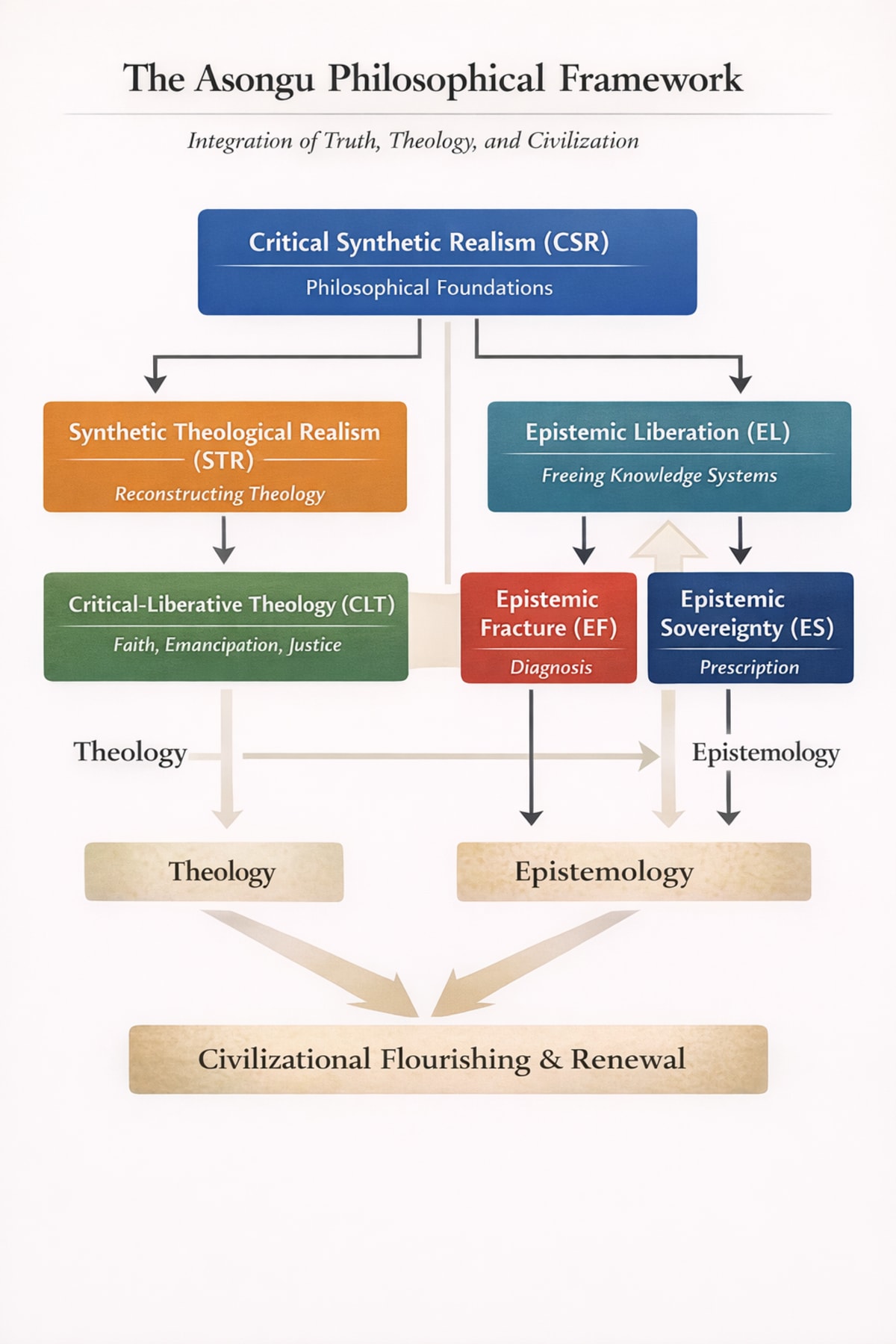
Structural Summary of the System
The propositions generate the following conceptual structure:
Critical Synthetic Realism (CSR)
→ philosophical foundation
Synthetic Theological Realism (STR)
→ theological methodology
Critical-Liberative Theology (CLT)
→ theological ethics
Epistemic Liberation (EL)
→ restoration of knowledge systems
Epistemic Fracture (EF)
→ diagnosis of epistemic collapse
Epistemic Sovereignty (ES)
→ institutional recovery of knowledge systems
→ Civilizational Flourishing and Renewal
Compact Formula
Your philosophical framework can therefore be summarized as:
CSR → STR → CLT
CSR → EL → EF → ES
→ Civilizational Flourishing
Significance of the System
The Asongu framework offers a systematic response to the contemporary crisis of knowledge fragmentation by integrating metaphysical realism, epistemic humility, theological reflection, and institutional ethics.
It proposes that the future stability of democratic societies and the flourishing of human communities depend upon the restoration of truth-oriented knowledge systems and ethically grounded institutions.