By Januarius Asongu, PhD
Critical Synthetic Realism (CSR) is a philosophical framework designed to address the crisis of knowledge fragmentation in the modern and postmodern world. It affirms the reality of truth while recognizing the fallibility and institutional mediation of human knowledge.
The framework rests upon five foundational theses.
Thesis 1 — The Reality Thesis
Reality exists independently of human perception, language, or social construction. Truth consists in the correspondence between human knowledge claims and the structures of reality.
This thesis rejects both strict positivist reductionism and radical relativism. While knowledge is mediated through human interpretation, it nevertheless refers to a reality that exists independently of the knower.
Thesis 2 — The Fallibilist Thesis
All human knowledge is provisional and subject to revision. No epistemic authority—whether scientific, political, religious, or cultural—possesses infallible access to truth.
Knowledge therefore progresses through critical testing, debate, and correction rather than through unquestionable authority.
Thesis 3 — The Synthetic Thesis
Knowledge advances through the integration of insights from multiple disciplines and perspectives. No single method or field of inquiry can fully capture the complexity of reality.
CSR therefore promotes a synthetic epistemology, in which philosophy, science, theology, and social inquiry interact in mutually corrective ways.
Thesis 4 — The Institutional Mediation Thesis
Knowledge does not exist in isolation but is produced and transmitted through institutions such as universities, scientific communities, religious traditions, media systems, and political structures.
These institutions shape the conditions under which knowledge can flourish or deteriorate. Healthy institutions therefore play a central role in sustaining reliable knowledge systems.
Thesis 5 — The Ethical Responsibility Thesis
The pursuit of knowledge carries ethical responsibility. Truth-seeking must be guided by intellectual virtues such as honesty, humility, openness to correction, and respect for evidence.
When knowledge systems become corrupted by ideology, power, or manipulation, the result is not merely intellectual error but institutional injustice and civilizational decline.
Implications of the Five Theses
Taken together, these theses establish CSR as a framework that integrates:
- metaphysical realism
- epistemic fallibilism
- interdisciplinary synthesis
- institutional analysis
- ethical responsibility
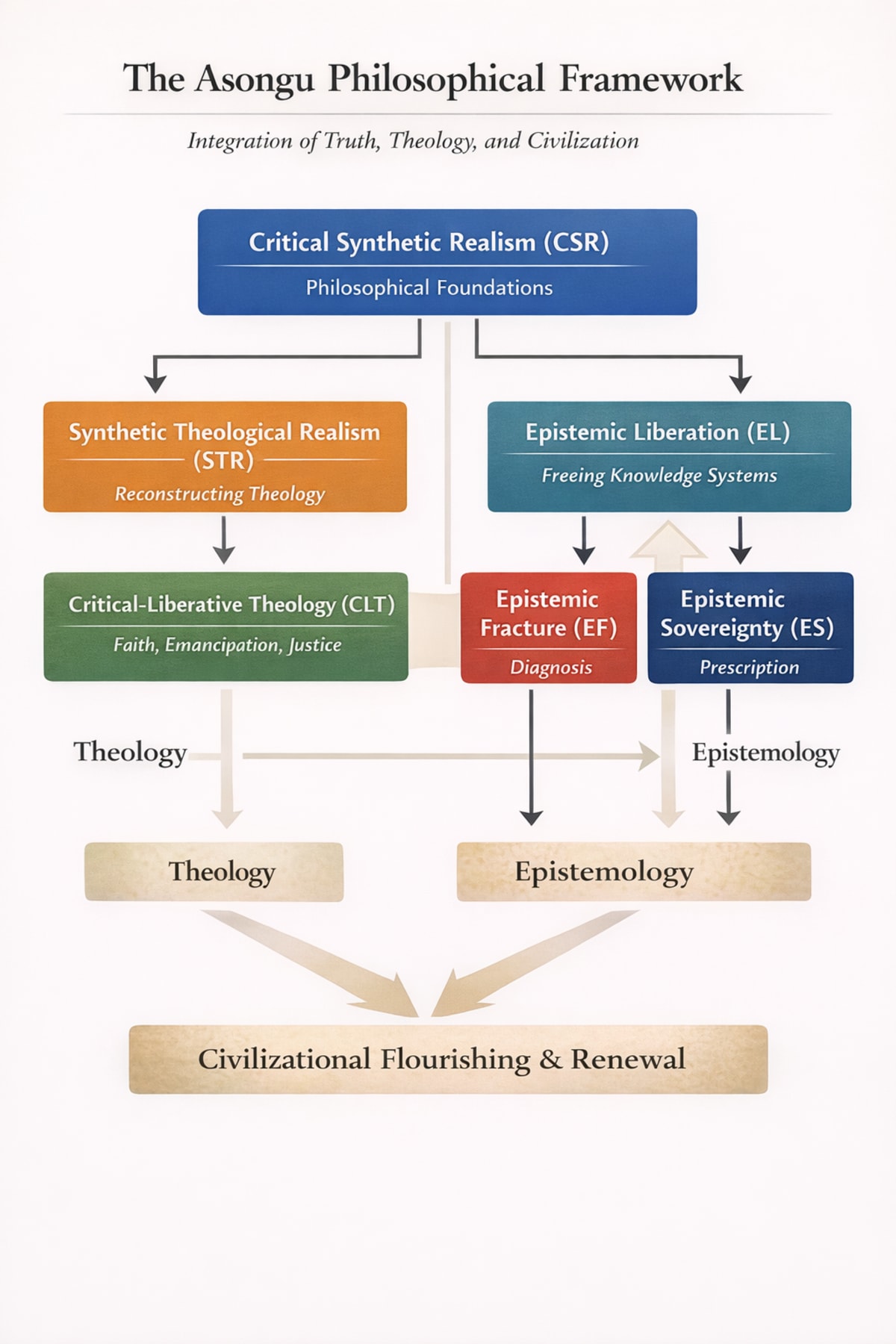
This philosophical foundation supports the broader architecture of the Asongu system.
Relationship to the Broader Framework
The five theses of CSR generate the subsequent developments in Prof. Asongu’s intellectual system:
CSR (Philosophical Foundation)
→ Synthetic Theological Realism (STR) — theological methodology
→ Critical-Liberative Theology (CLT) — theological ethics of liberation
CSR also supports the epistemic and civilizational branch:
→ Epistemic Liberation (EL) — restoration of truth-oriented knowledge systems
→ Epistemic Fracture (EF) — diagnosis of knowledge-system breakdown
→ Epistemic Sovereignty (ES) — institutional restoration of resilient knowledge systems
Together these concepts contribute to the ultimate aim of civilizational flourishing and renewal.
Concise Formula
Your philosophy can now be summarized in a compact structure:
CSR (five theses)
→ STR / CLT (theological branch)
→ EL → EF / ES (civilizational branch)
→ Civilizational Flourishing and Renewal
Why This Matters
Formulating the five theses accomplishes something important:
It transforms CSR from a general philosophical orientation into a clearly defined philosophical system.
This makes it easier for scholars to:
- reference the framework in academic literature
- teach the theory in university courses
- develop applications in theology, ethics, and institutional analysis.