By Januarius Asongu, PhD, author of The Splendor of Truth and Critical Synthetic Realism
Philosophies are often imagined as products of quiet academic reflection. Critical Synthetic Realism (CSR), my philosophical framework, emerged differently—from the friction between lived experience and humanity’s persistent resistance to truth.
Across continents, professions, and cultures, I encountered the same paradox: people do not merely lack knowledge; they often resist reality even when evidence stands before them. CSR grew from my attempt to understand this condition.
From Aquinas to Intellectual Correctability
My philosophical formation began in the early 1990s at St. Thomas Aquinas Major Seminary in Bambui, Cameroon. Under Bishop Immanuel Bushu, I was trained in Thomistic realism, a tradition grounded in the conviction that truth exists objectively and that the human intellect can know reality.
Yet an unexpected intellectual turning point came when Bishop Bushu introduced me to a monograph on Karl Popper by the Cameroonian philosopher Godfrey Tangwa. Popper’s philosophy of falsification revealed something Aquinas alone had not fully emphasized: human knowledge, while oriented toward truth, remains fallible and corrigible.
From that encounter emerged a lifelong conviction: truth may be objective, but human understanding is always provisional.
Philosophy in the Real World
My journey soon moved beyond formal philosophy into journalism, psychology, business leadership, technology, and cybersecurity. These fields became laboratories of reality.
In cybersecurity, mistakes are not abstract—they produce systemic failure. Reality exposes error without mercy. I began to observe a troubling phenomenon: highly educated individuals who mastered scientific knowledge yet interpreted life through beliefs incompatible with science itself.
Education had occurred, but epistemic transformation had not.
This realization pushed me toward a deeper question: Why does knowledge fail to change how human beings perceive reality?
The Splendor of Truth: The Birth of CSR
These reflections culminated in The Splendor of Truth: A Critical Philosophy of Knowledge and Global Agency (Wipf & Stock, 2026), the first systematic presentation of Critical Synthetic Realism.
In that work, I argued that humanity faces an epistemic crisis. Despite unprecedented access to information, societies increasingly distrust truth itself. CSR emerged as a philosophical synthesis integrating metaphysical realism, critical rationalism, liberation theology’s ethical urgency, and psychological insight into human cognition.
Its central claim is straightforward: truth exists independently of belief, but access to truth requires intellectual humility and continuous correction.
Why I Wrote Critical Synthetic Realism
After completing The Splendor of Truth, I realized that I had established CSR’s philosophical foundations but had not fully demonstrated how the framework operates within everyday life.
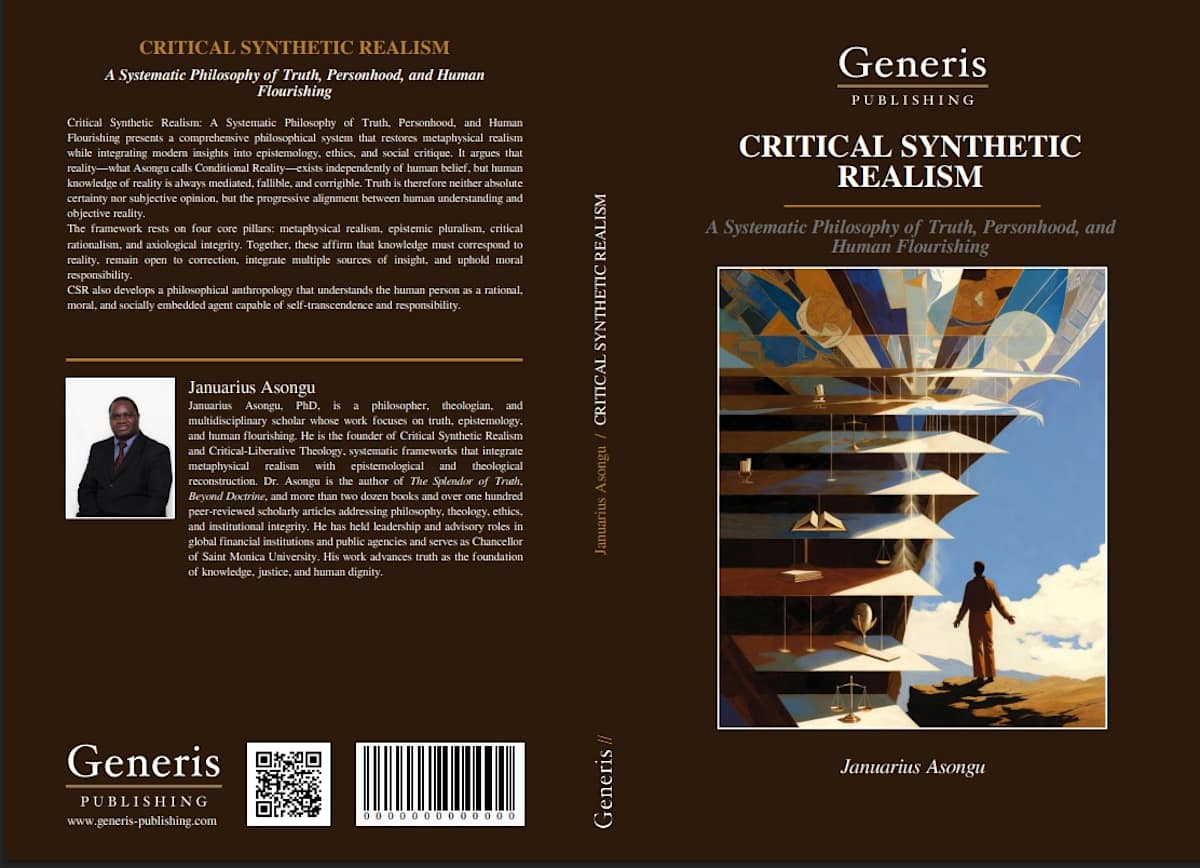
I therefore wrote Critical Synthetic Realism (Generis Publishing, 2026) immediately afterward to expand the project. While The Splendor of Truth explains why truth matters, Critical Synthetic Realism shows how the philosophy works in practice—across politics, psychology, culture, technology, and social development.
The second book translates theory into lived application.
Conditional Reality
At the heart of CSR lies what I call Conditional Reality. Reality is objective, but human access to it is conditioned by biological limits, cultural narratives, institutional structures, psychological formation, and moral character.
Reality itself is layered—physical, psychological, social, moral, and transcendent. A person may possess education yet remain blind to reality if they resist correction. For this reason, CSR identifies correctability as the central intellectual virtue.
Knowledge advances not through certainty but through openness to revision.
A Philosophy for a Post-Truth Age
Living and working in the United States confirmed that epistemic resistance is not confined to any culture. Political polarization, digital misinformation, and ideological tribalism revealed a global crisis of truth.
Human beings resist truth when it threatens identity, power, or belonging.
Critical Synthetic Realism responds to this crisis by placing the morally responsible person at the center of epistemology. Knowledge is not merely informational; it is transformative. To know truth is to undergo liberation—from superstition, ideological captivity, and intellectual complacency.
The purpose of knowledge is liberation.
The purpose of liberation is flourishing.
And flourishing begins when we acquire the courage to let reality correct us.