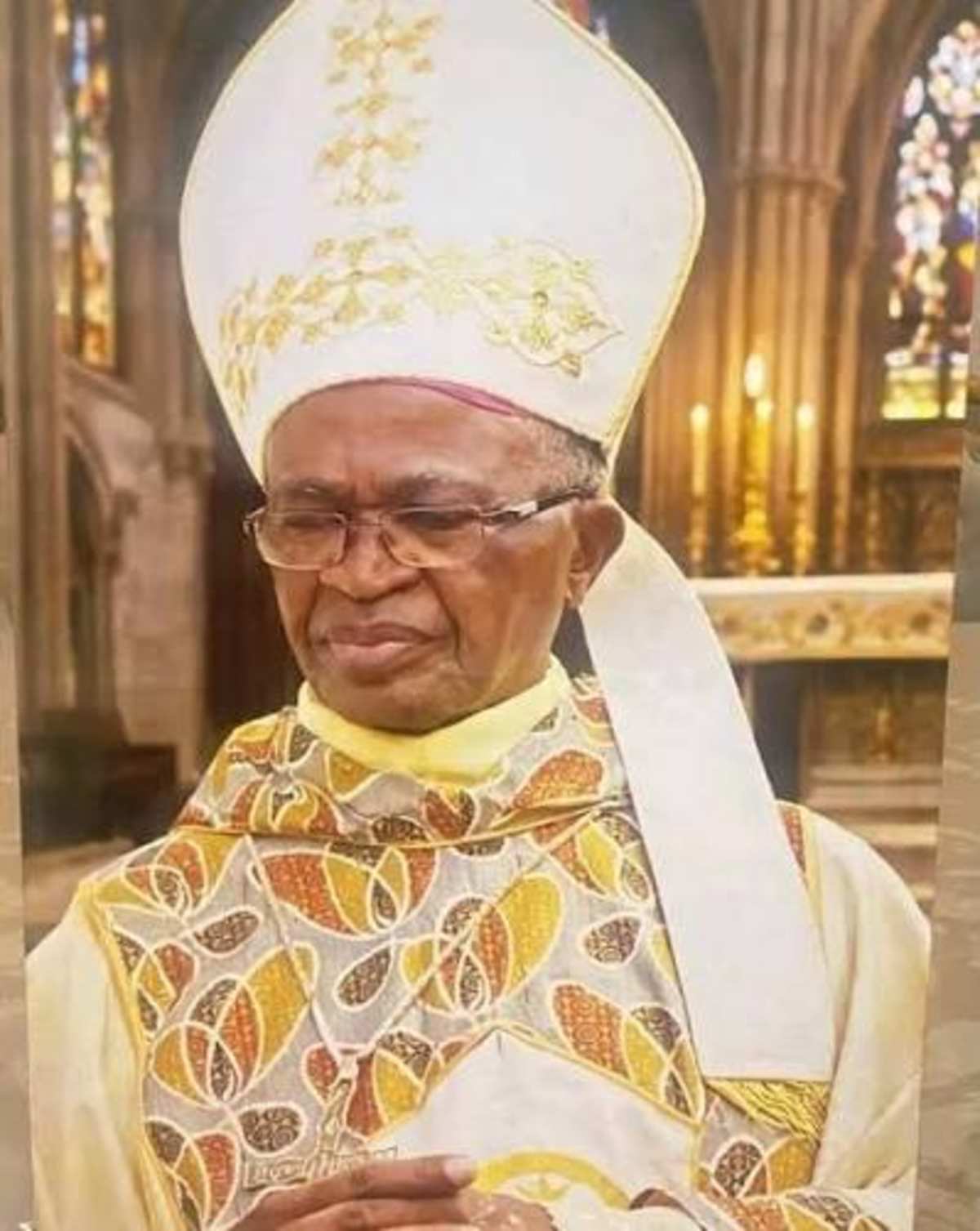
By Prof. Januarius Asongu, PhD
"Well done, good and faithful servant... Enter into the joy of your Lord." (Matthew 25:23)
Today, with profound sorrow, I learned of the passing of the Right Reverend Bishop Francis Teke Lysinge, S.T.L., D.H.L. (Hon.), who entered into eternal rest in Mamfe. The Church in Cameroon has lost one of her gentlest shepherds, and I have lost a cherished spiritual father.
There are some lives that proclaim the Gospel more eloquently than many sermons. Bishop Francis Teke Lysinge was such a life. Humility seemed to clothe him as naturally as his episcopal vestments. He was a priest par excellence—approachable, deeply prayerful, generous with his time, and unwaveringly faithful to God and His people. In an age when many have become cynical about religious leadership, he remained, for me, a living testimony that holiness is not an abstract ideal but a reality embodied in ordinary faithfulness.
I first came to know him when he served as Spiritual Director at Saint Thomas Aquinas Major Seminary (STAMS) in Bambui during the early 1990s. The Rector at the time was the then Fr. Immanuel B. Bushu. Both men would later become bishops, and together they profoundly shaped my intellectual, spiritual, and moral formation. Bishop Lysinge taught less by eloquence than by quiet witness. His gentleness carried authority; his humility commanded respect; his life pointed beyond itself to Christ.
His own vocation was itself a testimony to the mysterious workings of divine grace. Born into a Protestant family in Muea, he embraced the Catholic faith while a student at Sasse College, taking the name Francis after St. Francis Xavier. Ordained a priest in 1966, he would later become the founding Bishop of the Diocese of Mamfe when Pope John Paul II established the diocese in 1999. His episcopal motto, Fiat Voluntas Tua—"Thy Will Be Done"—beautifully summarized the spirit with which he lived his entire life.
I was privileged to attend the celebration of the twenty-fifth anniversary of his priestly ordination in 1991 in Bamenda and later in his home parish of Bokwango, Buea. The Silver Jubilee was celebrated together with his lifelong friend and fellow ordinand, the late Cardinal Christian Wiyghan Tumi, who would later serve as the principal consecrator when Bishop Lysinge became the first Bishop of Mamfe. It was a joyful celebration of two men whose friendship had been forged in faith and sustained through decades of priestly service.
One memory from that celebration has remained with me for more than three decades. The homily was preached by Fr. Immanuel Bushu, then Rector of STAMS. Reflecting on St. Paul's exhortation, "Give thanks in all circumstances" (1 Thessalonians 5:18), he made a distinction that transformed my understanding of Christian gratitude.
At the time, I struggled with his message. Cameroon was passing through profound political uncertainty, and hope often seemed distant. How could one possibly give thanks amid suffering and injustice?
Fr. Bushu explained that Scripture does not ask us to give thanks for evil or suffering. Rather, it calls us to give thanks in every circumstance. The distinction is profound. Christianity never glorifies evil, for evil contradicts the will of God. Instead, it invites us to trust that God remains present even in the valley of the shadow of death, bringing light out of darkness and life out of death. Gratitude, therefore, becomes an act of faith—a quiet confidence that, as St. Paul assures us, "all things work together for good for those who love God" (Romans 8:28).
More than three decades later, I finally understand that homily through the life of Bishop Lysinge himself. His journey into the Catholic Church, his faithful priesthood, his episcopal ministry, and now his peaceful return to the Lord all testify to a life surrendered to divine providence. Even as we mourn his passing, we give thanks—not for death itself, but for the extraordinary gift of his life. In doing so, Fr. Bushu's homily has become, at last, fully intelligible to me.
My relationship with Bishop Lysinge did not end with my seminary years. In 2009, I had the singular privilege of welcoming him to my home parish of Lewoh, where he concelebrated, together with Bishop Immanuel Bushu, the Mass marking my parents' fortieth wedding anniversary. Their presence transformed what was already a joyful family celebration into a moment of profound spiritual grace that my family continues to cherish.
My last extended conversations with Bishop Lysinge took place in Chicago shortly before his retirement from active ministry. We spoke at length about vocation, faith, and God's providence. Knowing that I had left the seminary, he offered words that have remained one of the greatest gifts I have ever received.
He reminded me that vocation is always God's gift and that I should never interpret my departure from the seminary as failure. Rather, he saw it as part of God's providential design. He encouraged me to place my knowledge, talents, and education at the service of the Church wherever God had called me. Those simple words became a quiet source of peace and encouragement that has accompanied me throughout my life's journey.
Years earlier, wrestling with difficult questions about my responsibilities as a Christian amid the struggle for the future of Ambazonia, I had written to Bishop Lysinge seeking his counsel. In those days, letters travelled by ordinary post. Mine never reached him. Years later, when I asked him about it, he told me he had never received it. Whether it was lost in transit or never delivered, I shall never know. Yet I have often reflected on what his response might have been. Knowing the man he was, I have little doubt that it would have united prayer with wisdom, compassion with truth, and justice with an unwavering commitment to peace.
When I founded Saint Monica University, I could think of no one more deserving of recognition. In 2014, the University conferred upon Bishop Francis Teke Lysinge an honorary doctorate in recognition of his immense contribution to Catholic education, his distinguished service as a seminary formator, and his visionary leadership as the founding Bishop of Mamfe. We were further honored when he accepted our invitation to serve as a Regent of the University and a member of its Board of Directors.
On that occasion, I remarked that his unwavering commitment to truth, integrity, humility, and honesty embodied precisely the virtues Cameroon most urgently needed. I believe those words are even truer today than they were then.
By the time I published Beyond Doctrine and Faith, Power, and Emancipation, Bishop Lysinge had become frail and had lost his sight. I have often wondered what he would have thought of those books. I suspect he might have challenged some of the arguments in Beyond Doctrine while warmly embracing the concern for justice, faith, and human dignity that animates Faith, Power, and Emancipation. Sadly, I never had the privilege of placing those volumes into his hands or hearing his reflections. That remains one of my quiet regrets.
Looking back over more than three decades, I see how often Divine Providence allowed our paths to cross: as my Spiritual Director at STAMS, at his Silver Jubilee celebration, at my parents' wedding anniversary in Lewoh, during our conversations in Chicago, and finally at Saint Monica University, where we had the privilege of honoring him. Each encounter became another stone in the spiritual altar God was quietly building in my own life.
Although I never became a priest, Bishop Lysinge never regarded that as failure. Instead, he encouraged me to discern God's providence and to continue serving the Church through scholarship, education, and the pursuit of truth. In many ways, he gave me permission to embrace the vocation that God had quietly prepared for me all along.
Scripture tells us that "the righteous will be remembered forever" (Psalm 112:6). Bishop Francis Teke Lysinge belongs among those righteous whose memory continues to preach long after their voices have fallen silent.
His greatness lay not in ecclesiastical office but in the simplicity with which he carried it; not in authority but in service; not in power but in humility. Like John the Baptist, he seemed always content that Christ should increase while he himself decreased.
Today, we commend him to the mercy of the Lord whom he served with unwavering fidelity for six decades as priest and shepherd. We give thanks for a life that reflected the Beatitudes, for hands that blessed, for knees worn by prayer, for a heart enlarged by charity, and for a soul that sought only to do the will of God.
May the Good Shepherd now receive His faithful servant into the eternal fold.
Eternal rest grant unto him, O Lord, and let perpetual light shine upon him. May his soul, and the souls of all the faithful departed, through the mercy of God, rest in peace. Amen.