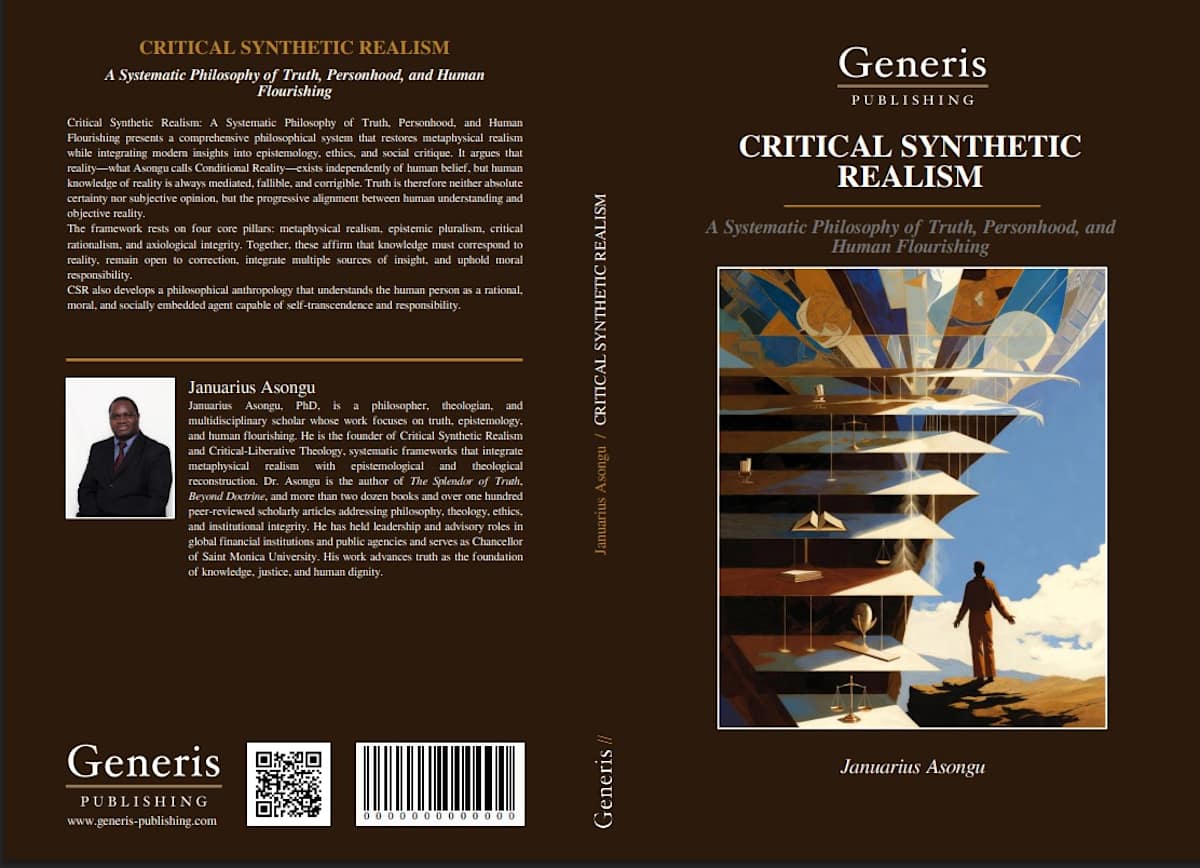
By Januarius Asongu, PhD, author of The Splendor of Truth and Critical Synthetic Realism
We live in an age overflowing with information yet increasingly uncertain about truth. Artificial intelligence generates knowledge at unprecedented speed. Social media amplifies opinion faster than evidence. Politics often rewards certainty rather than accuracy. In such a world, the most urgent philosophical question is no longer What do we know? but How do we know responsibly?
Critical Synthetic Realism (CSR) is my attempt to answer that question.
At its core, CSR begins with a simple conviction: reality exists independently of our beliefs, but human access to reality is never perfect. Truth is objective, yet our understanding of it is always developing, conditioned by culture, psychology, institutions, and moral character.
CSR therefore stands between two extremes that dominate modern thought.
On one side lies naïve realism—the assumption that what we perceive must automatically be true. On the other lies relativism—the claim that truth is merely constructed by culture or power. CSR rejects both. Reality is not invented by human beings, but neither do human beings encounter it without limitation.
We know the world through a process of continual correction.
The Meaning of “Critical,” “Synthetic,” and “Realism”
Each word in Critical Synthetic Realism matters.
Critical refers to disciplined questioning. Knowledge grows through testing, falsification, and intellectual humility. No belief, institution, or ideology is beyond examination. To be critical is not to be cynical; it is to remain open to correction.
Synthetic reflects integration. Human knowledge does not arise from a single discipline. Science, philosophy, theology, psychology, and lived experience each illuminate different dimensions of reality. CSR seeks to synthesize these perspectives rather than reduce truth to one method alone.
Realism affirms that truth exists independently of human opinion. The universe is not shaped by our preferences. Reality ultimately corrects us whether we acknowledge it or not.
Together, these principles form a philosophy grounded in both confidence and humility: confidence that truth exists, and humility about our ability to grasp it fully.
Conditional Reality
The central insight of CSR is what I call Conditional Reality. Reality is structured and layered—physical, psychological, social, moral, and transcendent. Our access to these layers depends on our intellectual and moral condition.
Two people may encounter the same evidence yet reach different conclusions because perception is shaped by prior beliefs, emotional commitments, and social identity. Education alone does not guarantee understanding. Genuine knowledge requires what CSR calls correctability—the willingness to revise oneself in light of reality.
Correctability is the highest intellectual virtue.
Why CSR Matters Today
The crises of our time—political polarization, conspiracy thinking, technological manipulation, and cultural fragmentation—are fundamentally epistemic crises. Societies struggle not because reality has disappeared but because shared standards for recognizing truth have weakened.
Critical Synthetic Realism proposes that human flourishing depends upon restoring those standards. Knowledge is not merely accumulation of information; it is alignment with reality. When individuals, institutions, and societies submit themselves to evidence, reason, and ethical responsibility, freedom becomes possible.
CSR therefore understands philosophy as a form of liberation. To know truthfully is to live more freely, act more responsibly, and build institutions capable of self-correction.
In a post-truth age, the task of philosophy is not to abandon truth but to pursue it more humbly and more rigorously than ever before.
Critical Synthetic Realism is an invitation to that pursuit—a call to think critically, synthesize wisely, and live realistically in the service of human flourishing.