By Janauarius Asongu, PhD
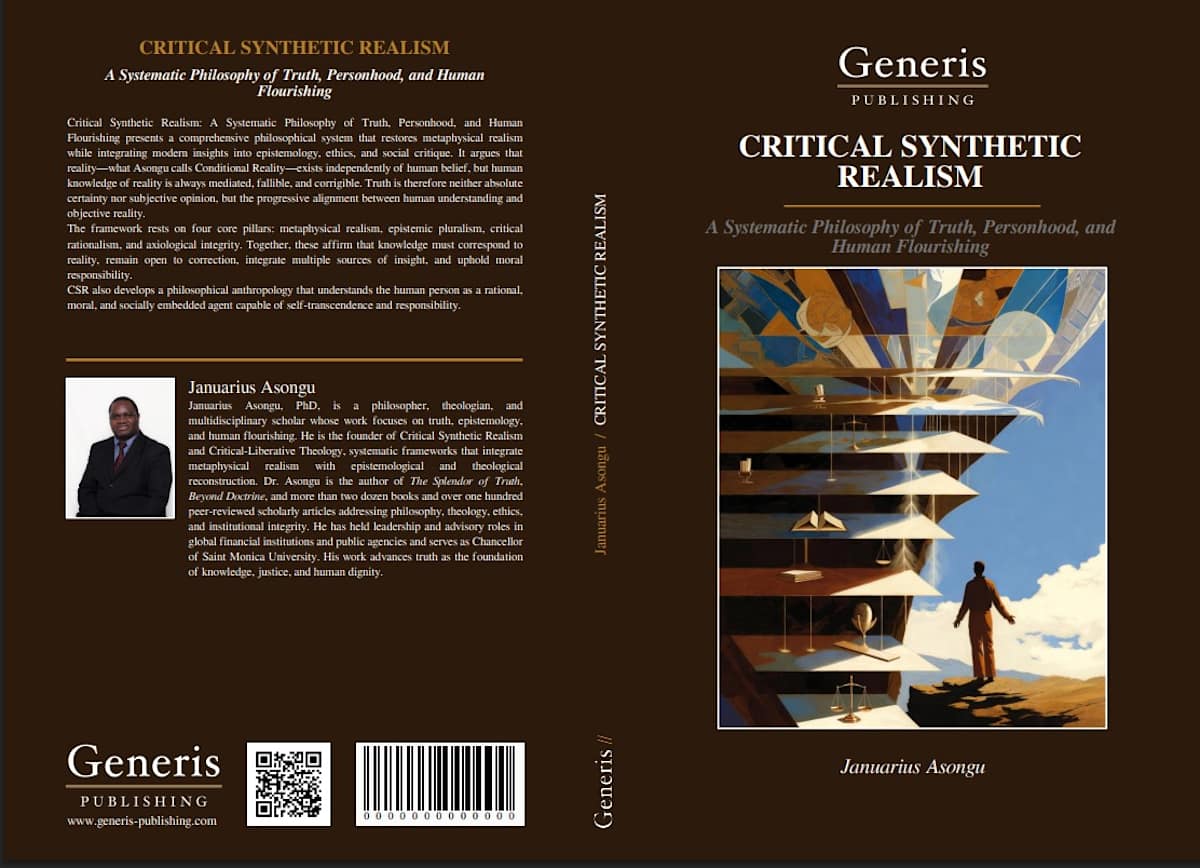
As we await the publication of Critical Synthetic Realism: A Systematic Philosophy of Truth, Personhood, and Human Flourishing (Generis Publishing, March 2026), many readers have asked a natural question:
How does this new book differ from The Splendor of Truth: A Critical Philosophy of Knowledge and Global Agency (Wipf & Stock, February 2026)?
The short answer is this:
The Splendor of Truth introduces and defends the epistemic core of CSR.
Critical Synthetic Realism presents the full systematic architecture of the philosophy.
But the distinction is deeper and worth clarifying.
1. The Splendor of Truth: The Epistemic Foundation
The Splendor of Truth is primarily a work of epistemology and public philosophy. It focuses on the crisis of truth in the modern world—misinformation, relativism, ideological polarization, digital distortion, and epistemic instability.
Its central concern is this:
How can human beings pursue truth responsibly in an age of fragmentation?
In that book, CSR is introduced and defended as a framework for:
- Metaphysical realism (truth corresponds to reality)
- Critical rationalism (all knowledge is fallible and correctable)
- Epistemic pluralism (correspondence and coherence as dual warrants)
- Intellectual virtue and epistemic humility
- Global agency and democratic responsibility
The book moves from theory to application. It examines AI, witchcraft beliefs, fatalism, democracy, ethics, prayer, political structures, and human flourishing—all through the lens of epistemic responsibility.
In many ways, The Splendor of Truth is CSR in action. It demonstrates how the framework operates in real-world contexts—social, political, spiritual, and technological. It is accessible, applied, and intentionally public-facing.
One might say:
The Splendor of Truth answers the question, “Why does truth matter?”
2. Critical Synthetic Realism: The Systematic Architecture
The forthcoming Critical Synthetic Realism is more foundational and more ambitious in scope. It is not simply about epistemology; it is a full philosophical system.
Where The Splendor of Truth concentrates on knowledge and agency, Critical Synthetic Realism develops the entire architecture:
- CSR Metaphysics (Conditional Reality and layered realism)
- CSR Epistemology (truth, interpretation, fallibility)
- CSR Ethics (flourishing and moral responsibility)
- CSR Anthropology (the human person as moral and transcendent agent)
- CSR Political Philosophy (justice, power, and institutional correctability)
- CSR Philosophy of History, Culture, Science, Technology, Aesthetics, and Ecology
- CSR Spirituality and Theology
In short, Critical Synthetic Realism is systematic. It builds the full philosophical cathedral.
Where The Splendor of Truth presents the pillars, Critical Synthetic Realism presents the blueprint and the entire structure.
3. Development, Not Repetition
The new book does not replace The Splendor of Truth; it deepens it.
If The Splendor of Truth represents the epistemic breakthrough—the insistence that truth, humility, and correction are indispensable to human flourishing—then Critical Synthetic Realism represents the philosophical maturation of that insight.
The first book confronts the crisis of truth.
The second reconstructs philosophy as an integrated whole.
The first argues that error is moral and social.
The second explains how metaphysics, anthropology, politics, and spirituality must align to overcome that error.
4. Why Both Matter
In my own intellectual journey, The Splendor of Truth reflects the urgency of our moment: defending truth against relativism and ideological distortion.
Critical Synthetic Realism reflects the longer arc of my formation—rooted in scholastic realism, shaped by Popperian fallibilism, influenced by liberation thought, African philosophy, phenomenology, virtue ethics, and contemporary science—and synthesized into a coherent philosophical system.
If readers want to understand the why of CSR, begin with The Splendor of Truth.
If they want to understand the what and the how of CSR as a comprehensive philosophical system, the new volume will take them deeper.
Together, the two works form a unified project:
Truth is real.
Error is moral.
Correction is necessary.
Flourishing depends on alignment with reality.
And philosophy must once again become synthetic—integrative, critical, realist, and ordered toward the liberation of the human person.