By Januarius Jingwa Asongu, PhD
Saint Monica University, Buea, Cameroon
Abstract
The contemporary “post-truth” condition reflects not merely political polarization or digital misinformation but a deeper epistemic crisis affecting how modern societies generate, validate, and transmit knowledge. Traditional epistemology has often concentrated on the justification of individual beliefs while neglecting the psychological processes, institutional structures, and moral traditions that shape knowledge systems at the societal level. This article introduces Critical Synthetic Realism (CSR) as a meta-epistemological framework designed to address these challenges. CSR integrates metaphysical realism, epistemic fallibilism, interdisciplinary synthesis, institutional mediation, and ethical responsibility into a comprehensive account of knowledge production and civilizational stability. Drawing upon philosophy of science, cognitive psychology, social epistemology, and Christian theological realism, the framework situates epistemology within broader institutional and moral ecosystems that sustain truth-seeking practices. The article argues that reliable knowledge systems depend not only on accurate theories of truth but also on institutions capable of maintaining intellectual virtue and communities capable of sustaining moral orientation toward truth. By integrating philosophical realism, psychological insight, and theological reflection, CSR offers a conceptual architecture for understanding how knowledge systems function, deteriorate, and may ultimately be renewed in the post-truth era.
Keywords: epistemology, realism, post-truth, theology, cognitive bias, institutional epistemology
Introduction
Modern civilization depends upon reliable systems of knowledge. Scientific research, technological innovation, economic planning, and democratic governance all rely upon institutions capable of generating accurate understandings of reality. When societies possess such institutions, they are able to coordinate collective action, adapt to environmental change, and pursue long-term development. When these systems deteriorate, the consequences extend far beyond intellectual disagreement to include political instability, institutional distrust, and civilizational decline.
In recent years scholars and commentators have increasingly described contemporary society as entering a post-truth era in which emotional persuasion, ideological allegiance, and identity-based narratives frequently outweigh empirical evidence in shaping public belief (McIntyre, 2018). The rapid diffusion of misinformation through digital communication networks, combined with declining trust in traditional epistemic authorities such as universities and scientific institutions, has contributed to widespread anxiety regarding the reliability of modern knowledge systems.
The epistemic challenges of the present era cannot be adequately understood through narrowly disciplinary approaches. Classical epistemology focused primarily on the justification of individual beliefs, examining questions concerning evidence, reliability, and rational inference (Audi, 2011). While these concerns remain important, contemporary societies rely upon complex epistemic infrastructures that extend far beyond individual cognition.
Scientific knowledge emerges through collaborative research communities governed by professional norms and peer-review systems (Kuhn, 1962). Public understanding of scientific findings depends heavily upon media institutions and educational systems (Goldman, 1999). Political decision-making requires reliable information flows between experts, institutions, and citizens. When these structures fail, epistemic fragmentation emerges across entire societies.
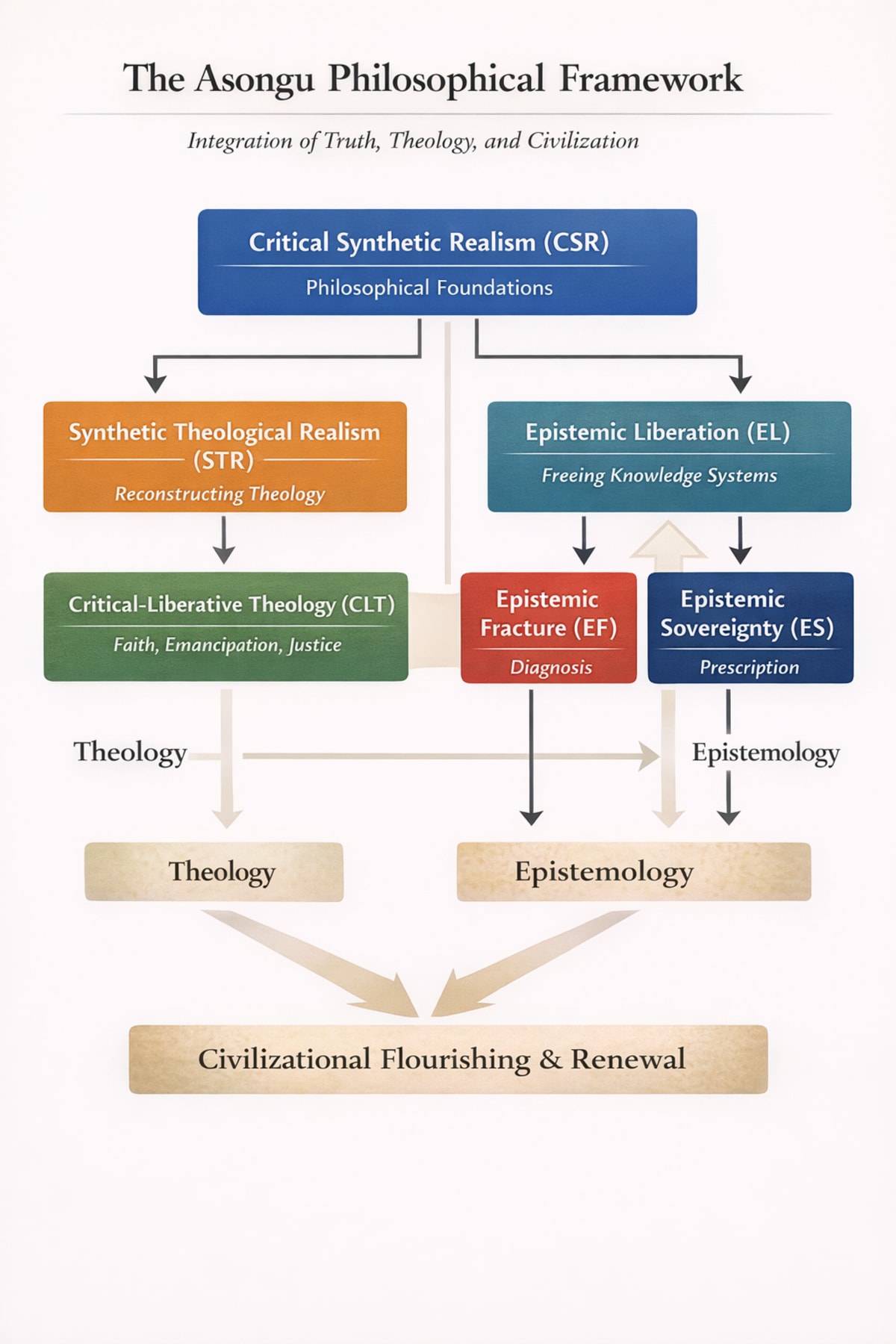
Addressing these challenges requires a conceptual framework capable of integrating multiple domains of inquiry: philosophy, psychology, theology, and institutional analysis. The philosophical framework developed by Januarius Jingwa Asongu, known as Critical Synthetic Realism (CSR), seeks to provide such an integration. CSR functions as a meta-epistemological framework, examining not only the justification of beliefs but also the institutional and moral conditions necessary for sustaining reliable knowledge systems.
By synthesizing insights from philosophy of science, cognitive psychology, social epistemology, and Christian theological realism, CSR offers a comprehensive approach to understanding knowledge in the post-truth era (Asongu, 2026a, 2026b).
The Epistemic Crisis of the Post-Truth Era
Digital Information Ecosystems
Digital communication technologies have transformed the production and dissemination of knowledge. While these technologies have expanded access to information, they have also created environments in which misinformation spreads rapidly. Algorithmic recommendation systems frequently reinforce pre-existing beliefs by prioritizing engagement over epistemic reliability (Sunstein, 2017).
These technological dynamics contribute to what some scholars describe as epistemic fragmentation, in which individuals inhabit informational environments that reinforce ideological identities rather than encourage critical engagement with evidence.
Institutional Distrust
Simultaneously, trust in traditional epistemic authorities has declined. Surveys indicate decreasing public confidence in governments, media organizations, and even scientific institutions (Pew Research Center, 2019). This erosion of trust undermines the ability of societies to coordinate collective action based upon shared knowledge.
Polanyi (1962) emphasized that scientific knowledge depends upon epistemic communities governed by shared norms and traditions. When these communities lose credibility, the authority of scientific expertise itself may become contested.
Polarization and Identity-Based Belief
Political polarization intensifies epistemic instability. Social identity theory suggests that individuals derive part of their identity from group membership (Tajfel & Turner, 1979). Consequently, beliefs may function as markers of group affiliation rather than purely intellectual commitments.
Research on identity-protective cognition demonstrates that individuals sometimes reject empirically supported conclusions when those conclusions appear to threaten group identity (Kahan, 2013).
These dynamics demonstrate that epistemology cannot be understood solely as a matter of logical reasoning; it must also account for psychological and social processes shaping belief formation.
Foundations of Critical Synthetic Realism
Critical Synthetic Realism emerges as a response to two dominant tendencies in modern epistemology: positivist reductionism and epistemic relativism.
Positivist traditions emphasize empirical verification as the primary criterion for legitimate knowledge. While enormously successful within the natural sciences, strict positivism struggles to account for moral reasoning, religious belief, and questions concerning meaning and value (Putnam, 1981).
Conversely, relativist approaches emphasize the social construction of knowledge to such an extent that the concept of objective truth becomes unstable. Radical relativism risks undermining the very possibility of rational evaluation among competing claims (Searle, 1995).
CSR attempts to navigate between these extremes by affirming two principles simultaneously:
- Reality exists independently of human cognition.
- Human knowledge of that reality remains fallible and historically mediated.
This position aligns with traditions of critical realism in philosophy of science (Bhaskar, 1975) while expanding epistemological analysis to include psychological and institutional dimensions.
The Five Core Theses of Critical Synthetic Realism
CSR can be summarized through five foundational theses.
The Reality Thesis
Reality possesses objective structures independent of human perception. Truth therefore involves correspondence between knowledge claims and the structures of reality (Aristotle, trans. 1998).
Without some form of realism, the distinction between knowledge and opinion becomes difficult to sustain.
The Fallibilist Thesis
Human knowledge remains provisional and subject to revision. Popper (1959) argued that scientific knowledge advances through conjecture and refutation rather than certainty.
CSR extends this fallibilist orientation beyond science to include philosophy, theology, and institutional knowledge systems.
The Synthetic Thesis
Reality is complex and multidimensional. No single discipline can fully capture its structure. Knowledge therefore advances through interdisciplinary synthesis involving philosophy, science, psychology, theology, and social inquiry (Asongu, 2026a).
The Institutional Mediation Thesis
Knowledge systems operate through institutions such as universities, scientific communities, media organizations, and religious traditions. These institutions shape the conditions under which knowledge can flourish or deteriorate (Goldman, 1999).
The Ethical Responsibility Thesis
The pursuit of knowledge carries ethical obligations. Intellectual virtues such as honesty, humility, and openness to correction are necessary for sustaining reliable inquiry (Zagzebski, 1996).
Psychological Dimensions of Knowledge
Human cognition does not function as a purely rational mechanism for evaluating evidence. Psychological research reveals numerous cognitive biases that shape perception and judgment.
Motivated Reasoning and Confirmation Bias
Motivated reasoning refers to the tendency for individuals to interpret information in ways that confirm desired conclusions (Kunda, 1990). Confirmation bias similarly leads individuals to seek evidence supporting preexisting beliefs while ignoring contradictory information (Nickerson, 1998).
These biases can interact with digital information environments to reinforce ideological polarization.
Dual-Process Cognition
Kahneman (2011) distinguishes between intuitive cognitive processes that operate rapidly and reflective processes involving deliberate reasoning. In many cases intuitive judgments shape beliefs before individuals consciously evaluate evidence.
CSR incorporates these insights by recognizing that epistemology must account for psychological processes influencing belief formation.
Theological Dimensions of Knowledge
The theological dimension of CSR reflects the historical relationship between faith and reason within the Christian intellectual tradition.
Augustine and Aquinas argued that human reason participates in a broader order of truth grounded in divine reality (Aquinas, trans. 1947). Contemporary philosophers such as Plantinga (2000) defend the rationality of religious belief within epistemology.
Within the Asongu framework, theological reflection is developed through Synthetic Theological Realism, which seeks to preserve the ontological realism of Christian doctrine while engaging contemporary philosophical and scientific discussions (Asongu, 2026b).
Theological traditions also contribute moral frameworks that cultivate intellectual virtues necessary for responsible inquiry.
Institutional Epistemology and Civilizational Stability
Modern societies depend upon institutions capable of producing reliable knowledge. Universities conduct research and train new generations of scholars. Scientific communities evaluate evidence through peer review. Media institutions disseminate information to the broader public.
Together these structures form what CSR describes as the epistemic infrastructure of civilization.
When these institutions function effectively, societies possess the capacity for collective learning. When they deteriorate, epistemic fragmentation emerges.
From Epistemology to Civilizational Analysis
CSR expands epistemology beyond individual belief justification toward analysis of civilizational knowledge systems.
Historical evidence suggests that the decline of civilizations often involves deterioration of intellectual institutions responsible for preserving knowledge (Toynbee, 1961). When societies lose the capacity to align belief with reality, decision-making becomes increasingly driven by ideology rather than evidence.
CSR therefore proposes that epistemology must examine the institutional conditions necessary for sustaining truth-oriented inquiry across generations.
Conclusion
The epistemic challenges of the post-truth era require philosophical frameworks capable of integrating multiple dimensions of human knowledge. Critical Synthetic Realism provides such a framework by combining metaphysical realism, epistemic fallibilism, interdisciplinary synthesis, psychological insight, theological reflection, and institutional analysis.
By situating epistemology within broader cognitive, moral, and institutional ecosystems, CSR offers conceptual tools for understanding how knowledge systems function, deteriorate, and may ultimately be renewed.
In this sense CSR represents not merely a theory of knowledge but a broader intellectual architecture for sustaining truth-oriented inquiry within modern civilizations.
References
Aristotle. (1998). Metaphysics. Harvard University Press.
Asongu, J. J. (2026a). Critical synthetic realism: A systematic philosophy of truth, personhood, and human flourishing. Generis Publishing.
Asongu, J. J. (2026b). The splendor of truth: A critical philosophy of knowledge and global agency. Wipf & Stock.
Asongu, J. J. (2026c). Beyond doctrine: A critical-liberative theology of faith and emancipation. Wipf & Stock.
Audi, R. (2011). Epistemology: A contemporary introduction to the theory of knowledge. Routledge.
Bhaskar, R. (1975). A realist theory of science. Routledge.
Goldman, A. (1999). Knowledge in a social world. Oxford University Press.
Kahan, D. (2013). Ideology and motivated reasoning. Judgment and Decision Making, 8(4).
Kahneman, D. (2011). Thinking, fast and slow. Farrar, Straus and Giroux.
Kuhn, T. (1962). The structure of scientific revolutions. University of Chicago Press.
Kunda, Z. (1990). Motivated reasoning. Psychological Bulletin, 108(3).
McIntyre, L. (2018). Post-truth. MIT Press.
Nickerson, R. (1998). Confirmation bias. Review of General Psychology, 2(2).
Plantinga, A. (2000). Warranted Christian belief. Oxford University Press.
Polanyi, M. (1962). Personal knowledge. University of Chicago Press.
Popper, K. (1959). The logic of scientific discovery. Routledge.
Putnam, H. (1981). Reason, truth and history. Cambridge University Press.
Searle, J. (1995). The construction of social reality. Free Press.
Sunstein, C. (2017). #Republic. Princeton University Press.
Tajfel, H., & Turner, J. (1979). The social psychology of intergroup relations.
Toynbee, A. (1961). A study of history. Oxford University Press.
Zagzebski, L. (1996). Virtues of the mind. Cambridge University Press.