By Januarius Jingwa Asongu, PhD
Saint Monica University, Buea, Cameroon
Abstract
Contemporary societies face a growing crisis of epistemic fragmentation characterized by the erosion of shared truth standards, institutional distrust, ideological polarization, and the proliferation of misinformation. These developments raise fundamental questions about the nature of knowledge, the authority of institutions, and the conditions required for civilizational stability. This article presents the Ten Propositions of the Asongu System, a synthetic philosophical framework designed to integrate metaphysical realism, epistemic fallibilism, theological reflection, and institutional analysis. The system emerges from the philosophical foundation of Critical Synthetic Realism (CSR) and extends into theological methodology through Synthetic Theological Realism (STR) and ethical praxis through Critical-Liberative Theology (CLT). It further introduces the civilizational concepts of Epistemic Liberation (EL), Epistemic Fracture (EF), and Epistemic Sovereignty (ES) to analyze the health of knowledge systems within societies. The ten propositions provide a systematic articulation of the framework's underlying philosophical and theological commitments. By integrating epistemology, institutional theory, and ethics, the Asongu System offers a comprehensive approach to understanding the relationship between knowledge, institutions, and civilizational flourishing. The article argues that the restoration of truth-oriented knowledge systems and ethically grounded institutions is essential for sustaining democratic societies and human flourishing in the twenty-first century.
Keywords: Critical Synthetic Realism, epistemology, theology, epistemic sovereignty, institutional ethics, civilizational theory, knowledge systems
Introduction
The contemporary world confronts an increasingly visible crisis of knowledge. Public debates once mediated through shared epistemic standards have become deeply fragmented. Scientific expertise is contested by ideological movements; political discourse is increasingly shaped by misinformation ecosystems; religious and secular worldviews compete for cultural authority; and digital media systems amplify polarized narratives rather than facilitating constructive deliberation.
This condition has profound consequences for both intellectual life and democratic governance. When societies lose the ability to distinguish reliable knowledge from ideological distortion, the institutional foundations of social cooperation begin to weaken. Universities, media organizations, religious institutions, and scientific communities—all historically responsible for cultivating reliable knowledge—find themselves subject to political pressure, economic incentives, and technological disruption.
Philosophically, these developments reflect a deeper epistemological problem. The modern intellectual landscape has been shaped by competing traditions that often fail to integrate their insights into a coherent framework. Positivist approaches have emphasized empirical verification but frequently neglected broader metaphysical questions. Postmodern theories have exposed the social construction of knowledge but sometimes undermine the very possibility of objective truth. Meanwhile, disciplinary specialization has produced immense intellectual progress while simultaneously fragmenting knowledge across isolated fields.
The Asongu System emerges as a response to this situation. Developed as a synthetic philosophical and theological framework, it seeks to integrate four central dimensions of intellectual inquiry:
- Metaphysical realism regarding the existence of objective reality
- Epistemic humility concerning the fallibility of human knowledge
- Theological reflection concerning the relationship between truth, faith, and moral order
- Institutional analysis concerning the role of knowledge systems in sustaining civilizational stability
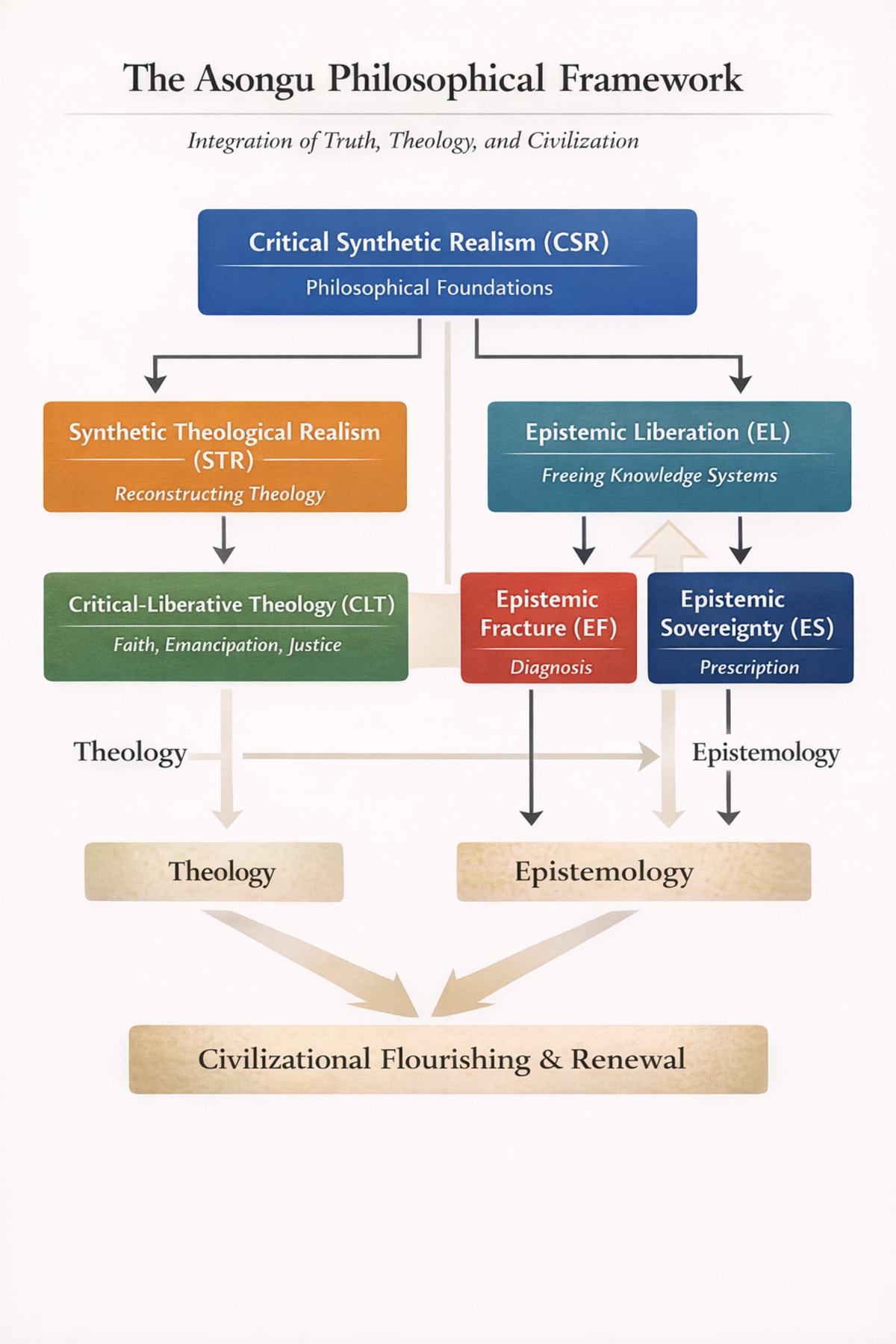
The system is grounded in Critical Synthetic Realism (CSR), a philosophical framework designed to overcome epistemic fragmentation by integrating realism, fallibilism, interdisciplinary synthesis, institutional mediation, and ethical responsibility (Asongu, 2026a). From this philosophical foundation emerge several additional conceptual developments. In theology, CSR generates Synthetic Theological Realism (STR) and Critical-Liberative Theology (CLT). In civilizational analysis, it gives rise to the concepts of Epistemic Liberation (EL), Epistemic Fracture (EF), and Epistemic Sovereignty (ES).
Together these concepts form a unified intellectual architecture aimed at understanding how societies produce, maintain, and sometimes lose reliable knowledge systems. The ultimate concern of the Asongu System is therefore not merely epistemological but civilizational. Knowledge systems shape political institutions, ethical norms, and collective decision-making. When these systems deteriorate, societies may experience instability, injustice, and decline.
The purpose of this article is to present the Ten Propositions of the Asongu System. These propositions summarize the central philosophical and theological commitments of the framework. By articulating them systematically, the article seeks to transform the Asongu System into a clearly defined theoretical model that scholars can analyze, critique, and apply across disciplines.
Proposition 1 — Reality Exists Independently of Human Interpretation
The first proposition of the Asongu System affirms the existence of objective reality independent of human perception, language, or cultural construction. Reality possesses structures and properties that exist regardless of whether human beings recognize or interpret them.
This claim situates the system firmly within the tradition of metaphysical realism, a philosophical position historically associated with thinkers such as Aristotle and Thomas Aquinas. According to this tradition, truth consists in the correspondence between intellectual judgments and the structures of reality (Aquinas, 1920).
The affirmation of objective reality serves as the ontological foundation of the entire framework. Without such a foundation, epistemology risks collapsing into relativism in which truth becomes merely a product of social consensus or linguistic construction.
However, the Asongu System does not deny that knowledge is mediated through interpretation. Human understanding is shaped by cultural contexts, conceptual frameworks, and institutional influences. Nevertheless, these mediations do not eliminate the existence of an external reality toward which knowledge claims are directed.
The first proposition therefore establishes a crucial distinction between reality itself and human interpretations of reality. While interpretations may vary, the underlying structures of reality remain independent of human perception.
Proposition 2 — Truth Corresponds to Reality but Is Known Fallibly
The second proposition develops the epistemological implications of metaphysical realism. While truth corresponds to reality, human access to truth is always fallible and subject to revision.
This principle draws upon the tradition of critical rationalism, particularly the work of Karl Popper (1963), who argued that knowledge advances through processes of conjecture, criticism, and correction rather than through the accumulation of certain knowledge.
The Asongu System therefore combines realism with epistemic humility. Truth exists, but human beings never possess complete or infallible access to it. Scientific theories, philosophical arguments, theological doctrines, and political ideologies must remain open to critique and revision.
This fallibilist orientation performs an important ethical function. By acknowledging the limitations of human understanding, it discourages intellectual authoritarianism and encourages open dialogue among competing perspectives.
Proposition 3 — Knowledge Advances Through Synthesis
The third proposition addresses the fragmentation of modern knowledge systems. Contemporary academia is characterized by increasing specialization, which often isolates disciplines from one another. While specialization promotes methodological rigor, it can also prevent scholars from addressing complex questions that transcend disciplinary boundaries.
The Asongu System therefore proposes that knowledge advances through synthetic integration. Philosophy, science, theology, and social inquiry each contribute distinctive insights into the nature of reality. When these disciplines interact in mutually corrective ways, they can approach a more comprehensive understanding of complex phenomena.
This synthetic approach does not eliminate disciplinary differences. Instead, it encourages interdisciplinary dialogue in which diverse methods and perspectives contribute to a shared pursuit of truth.
Proposition 4 — Knowledge Systems Are Mediated by Institutions
The fourth proposition recognizes that knowledge does not exist in isolation. Instead, it is produced and transmitted through institutions such as universities, scientific communities, religious traditions, media systems, and political structures.
Sociologists of knowledge such as Robert Merton (1973) and Thomas Kuhn (1962) have shown that intellectual inquiry is shaped by institutional norms, professional networks, and paradigmatic frameworks. The Asongu System builds upon this insight by emphasizing that the health of knowledge institutions directly affects the reliability of knowledge itself.
When institutions promote intellectual freedom, methodological rigor, and open debate, they support the development of reliable knowledge systems. Conversely, when institutions become dominated by ideology, political pressure, or economic incentives, they may distort knowledge production.
Institutional integrity therefore becomes a central concern within the Asongu framework.
Proposition 5 — Ethical Responsibility Is Integral to Knowledge
The fifth proposition integrates epistemology with ethics. The pursuit of knowledge carries moral responsibilities. Intellectual inquiry must be guided by virtues such as honesty, humility, openness to correction, and respect for evidence.
The ethical dimension of knowledge is particularly important in contemporary societies where misinformation and ideological manipulation can spread rapidly through digital communication systems.
Within the Asongu System, epistemic virtues serve as safeguards against the corruption of knowledge. Scholars and institutions must cultivate a commitment to truth that transcends partisan interests or ideological commitments.
Proposition 6 — Theology Must Engage Reality Through Synthetic Theological Realism
The sixth proposition extends the philosophical foundations of CSR into theological methodology through Synthetic Theological Realism (STR).
STR maintains that theological claims refer to realities that transcend purely symbolic or cultural interpretations. At the same time, theological reflection must engage historical context, intellectual pluralism, and interdisciplinary dialogue.
Rather than isolating theology from other fields of inquiry, STR encourages constructive engagement with philosophy, science, and social analysis. The goal is to preserve the ontological claims of faith while situating them within a broader intellectual conversation.
Proposition 7 — Faith Must Address Structures of Injustice
The seventh proposition introduces the ethical dimension of theological reflection through Critical-Liberative Theology (CLT).
Building upon earlier traditions of liberation theology (Gutiérrez, 1988), CLT expands the scope of theological critique to include contemporary forms of domination beyond purely economic structures. These include political repression, epistemic manipulation, cultural marginalization, and institutional injustice.
CLT therefore positions theology as a critical resource for analyzing and confronting systems of oppression. Faith is not merely a matter of private belief but also a commitment to justice within social and institutional structures.
Proposition 8 — Knowledge Systems Can Experience Epistemic Breakdown
The eighth proposition introduces the concept of Epistemic Fracture (EF). This term describes the condition in which knowledge systems lose their capacity to sustain reliable truth-seeking.
Epistemic fracture can manifest in several ways:
• ideological polarization
• erosion of institutional trust
• proliferation of misinformation
• politicization of scientific expertise
• fragmentation of public discourse
When such conditions emerge, societies may experience profound instability. Without shared epistemic standards, democratic deliberation becomes increasingly difficult.
Proposition 9 — Civilizations Require Epistemic Liberation and Sovereignty
In response to epistemic fracture, the Asongu System proposes the concepts of Epistemic Liberation (EL) and Epistemic Sovereignty (ES).
Epistemic Liberation refers to the process by which knowledge systems free themselves from ideological domination, censorship, and manipulation. Through this process, institutions regain their capacity to pursue truth-oriented inquiry.
Epistemic Sovereignty describes the institutional condition in which societies possess resilient knowledge systems capable of self-correction and intellectual independence.
Together these concepts emphasize the importance of protecting the autonomy and integrity of knowledge institutions.
Proposition 10 — Civilizational Flourishing Depends on Truth-Oriented Institutions
The final proposition synthesizes the preceding principles into a broader theory of civilizational development.
Civilizations flourish when their institutions protect intellectual freedom, ethical responsibility, and open inquiry. Universities, media systems, religious traditions, and scientific communities must function as guardians of reliable knowledge.
When these institutions collapse or become corrupted, societies risk entering periods of intellectual and political decline.
The ultimate aim of the Asongu System is therefore civilizational renewal through the restoration of truth-oriented institutions.
Structural Summary of the System
The ten propositions generate a coherent conceptual structure that may be summarized as follows.
Critical Synthetic Realism (CSR)
→ philosophical foundation
Synthetic Theological Realism (STR)
→ theological methodology
Critical-Liberative Theology (CLT)
→ theological ethics
Epistemic Liberation (EL)
→ restoration of knowledge systems
Epistemic Fracture (EF)
→ diagnosis of epistemic collapse
Epistemic Sovereignty (ES)
→ institutional recovery of knowledge systems
→ Civilizational Flourishing and Renewal
This structure may be summarized in a compact conceptual formula:
CSR → STR → CLT
CSR → EL → EF → ES
→ Civilizational Flourishing
Conclusion
The Ten Propositions of the Asongu System articulate a comprehensive philosophical framework for addressing the contemporary crisis of knowledge fragmentation. By integrating metaphysical realism, epistemic humility, theological reflection, and institutional analysis, the system provides a multidimensional approach to understanding how knowledge systems shape civilizational stability.
The framework suggests that the future of democratic societies depends not only on economic or political reforms but also on the restoration of truth-oriented knowledge institutions. Universities, scientific communities, religious traditions, and media systems must cultivate intellectual integrity and ethical responsibility if they are to sustain reliable knowledge.
In an age characterized by misinformation, ideological polarization, and institutional distrust, the Asongu System offers a synthetic vision of knowledge that reconnects truth, ethics, and institutional responsibility.
Ultimately, the flourishing of human communities depends upon the preservation of knowledge systems capable of pursuing truth with humility, courage, and intellectual integrity.
References
Aquinas, T. (1920). Summa Theologiae. Burns, Oates & Washbourne.
Asongu, J. J. (2026a). The splendor of truth: A critical philosophy of knowledge and global agency. Wipf & Stock.
Asongu, J. J. (2026b). Critical synthetic realism: A systematic philosophy of truth, personhood, and human flourishing. Generis Publishing.
Gutiérrez, G. (1988). A theology of liberation. Orbis Books.
Kuhn, T. S. (1962). The structure of scientific revolutions. University of Chicago Press.
Merton, R. K. (1973). The sociology of science. University of Chicago Press.
Popper, K. (1963). Conjectures and refutations: The growth of scientific knowledge. Routledge.