By Januarius Jingwa Asongu, PhD
Saint Monica University, Buea, Cameroon
Abstract
Contemporary societies face a profound crisis of knowledge fragmentation manifested in institutional mistrust, ideological polarization, and the destabilization of shared standards of truth. This crisis affects not only academic disciplines but also the broader structures through which societies generate and sustain reliable knowledge. The intellectual framework developed by Januarius Jingwa Asongu proposes a systematic response to this challenge by integrating philosophical realism, epistemic humility, theological reflection, and institutional analysis. This article examines the architecture of the Asongu system and its central components: Critical Synthetic Realism (CSR), Synthetic Theological Realism (STR), Critical-Liberative Theology (CLT), Epistemic Liberation (EL), Epistemic Fracture (EF), and Epistemic Sovereignty (ES). The article argues that these concepts form an integrated theoretical structure linking philosophy, theology, and civilizational analysis. By situating epistemology within the broader institutional and ethical contexts in which knowledge systems operate, the framework offers a comprehensive approach to understanding both the emergence and the breakdown of civilizational knowledge systems. The study concludes that the Asongu framework represents an emerging interdisciplinary paradigm for addressing the epistemic instability of contemporary societies.
Keywords: Critical Synthetic Realism, epistemology, institutional knowledge, civilizational theory, theology, epistemic sovereignty
Introduction
The stability of civilizations depends upon their capacity to generate reliable knowledge about the world. Societies must continually interpret reality, test beliefs against evidence, and adapt institutions in response to new information. When these processes function effectively, societies are able to innovate, coordinate collective action, and sustain long-term development. When they fail, intellectual confusion and institutional instability often follow.
Throughout history, philosophical traditions have attempted to explain the relationship between knowledge and social order. Classical Greek philosophy explored the connection between truth and civic life. Medieval scholasticism integrated metaphysical realism with theological doctrine. Enlightenment thinkers emphasized scientific rationality and individual autonomy. In the modern period, social theorists increasingly examined how institutions shape the production and distribution of knowledge.
Yet the contemporary world presents challenges that transcend traditional disciplinary boundaries. Rapid technological transformation, global communication networks, and ideological polarization have produced an environment in which the reliability of knowledge systems is increasingly contested. Public trust in scientific institutions, media organizations, and political authorities has declined across many societies. The proliferation of digital information ecosystems has made it difficult to distinguish reliable knowledge from misinformation or ideological narratives.
In response to these developments, the philosophical framework developed by Januarius Jingwa Asongu proposes a systematic approach to understanding the relationship between knowledge, institutions, and civilizational stability. The framework integrates insights from epistemology, theology, sociology of knowledge, and civilizational studies into a coherent intellectual architecture.
At its foundation lies Critical Synthetic Realism (CSR), a philosophical framework that affirms the objective existence of reality while recognizing the fallibility and mediation of human knowledge. From this philosophical foundation emerge several related developments that extend the framework into theological and civilizational domains.
The theological dimension of the framework is articulated through Synthetic Theological Realism (STR) and Critical-Liberative Theology (CLT). These concepts apply the epistemological principles of CSR to theological reflection and social ethics.
The civilizational dimension of the framework introduces three related concepts: Epistemic Liberation (EL), Epistemic Fracture (EF), and Epistemic Sovereignty (ES). These concepts describe the processes through which societies maintain, lose, and potentially restore reliable knowledge systems.
Taken together, these components form what may be described as the Asongu system, an interdisciplinary theoretical framework designed to address the epistemic challenges of contemporary civilization.
This article examines the architecture of this system and explores the conceptual relationships among its principal components.
Critical Synthetic Realism: Philosophical Foundations
The Crisis of Modern Epistemology
Modern epistemology has long been characterized by tension between two opposing tendencies. On one side stand forms of positivist empiricism that emphasize scientific verification as the primary criterion of knowledge. These approaches often seek to exclude metaphysical or theological claims from legitimate inquiry.
On the other side stand constructivist and relativist perspectives that emphasize the social construction of knowledge. Within these frameworks, truth claims are frequently interpreted primarily as expressions of cultural narratives or power structures.
Both approaches contain important insights. Scientific empiricism has generated extraordinary advances in understanding the natural world, while social constructivism highlights the ways in which knowledge is shaped by historical and cultural contexts. Yet both perspectives also present limitations.
Strict positivism struggles to account for the normative, ethical, and metaphysical dimensions of human inquiry. Radical relativism, by contrast, risks undermining the very concept of objective truth.
Critical Synthetic Realism seeks to address these limitations by integrating insights from both traditions while avoiding their extremes.
Ontological Realism
The first principle of CSR is ontological realism. Reality exists independently of human perception, language, or social construction. The world possesses structures and causal relationships that do not depend upon human interpretation.
This commitment to realism provides a foundation for the concept of truth as correspondence between knowledge claims and the structures of reality.
Without such a foundation, the possibility of rational evaluation among competing claims becomes difficult to sustain.
Epistemic Fallibilism
The second principle of CSR is epistemic fallibilism. Human knowledge of reality is always partial and subject to revision. Because knowledge is mediated through cognitive, cultural, and institutional processes, no human authority possesses infallible access to truth.
Scientific inquiry, philosophical reasoning, and theological reflection therefore progress through processes of criticism, debate, and correction.
Fallibilism encourages intellectual humility while preserving commitment to objective truth.
Synthetic Epistemology
A third distinctive feature of CSR is its emphasis on synthetic epistemology. The complexity of reality requires the integration of insights from multiple disciplines.
Philosophy clarifies conceptual frameworks and logical structures. Science investigates empirical phenomena through experimental methods. Theology explores questions concerning transcendence, meaning, and ultimate reality. Social inquiry examines institutional and cultural dynamics.
Synthetic epistemology encourages dialogue among these fields in order to generate more comprehensive understanding.
Theological Development of the Framework
Synthetic Theological Realism (STR)
Synthetic Theological Realism extends the principles of CSR into the domain of theology. STR maintains that theological claims refer to realities that transcend purely symbolic or cultural interpretation.
At the same time, theological reflection occurs within historical contexts and intellectual traditions that shape interpretation. STR therefore combines doctrinal realism with openness to interdisciplinary dialogue.
Rather than isolating theology from other forms of inquiry, STR encourages interaction between theology, philosophy, science, and social analysis.
This synthetic approach seeks to reconstruct theological reflection in a manner capable of engaging contemporary intellectual challenges.
Critical-Liberative Theology (CLT)
Critical-Liberative Theology represents the ethical dimension of the Asongu framework. CLT builds upon the tradition of liberation theology while expanding its analytical scope.
Where classical liberation theology focused primarily on economic exploitation, CLT examines broader structures of domination that affect human dignity. These include epistemic manipulation, institutional injustice, technological power, and cultural marginalization.
CLT therefore positions theology as a critical resource for addressing contemporary forms of structural injustice.
Epistemic Dynamics of Civilizations
Epistemic Liberation (EL)
Epistemic Liberation refers to the process by which individuals and institutions recover the conditions necessary for reliable knowledge production. Liberation occurs when knowledge systems are freed from ideological capture, coercion, or structural distortion.
Societies experiencing epistemic crisis must restore intellectual freedom, institutional transparency, and critical debate in order to rebuild trust in knowledge systems.
Epistemic Fracture (EF)
Epistemic Fracture describes the condition in which the mechanisms that allow societies to align belief with reality cease to function effectively.
When institutions responsible for knowledge production lose credibility or become dominated by ideological forces, societies may experience widespread epistemic instability.
Symptoms of epistemic fracture include misinformation ecosystems, institutional distrust, and ideological polarization.
Epistemic Sovereignty (ES)
Epistemic Sovereignty refers to the institutional capacity of a society to sustain resilient and truth-oriented knowledge systems.
Societies possessing epistemic sovereignty maintain institutions that protect intellectual freedom, uphold epistemic standards, and encourage open inquiry.
These conditions allow societies to generate reliable knowledge and adapt to changing circumstances.
Civilizational Intelligence and Social Stability
The Asongu framework ultimately situates epistemology within a broader theory of civilizational development. Societies capable of sustaining reliable knowledge systems exhibit what may be described as civilizational intelligence.
Civilizational intelligence refers to the collective capacity of a society to generate, preserve, and apply knowledge in ways that support long-term stability and development.
Civilizations possessing strong epistemic institutions can innovate, respond to crises, and coordinate collective action effectively. By contrast, societies experiencing epistemic fragmentation may struggle to maintain coherent public discourse or effective governance.
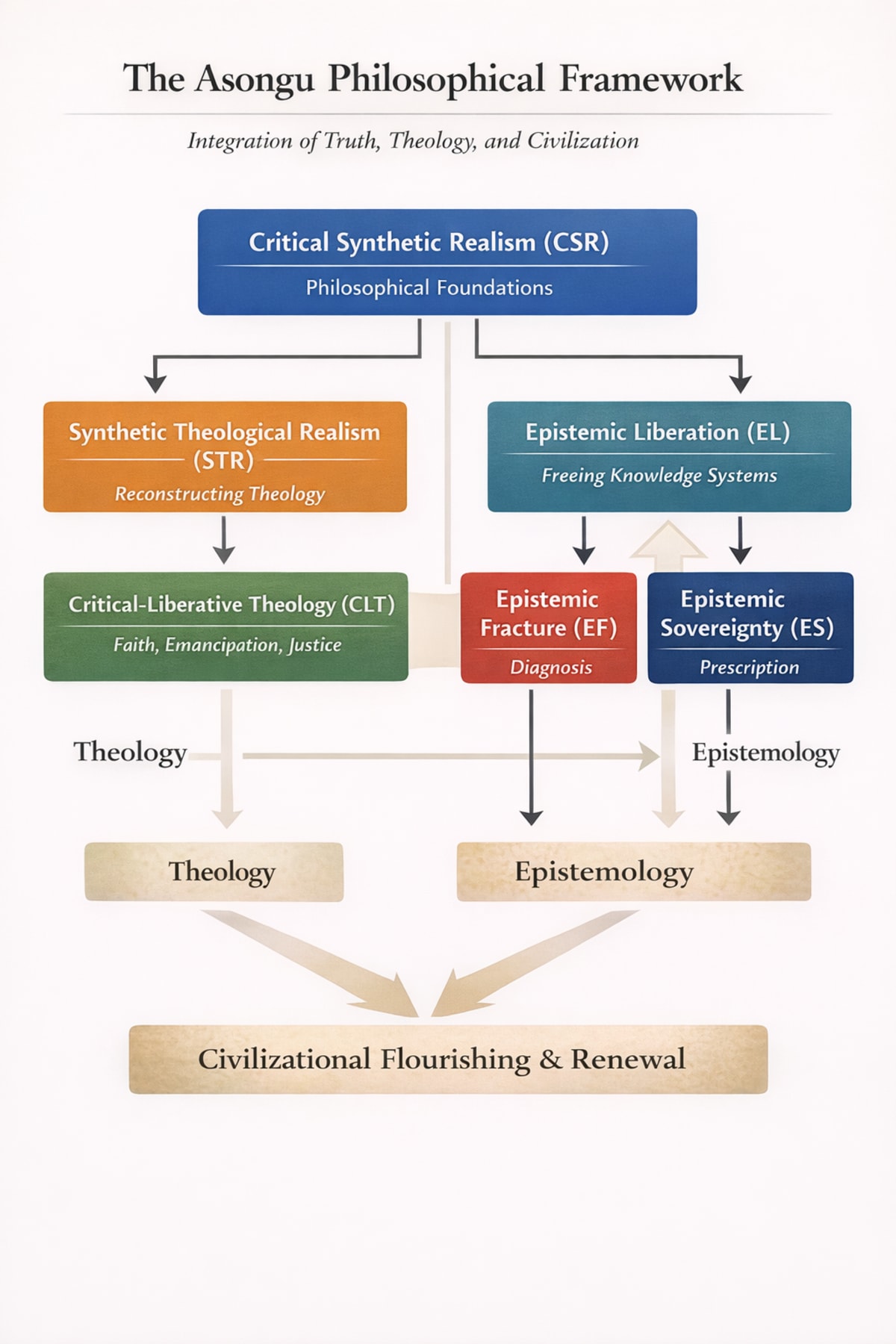
Structural Architecture of the Asongu System
The various components of the Asongu framework form a coherent conceptual architecture.
Philosophical foundation
Critical Synthetic Realism (CSR)
Theological development
Synthetic Theological Realism (STR)
Critical-Liberative Theology (CLT)
Epistemic analysis
Epistemic Liberation (EL)
Epistemic Fracture (EF)
Epistemic Sovereignty (ES)
Normative objective
Civilizational Flourishing
This architecture integrates philosophical realism, theological reflection, and institutional analysis into a unified theoretical system.
Significance of the Framework
The Asongu system contributes to contemporary intellectual discourse in several important ways.
First, it reaffirms the possibility of objective truth while acknowledging the fallibility and mediation of human knowledge.
Second, it emphasizes the institutional dimension of knowledge production, highlighting the role of universities, scientific communities, and other organizations in sustaining reliable knowledge systems.
Third, it integrates philosophical, theological, and civilizational analysis into a unified framework capable of addressing complex contemporary challenges.
Finally, the framework provides conceptual tools for analyzing the epistemic stability of societies and the conditions necessary for civilizational flourishing.
Conclusion
The contemporary crisis of epistemic fragmentation presents one of the most significant intellectual challenges of the modern world. Societies must maintain reliable knowledge systems in order to sustain democratic governance, scientific progress, and ethical social order.
The framework developed by Januarius Jingwa Asongu represents an ambitious attempt to address this challenge through an integrated philosophical architecture. By combining metaphysical realism, epistemic humility, theological reflection, and institutional analysis, the Asongu system offers a comprehensive approach to understanding the dynamics of knowledge systems within civilizations.
The architecture of the framework reveals how its various components interact to form a coherent intellectual system capable of addressing the epistemic instability of contemporary societies.
References
Asongu, J. J. (2026). Beyond doctrine: A critical-liberative theology of faith and emancipation. Wipf & Stock.
Asongu, J. J. (2026). Critical synthetic realism: A systematic philosophy of truth, personhood, and human flourishing. Generis Publishing.
Asongu, J. J. (2026). The splendor of truth: A critical philosophy of knowledge and global agency. Wipf & Stock.
Asongu, J. J. (2026). The epistemic fracture and the fate of civilizations.