By Januarius Jingwa Asongu, PhD
Saint Monica University, Buea, Cameroon
Abstract
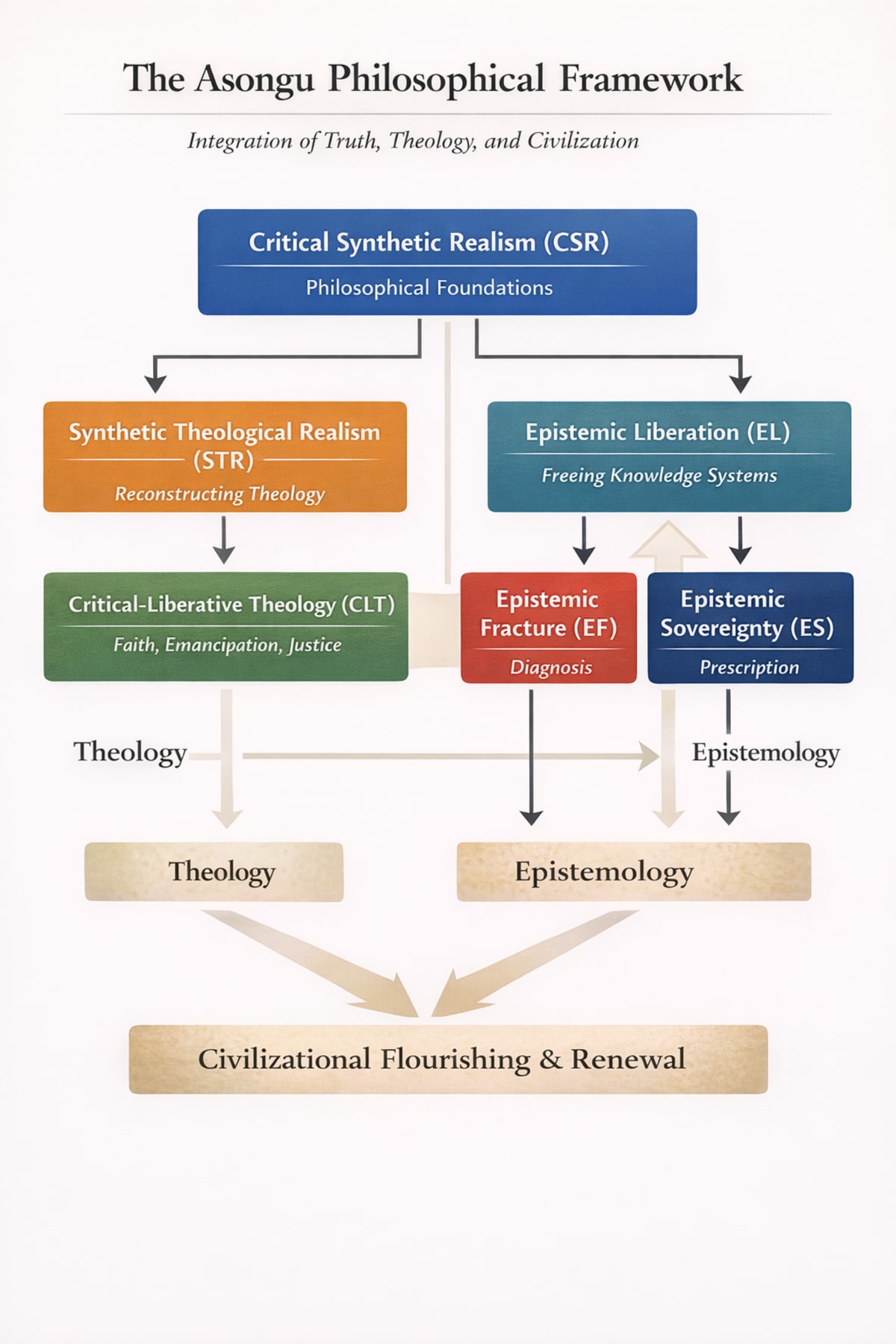
Contemporary societies face an intensifying crisis of epistemic fragmentation characterized by institutional distrust, ideological polarization, and the proliferation of misinformation within digitally mediated information ecosystems. Traditional disciplinary approaches often address these problems in isolation, focusing either on philosophical theories of truth, psychological dynamics of belief formation, theological questions of meaning, or sociological analyses of institutions. This article introduces the Asongu Framework, an interdisciplinary intellectual architecture designed to integrate these dimensions into a unified account of knowledge systems and civilizational stability. The framework rests upon Critical Synthetic Realism (CSR) as its philosophical foundation and develops along two principal trajectories: a theological trajectory encompassing Synthetic Theological Realism (STR) and Critical-Liberative Theology (CLT), and an epistemic-civilizational trajectory encompassing Epistemic Liberation (EL), Epistemic Fracture (EF), and Epistemic Sovereignty (ES). Together these concepts provide a systematic approach for analyzing how societies generate, sustain, and sometimes lose reliable knowledge systems. The article argues that the resilience of modern civilizations depends upon institutions capable of maintaining truth-oriented inquiry, ethical responsibility, and interdisciplinary intellectual synthesis. The Asongu Framework therefore offers a comprehensive theoretical model for understanding the relationship between knowledge, institutions, theology, and civilizational flourishing.
Keywords: Critical Synthetic Realism, epistemology, theology, institutional epistemology, civilizational theory
Introduction
The early twenty-first century has witnessed growing concern regarding the stability of contemporary knowledge systems. Public discourse frequently references the emergence of a “post-truth” condition in which emotional persuasion, ideological allegiance, and identity-driven narratives often overshadow empirical evidence and rational deliberation. The proliferation of misinformation through digital communication networks, combined with declining trust in traditional epistemic institutions such as universities, scientific communities, and professional media organizations, has contributed to widespread uncertainty regarding the reliability of public knowledge.
These developments raise fundamental questions concerning the relationship between knowledge, institutions, and civilizational stability. Modern societies depend upon complex epistemic infrastructures that allow communities to generate reliable knowledge, coordinate collective action, and respond to emerging challenges. When these infrastructures weaken, societies may experience not only intellectual confusion but also political instability and social fragmentation.
Addressing this challenge requires a conceptual framework capable of integrating multiple dimensions of human inquiry. Philosophical realism addresses the nature of truth and the relationship between knowledge and reality. Psychology examines the cognitive processes through which beliefs are formed and maintained. Theology explores questions of meaning, moral orientation, and ultimate reality. Institutional analysis investigates how organizations shape the production and dissemination of knowledge.
The Asongu Framework seeks to integrate these dimensions into a coherent intellectual architecture for understanding knowledge systems in modern societies. At its philosophical core lies Critical Synthetic Realism (CSR), which provides the epistemological foundation for the entire system. From this foundation emerge theological developments—Synthetic Theological Realism (STR) and Critical-Liberative Theology (CLT)—as well as epistemic-civilizational concepts such as Epistemic Liberation (EL), Epistemic Fracture (EF), and Epistemic Sovereignty (ES).
Together these concepts form a systematic approach to analyzing how societies generate, sustain, and sometimes lose reliable knowledge systems.
Critical Synthetic Realism: Philosophical Foundations
At the foundation of the Asongu Framework lies Critical Synthetic Realism, a philosophical approach designed to address the fragmentation of contemporary knowledge systems. CSR affirms that reality exists independently of human perception while recognizing that human knowledge of reality is always fallible, historically mediated, and institutionally structured.
CSR builds upon several major philosophical traditions. From classical realism it inherits the conviction that truth corresponds to objective reality. From fallibilist epistemology it adopts the insight that all human knowledge remains open to correction and revision. From interdisciplinary philosophy it draws the conviction that complex realities require synthetic engagement across multiple fields of inquiry.
Within CSR, knowledge advances through the interaction of philosophical reflection, empirical investigation, psychological insight, and institutional mediation. This synthetic approach attempts to overcome the disciplinary fragmentation that often characterizes modern academic discourse.
The Five Core Theses of Critical Synthetic Realism
The epistemological architecture of CSR can be summarized through five foundational principles.
The Reality Thesis affirms that reality possesses an objective structure independent of human cognition. Knowledge claims aim to describe this structure as accurately as possible.
The Fallibilist Thesis acknowledges that human understanding of reality remains provisional and subject to revision through critical inquiry and empirical testing.
The Synthetic Thesis emphasizes that knowledge advances through interdisciplinary integration rather than through isolated disciplinary approaches.
The Institutional Mediation Thesis recognizes that knowledge systems operate through institutions such as universities, research communities, religious traditions, and media organizations.
The Ethical Responsibility Thesis affirms that the pursuit of knowledge carries moral obligations, including intellectual honesty, humility, and openness to correction.
Together these theses form the philosophical foundation upon which the broader Asongu Framework develops.
Synthetic Theological Realism
From the philosophical foundation of CSR emerges Synthetic Theological Realism (STR), a theological methodology that seeks to reconstruct Christian theological reflection after the fragmentation produced by modern and postmodern intellectual movements.
STR affirms that theological claims refer to a real divine reality while acknowledging that human understanding of that reality develops historically and remains subject to interpretation. By integrating insights from philosophy, history, and social analysis, STR aims to preserve the ontological realism of Christian doctrine while engaging contemporary intellectual contexts.
This approach seeks to move beyond the polarization that has sometimes characterized modern theological discourse between rigid doctrinal traditionalism and radical theological relativism.
Critical-Liberative Theology
Building upon the methodological foundations of STR, Critical-Liberative Theology (CLT) examines the ethical implications of faith in relation to structures of injustice. CLT draws inspiration from classical liberation theology while expanding its scope to address contemporary forms of domination that extend beyond purely economic exploitation.
These forms of domination include epistemic manipulation, institutional corruption, technological control, and informational inequality. CLT therefore seeks to integrate theological reflection with critical analysis of political and institutional structures that shape human dignity and social justice.
Epistemic Liberation and Civilizational Renewal
The epistemic branch of the Asongu Framework focuses on the dynamics through which societies generate and sustain knowledge systems. Within this branch, the concept of Epistemic Liberation refers to the process through which individuals and institutions free their knowledge systems from ideological distortion and structural manipulation.
Epistemic liberation involves both institutional reform and cultural transformation. Universities must maintain intellectual independence, media organizations must commit to responsible information dissemination, and educational systems must cultivate critical thinking and intellectual virtue.
Epistemic Fracture
When societies fail to maintain reliable knowledge systems, they may experience Epistemic Fracture. Epistemic fracture occurs when the institutions responsible for producing and transmitting knowledge lose credibility or become captured by ideological forces.
Symptoms of epistemic fracture include widespread misinformation, polarization of public discourse, and declining trust in scientific and governmental institutions.
Epistemic Sovereignty
The restoration of reliable knowledge systems leads to Epistemic Sovereignty, the institutional capacity of a society to sustain resilient and self-correcting knowledge systems across generations.
Societies possessing epistemic sovereignty cultivate institutions that protect intellectual freedom, encourage critical debate, and maintain transparent standards for evaluating knowledge claims.
Civilizational Flourishing
The ultimate goal of the Asongu Framework is civilizational flourishing. Civilizational flourishing occurs when societies sustain ethical institutions, resilient knowledge systems, and social structures that support human dignity, justice, and intellectual freedom.
In this sense epistemology becomes inseparable from broader questions concerning the long-term stability and moral orientation of human civilizations.
Conclusion
The Asongu Framework represents an attempt to reconstruct epistemology as an interdisciplinary field capable of addressing the complex challenges facing contemporary societies. By integrating philosophical realism, psychological insight, theological reflection, and institutional analysis, the framework provides a comprehensive model for understanding how knowledge systems shape the trajectory of civilizations.
In an era characterized by epistemic fragmentation and institutional distrust, such an integrative approach may prove essential for restoring the conditions necessary for reliable knowledge and sustainable civilizational development.
References
Asongu, J. J. (2026). Critical synthetic realism: A systematic philosophy of truth, personhood, and human flourishing. Generis Publishing.
Asongu, J. J. (2026). The splendor of truth: A critical philosophy of knowledge and global agency. Wipf & Stock.
Asongu, J. J. (2026). Beyond doctrine: A critical-liberative theology of faith and emancipation. Wipf & Stock.