By Januarius Jingwa Asongu
Saint Monica University, Buea, Cameroon
Abstract
Contemporary intellectual life is characterized by an increasing fragmentation of knowledge systems. The collapse of shared epistemic authorities, the proliferation of competing truth claims, and the institutionalization of ideological knowledge production have produced what may be described as an epistemic crisis. This article introduces and systematizes the five core theses of Critical Synthetic Realism (CSR), a philosophical framework developed to address this condition. CSR affirms the objective reality of truth while recognizing the fallibility, institutional mediation, and ethical responsibility inherent in human knowledge production. The framework rests upon five foundational propositions: the Reality Thesis, the Fallibilist Thesis, the Synthetic Thesis, the Institutional Mediation Thesis, and the Ethical Responsibility Thesis. Together, these theses establish CSR as an integrative epistemological architecture that combines metaphysical realism, epistemic fallibilism, interdisciplinary synthesis, institutional analysis, and ethical responsibility. The article further explores the implications of CSR for theology, social institutions, and civilizational development. In particular, it demonstrates how CSR functions as the philosophical foundation for a broader intellectual system that includes Synthetic Theological Realism, Critical-Liberative Theology, Epistemic Liberation, Epistemic Fracture, and Epistemic Sovereignty. By clarifying the conceptual structure of CSR, this article aims to provide scholars with a coherent framework capable of guiding research, institutional analysis, and interdisciplinary dialogue in an age of epistemic instability.
Keywords: Critical Synthetic Realism, epistemology, realism, fallibilism, interdisciplinary knowledge, epistemic institutions, epistemic sovereignty, philosophy of knowledge
Introduction
Modern intellectual life is increasingly characterized by a profound crisis of epistemic coherence. Across the natural sciences, the humanities, public discourse, and political institutions, scholars and citizens alike confront an environment in which the authority of knowledge appears simultaneously indispensable and deeply contested. Scientific expertise is questioned by ideological movements; religious traditions compete with secular frameworks of meaning; media ecosystems fragment into mutually reinforcing echo chambers; and algorithmic information systems accelerate the circulation of misinformation and partial truths.
The resulting condition may be described as epistemic fragmentation—a situation in which societies lack a shared framework for evaluating truth claims. This fragmentation produces both intellectual uncertainty and political instability. When societies cannot agree on what counts as reliable knowledge, the foundations of democratic deliberation, scientific cooperation, and institutional trust begin to erode.
The philosophical roots of this crisis are complex. Enlightenment rationalism sought to ground knowledge in universal reason, yet it frequently underestimated the historical and social conditions of knowledge production. Positivist models of science emphasized empirical verification but often reduced reality to what could be measured through narrow methodological frameworks. In reaction, postmodern thought challenged the possibility of objective truth, emphasizing the linguistic and cultural mediation of knowledge. While these critiques exposed important limitations within modern epistemology, they also contributed to a climate in which truth itself appeared increasingly contingent or constructed.
The tension between these competing traditions—positivism, relativism, and disciplinary fragmentation—has left contemporary intellectual life without a widely accepted philosophical synthesis capable of integrating realism, fallibilism, institutional analysis, and ethical responsibility.
Critical Synthetic Realism (CSR) emerges as a response to this condition. Developed as a systematic philosophical framework, CSR seeks to recover the possibility of truth while acknowledging the fallible and socially mediated character of human knowledge. The approach rejects both the reductionism of strict positivism and the relativism of radical constructivism. Instead, it proposes a layered epistemology in which knowledge claims are evaluated through the interaction of empirical evidence, interdisciplinary synthesis, institutional accountability, and ethical responsibility.
CSR is therefore not merely a theory of knowledge in the narrow sense. It is also a framework for understanding the relationship between knowledge systems and civilizational stability. Knowledge institutions—universities, scientific communities, religious traditions, and media systems—play a decisive role in shaping how societies interpret reality. When these institutions function well, they enable societies to correct error and refine understanding. When they become corrupted by ideology or power, they can produce widespread epistemic distortion.
The purpose of this article is to present the five core theses that constitute the philosophical foundation of Critical Synthetic Realism. These theses provide the conceptual architecture that organizes the broader CSR framework. By articulating these principles in systematic form, the article seeks to transform CSR from a general philosophical orientation into a clearly defined theoretical system that can be referenced, debated, and applied across academic disciplines.
The five theses are:
- The Reality Thesis
- The Fallibilist Thesis
- The Synthetic Thesis
- The Institutional Mediation Thesis
- The Ethical Responsibility Thesis
Together these principles establish a philosophical structure capable of integrating metaphysical realism, epistemic humility, interdisciplinary cooperation, institutional accountability, and ethical responsibility. The article proceeds by examining each thesis in detail before exploring their implications for theology, institutional analysis, and civilizational renewal.
The Reality Thesis
The first and most fundamental principle of Critical Synthetic Realism is the Reality Thesis. This thesis affirms that reality exists independently of human perception, language, or social construction. The existence of an objective world is not contingent upon human awareness or cultural interpretation. Instead, human knowledge attempts—often imperfectly—to correspond to structures that exist independently of the knower.
This position aligns CSR with the long philosophical tradition of metaphysical realism. From Aristotle through Thomas Aquinas and into contemporary philosophy of science, many thinkers have argued that truth consists in a correspondence between intellect and reality. Aquinas famously defined truth as adaequatio intellectus et rei—the adequation of intellect and thing (Aquinas, 1920). While human understanding may be limited or fallible, the world itself possesses structures that can be progressively understood through inquiry.
CSR adopts this realist orientation but develops it within the context of modern epistemological debates. During the twentieth century, positivist philosophy often attempted to ground knowledge solely in empirical verification. This approach succeeded in promoting rigorous scientific methodology but frequently neglected broader metaphysical questions. In contrast, postmodern approaches emphasized the linguistic and cultural mediation of knowledge, sometimes concluding that truth itself is socially constructed.
Critical Synthetic Realism rejects both extremes. On the one hand, strict positivism reduces reality to what can be measured empirically, overlooking the broader ontological structures that shape existence. On the other hand, radical relativism risks dissolving truth into competing narratives or discourses.
The Reality Thesis therefore affirms two key propositions simultaneously.
First, reality exists independently of human knowledge. The physical universe, biological systems, social structures, and moral realities are not simply products of human imagination. They possess objective features that constrain interpretation and investigation.
Second, human knowledge aims to correspond to this reality. Scientific theories, philosophical arguments, theological doctrines, and social analyses attempt to describe aspects of the world as it actually exists.
Importantly, the recognition that knowledge is mediated by language and interpretation does not invalidate the concept of truth. Instead, mediation simply means that knowledge is achieved through historically situated processes of inquiry. The existence of interpretation does not eliminate the possibility of reference to reality.
Within CSR, realism therefore functions as the ontological anchor that prevents epistemology from collapsing into relativism. Without such an anchor, knowledge claims cannot be evaluated according to their correspondence with the world. In such a scenario, intellectual debates risk devolving into struggles for rhetorical dominance rather than genuine inquiry.
The Reality Thesis thus establishes the metaphysical foundation upon which the remaining CSR theses are built. It affirms that truth is possible because reality exists independently of the knower.
The Fallibilist Thesis
While the Reality Thesis affirms the possibility of objective truth, the Fallibilist Thesis emphasizes the limitations of human knowledge. According to this principle, all human knowledge is provisional and subject to revision. No epistemic authority—whether scientific, political, or religious—possesses infallible access to truth.
This thesis draws inspiration from traditions of critical rationalism associated with philosophers such as Karl Popper (1963). Popper argued that scientific progress does not occur through the accumulation of certain knowledge but through a process of conjecture and refutation. Hypotheses are proposed, tested, criticized, and replaced when evidence reveals their limitations.
CSR extends this insight beyond the natural sciences to encompass all domains of knowledge. Scientific theories, philosophical arguments, theological interpretations, and political ideologies are all products of human reasoning and therefore remain open to correction.
The Fallibilist Thesis thus introduces an essential element of epistemic humility into the CSR framework. If knowledge claims are always subject to revision, intellectual inquiry must remain open to critique and dialogue.
This principle has several important implications.
First, fallibilism protects knowledge systems from the dangers of epistemic authoritarianism. When institutions claim infallible authority, they often suppress dissent and inhibit the critical processes necessary for intellectual progress.
Second, fallibilism encourages a culture of continuous inquiry. Because knowledge remains provisional, scholars and institutions must constantly test assumptions and refine understanding.
Third, fallibilism fosters intellectual pluralism. Competing theories and perspectives become valuable resources for evaluating truth claims rather than threats to be eliminated.
CSR therefore combines metaphysical realism with epistemic humility. Truth exists, but human access to truth is mediated through imperfect processes of investigation and interpretation.
The Synthetic Thesis
The Synthetic Thesis represents one of the most distinctive features of Critical Synthetic Realism. According to this principle, knowledge advances through the integration of insights from multiple disciplines and perspectives. No single field of inquiry can fully capture the complexity of reality.
Modern academia is characterized by increasing specialization. While disciplinary expertise enables rigorous investigation, it can also produce intellectual fragmentation. Researchers often operate within narrowly defined methodological frameworks that limit engagement with broader questions.
CSR responds to this problem by proposing a synthetic epistemology. Rather than isolating disciplines, the synthetic approach encourages interaction among philosophy, science, theology, and social inquiry. Each discipline contributes distinct insights while also benefiting from the corrective perspectives of others.
Philosophy, for example, provides conceptual clarity and metaphysical reflection. The natural sciences contribute empirical investigation into the structures of the physical world. Theology explores questions of meaning, transcendence, and moral order. The social sciences analyze institutional dynamics and cultural processes.
When these disciplines remain isolated, they risk generating incomplete or distorted understandings of reality. By contrast, synthetic inquiry encourages dialogue across intellectual traditions.
The Synthetic Thesis therefore positions CSR as a meta-epistemological framework that facilitates interdisciplinary collaboration. Rather than replacing existing disciplines, CSR provides a philosophical structure within which their insights can be integrated.
The Institutional Mediation Thesis
The fourth principle of CSR recognizes that knowledge is not produced by isolated individuals but by institutions. Universities, research communities, religious traditions, media systems, and political structures all shape the conditions under which knowledge is created and transmitted.
This insight draws upon sociological analyses of knowledge production developed by thinkers such as Robert Merton (1973) and Thomas Kuhn (1962). These scholars demonstrated that scientific knowledge is influenced by institutional norms, professional networks, and paradigmatic frameworks.
CSR builds upon this tradition by emphasizing that institutions can either sustain or undermine reliable knowledge systems.
Healthy knowledge institutions exhibit several characteristics:
• openness to critique
• methodological rigor
• intellectual pluralism
• mechanisms for correcting error
When these conditions are present, institutions enable societies to refine knowledge over time.
However, institutions can also become epistemically corrupted. Ideological pressures, political manipulation, economic incentives, and media polarization can distort knowledge production. When such corruption occurs, societies may experience widespread epistemic breakdown.
CSR therefore emphasizes the importance of institutional design in sustaining reliable knowledge systems. The integrity of universities, scientific organizations, religious communities, and media institutions becomes a central concern for philosophical inquiry.
The Ethical Responsibility Thesis
The final principle of CSR is the Ethical Responsibility Thesis. According to this thesis, the pursuit of knowledge carries moral obligations. Truth-seeking must be guided by intellectual virtues such as honesty, humility, openness to correction, and respect for evidence.
Epistemology cannot be separated from ethics. Knowledge systems influence public policy, social justice, and civilizational stability. When knowledge is manipulated for ideological or political purposes, the consequences extend far beyond academic debates.
The Ethical Responsibility Thesis therefore emphasizes the cultivation of epistemic virtues. Scholars, institutions, and citizens must approach knowledge with integrity and responsibility.
Intellectual honesty requires a willingness to acknowledge evidence even when it challenges personal beliefs. Humility recognizes the fallibility of one's own understanding. Openness to dialogue enables the correction of error.
CSR thus integrates epistemology and ethics into a unified framework. The search for truth becomes both an intellectual and moral endeavor.
Implications of the Five Theses
Taken together, the five theses of Critical Synthetic Realism establish a comprehensive philosophical framework that integrates multiple dimensions of knowledge.
CSR combines:
• Metaphysical realism (reality exists independently of the knower)
• Epistemic fallibilism (knowledge remains provisional)
• Interdisciplinary synthesis (multiple disciplines contribute to understanding reality)
• Institutional analysis (knowledge systems depend upon social institutions)
• Ethical responsibility (truth-seeking requires intellectual virtue)
This integration allows CSR to function as both a theory of knowledge and a framework for analyzing civilizational dynamics.
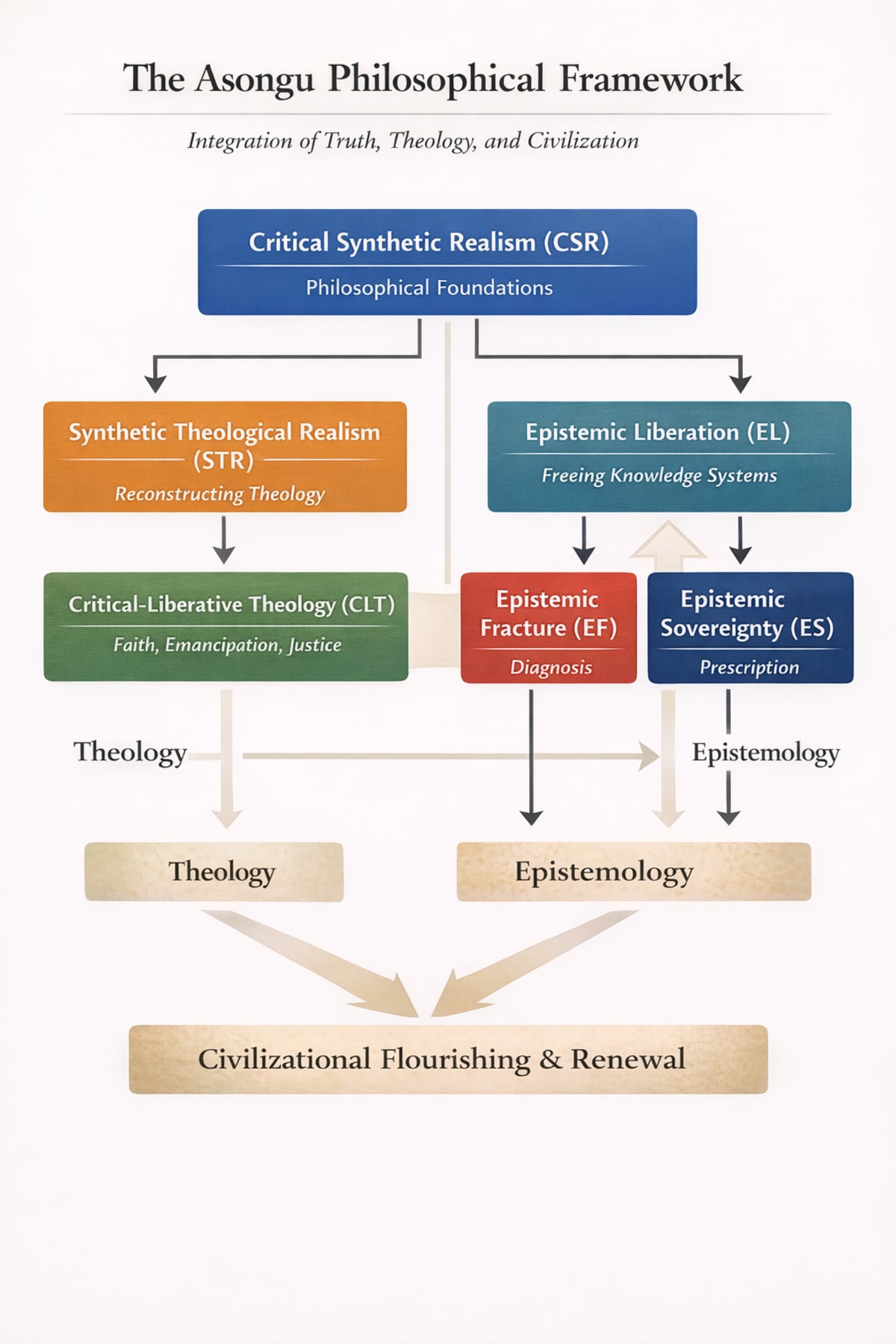
CSR Within the Broader Asongu Framework
The philosophical structure of CSR also generates several additional concepts within the broader intellectual system developed by Asongu (2026a, 2026b).
From the philosophical foundation of CSR emerge two primary branches.
The theological branch includes:
• Synthetic Theological Realism (STR) — a methodological framework for theology
• Critical-Liberative Theology (CLT) — an ethical approach to social justice and liberation
The civilizational branch includes:
• Epistemic Liberation (EL) — the restoration of truth-oriented knowledge systems
• Epistemic Fracture (EF) — the diagnosis of systemic breakdown in knowledge institutions
• Epistemic Sovereignty (ES) — the institutional restoration of resilient knowledge systems
Together these concepts aim toward the ultimate goal of civilizational flourishing and renewal.
CSR thus serves as the philosophical foundation for a broader program of intellectual reconstruction in an age of epistemic instability.
Conclusion
The contemporary world faces an unprecedented crisis of epistemic fragmentation. Competing truth claims, institutional distrust, and ideological polarization have created conditions in which reliable knowledge appears increasingly fragile.
Critical Synthetic Realism offers a philosophical framework capable of addressing this challenge. By integrating metaphysical realism, epistemic fallibilism, interdisciplinary synthesis, institutional analysis, and ethical responsibility, CSR provides a coherent structure for understanding how knowledge systems function within complex societies.
The five core theses presented in this article establish the conceptual foundation of this framework. They affirm that truth exists, that knowledge remains fallible, that disciplines must cooperate, that institutions shape knowledge production, and that truth-seeking requires ethical responsibility.
By articulating these principles clearly, CSR becomes a philosophical system that scholars can analyze, critique, and develop further. Its ultimate aim is not merely theoretical clarity but the restoration of resilient knowledge systems capable of sustaining civilizational flourishing.
References
Aquinas, T. (1920). Summa Theologiae (Fathers of the English Dominican Province, Trans.). Burns, Oates & Washbourne.
Asongu, J. J. (2026a). The Splendor of Truth: A critical philosophy of knowledge and global agency. Wipf & Stock.
Asongu, J. J. (2026b). Critical Synthetic Realism: A systematic philosophy of truth, personhood, and human flourishing. Generis Publishing.
Kuhn, T. S. (1962). The structure of scientific revolutions. University of Chicago Press.
Merton, R. K. (1973). The sociology of science: Theoretical and empirical investigations. University of Chicago Press.
Popper, K. (1963). Conjectures and refutations: The growth of scientific knowledge. Routledge.