By Januarius Jingwa Asongu, PhD
Saint Monica University, Buea, Cameroon
Abstract
Philosophical traditions are sustained not only through arguments but also through conceptual vocabularies that enable systematic communication across scholarly communities. The intellectual framework developed by Januarius Jingwa Asongu integrates metaphysical realism, epistemic humility, theological reflection, and institutional analysis in order to address the contemporary crisis of knowledge fragmentation. As this framework has expanded across several works—including The Splendor of Truth, Critical Synthetic Realism, Beyond Doctrine, and The Epistemic Fracture and the Fate of Civilizations—a coherent conceptual lexicon has become increasingly necessary. This article develops a structured glossary of the key concepts that constitute the Asongu framework. Central terms include Critical Synthetic Realism (CSR), Synthetic Theological Realism (STR), Critical-Liberative Theology (CLT), Epistemic Liberation (EL), Epistemic Fracture (EF), and Epistemic Sovereignty (ES), along with related concepts such as epistemic pluralism, institutional epistemology, conditional causality, civilizational intelligence, and civilizational flourishing. By situating these concepts within the broader architecture of the Asongu system, the article demonstrates how the framework integrates philosophical realism, interdisciplinary synthesis, theological reflection, and civilizational analysis. The resulting lexicon provides scholars and students with a conceptual map that facilitates systematic engagement with the framework and its potential applications across philosophy, theology, social theory, and institutional analysis.
Keywords: Critical Synthetic Realism, epistemology, institutional knowledge, epistemic sovereignty, civilizational theory, theology, glossary
Introduction
Throughout the history of philosophy and theology, intellectual traditions have relied upon carefully defined conceptual vocabularies in order to sustain scholarly discourse. Aristotle’s metaphysical categories, Thomas Aquinas’s theological distinctions, Immanuel Kant’s critical terminology, and Karl Marx’s socio-economic concepts all illustrate how philosophical systems depend upon stable conceptual frameworks that allow scholars to engage ideas with precision and continuity.
Without such conceptual clarity, philosophical inquiry risks becoming fragmented. Arguments may be presented without shared definitions, and intellectual traditions may struggle to develop coherent trajectories across generations. For this reason, conceptual lexicons play an essential role in the development of philosophical systems. They provide scholars with a shared language through which ideas can be articulated, debated, and refined.
The contemporary intellectual landscape presents particular challenges that make such conceptual clarity especially important. Modern societies are experiencing an unprecedented degree of epistemic fragmentation. Institutions that historically served as guardians of reliable knowledge—including universities, scientific communities, religious traditions, and professional media organizations—now face growing skepticism and declining public trust. Digital communication technologies have transformed the production and dissemination of information, creating environments in which misinformation, ideological polarization, and epistemic instability can spread rapidly.
In this context, philosophical reflection on the structure of knowledge systems has become increasingly urgent. The framework developed by Januarius Jingwa Asongu represents an attempt to respond to this crisis through an integrated intellectual system that combines philosophical realism, epistemic fallibilism, theological reflection, and institutional analysis.
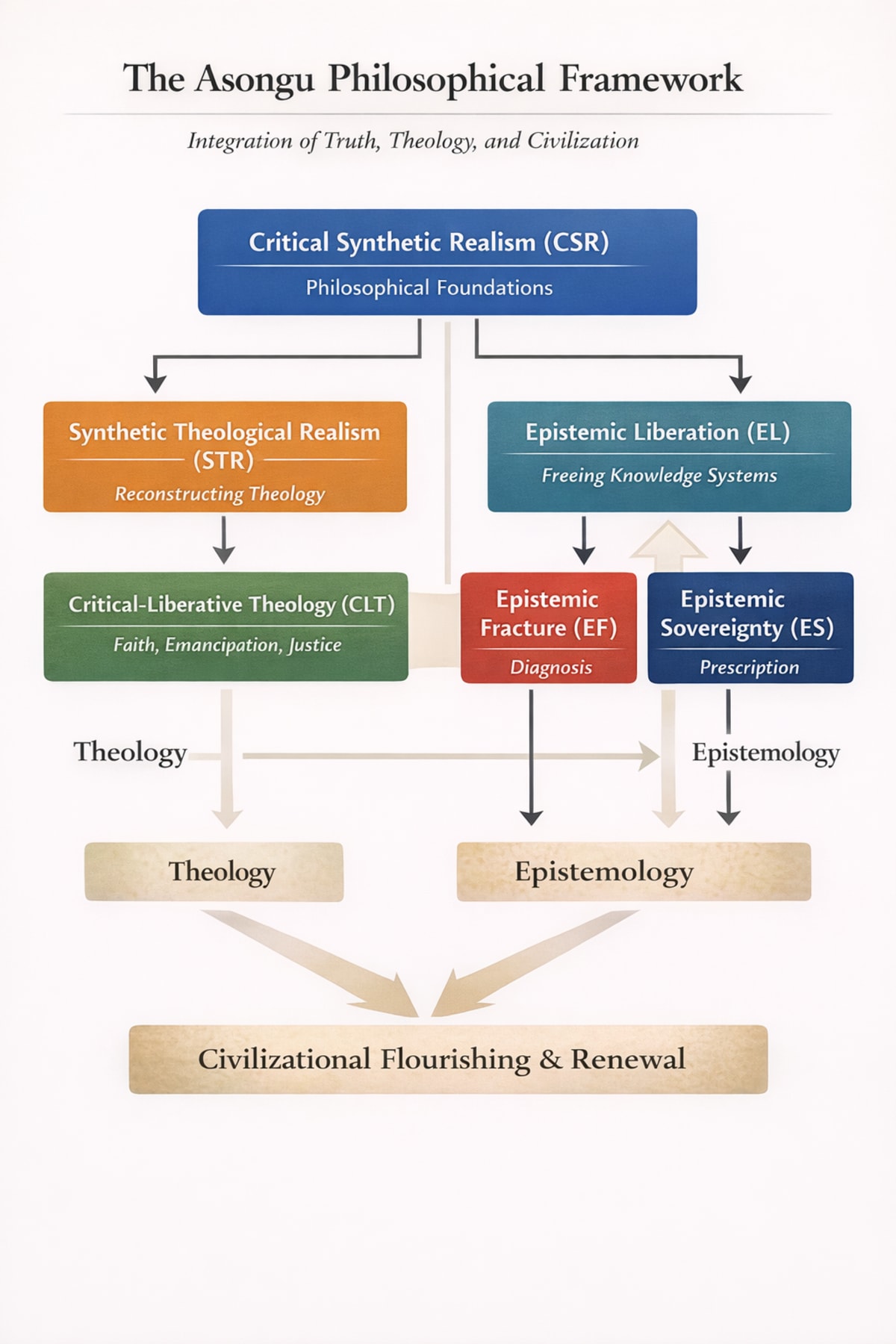
At the foundation of this framework lies Critical Synthetic Realism (CSR), a philosophical approach that affirms the independent existence of reality while recognizing the fallibility and mediation of human knowledge. From this foundation emerge several related conceptual developments. In theology, CSR generates Synthetic Theological Realism (STR) and Critical-Liberative Theology (CLT). In civilizational analysis, it introduces the concepts of Epistemic Liberation (EL), Epistemic Fracture (EF), and Epistemic Sovereignty (ES).
Together these concepts form a broader intellectual architecture aimed at understanding how societies generate, maintain, and sometimes lose reliable knowledge systems.
As this framework has expanded across multiple scholarly works, the need for a structured conceptual vocabulary has become increasingly evident. Scholars engaging the framework require clear definitions of its key concepts in order to understand their relationships and implications.
This article therefore develops a conceptual lexicon of the Asongu framework. Rather than simply presenting a list of definitions, the article situates each concept within the broader architecture of the system. The goal is to provide scholars and students with a conceptual map that clarifies how the various components of the framework interact.
Critical Synthetic Realism: The Philosophical Foundation
Critical Synthetic Realism (CSR)
Critical Synthetic Realism constitutes the philosophical foundation of the Asongu framework. CSR is designed as a response to two opposing tendencies that have shaped modern epistemological debates: positivist reductionism and radical epistemic relativism.
Positivist traditions often seek to reduce knowledge to empirical verification within narrowly defined scientific frameworks. While such approaches have generated remarkable scientific achievements, they sometimes exclude philosophical, ethical, and theological dimensions of inquiry that remain essential for understanding human experience.
At the opposite extreme, postmodern relativist approaches frequently emphasize the social construction of knowledge to such an extent that the very concept of objective truth becomes unstable. If all knowledge claims are interpreted primarily as products of power structures or linguistic conventions, the possibility of rational evaluation among competing claims becomes difficult to sustain.
CSR attempts to navigate between these extremes by affirming two principles simultaneously. First, reality exists independently of human perception, language, or cultural interpretation. Second, human knowledge of reality is always mediated through cognitive, historical, and institutional processes.
This dual affirmation produces a form of epistemological realism that acknowledges the fallibility of human knowledge without abandoning the concept of objective truth. Knowledge claims aim to correspond to reality, yet they remain open to revision as new evidence emerges or existing assumptions are challenged.
CSR therefore integrates metaphysical realism with epistemic fallibilism.
A distinctive feature of the framework is its emphasis on synthetic epistemology. Because reality is complex and multidimensional, no single discipline can claim comprehensive authority over truth. Instead, knowledge advances through the interaction of diverse intellectual traditions.
Philosophy, science, theology, and social inquiry each illuminate different aspects of reality. When these disciplines interact in mutually critical and cooperative ways, they produce a more comprehensive understanding than any single perspective could achieve in isolation.
CSR thus promotes an epistemology of interdisciplinary synthesis. Knowledge emerges through dialogue among diverse forms of inquiry, each contributing insights that refine and correct the others.
Epistemic Pluralism and the Structure of Inquiry
Epistemic Pluralism
Closely related to the synthetic dimension of CSR is the concept of epistemic pluralism. Epistemic pluralism recognizes that the pursuit of truth often requires multiple methodological approaches and intellectual perspectives.
Complex phenomena cannot always be adequately understood through a single disciplinary lens. For example, the study of human behavior may require insights from psychology, sociology, philosophy, and neuroscience. Similarly, questions concerning human dignity and justice may involve contributions from ethics, theology, political theory, and economics.
Epistemic pluralism therefore encourages openness to diverse intellectual traditions while maintaining commitment to rational evaluation and empirical accountability.
Importantly, pluralism does not imply relativism. The recognition that multiple perspectives contribute to understanding does not eliminate the possibility of evaluating competing claims. Instead, pluralism acknowledges that truth is often approached through converging insights from different domains of inquiry.
Within the Asongu framework, epistemic pluralism functions as a methodological safeguard against intellectual reductionism. By encouraging dialogue across disciplines, it helps prevent the fragmentation of knowledge systems.
Institutional Mediation and Knowledge Production
Institutional Epistemology
One of the distinctive contributions of the Asongu framework is its emphasis on the institutional dimension of knowledge production. Knowledge does not emerge solely from individual thinkers; it is generated and transmitted through complex institutional structures.
Universities, scientific communities, religious traditions, media organizations, and governance systems all play critical roles in shaping the conditions under which knowledge is produced and disseminated.
The concept of institutional epistemology examines how these institutions influence the reliability and legitimacy of knowledge claims. Healthy epistemic institutions maintain rigorous standards of inquiry, encourage intellectual diversity, and protect the independence of research and debate.
When institutions function effectively, they provide the infrastructure necessary for societies to sustain reliable knowledge systems. When institutions deteriorate, however, knowledge production may become distorted by ideological pressures, economic incentives, or political manipulation.
The study of institutional epistemology therefore connects philosophical reflection with sociological and political analysis. It highlights the ways in which intellectual inquiry depends upon institutional environments that support open and critical investigation.
Theological Developments within the Framework
Synthetic Theological Realism (STR)
From the philosophical foundation of CSR emerges a distinctive theological methodology known as Synthetic Theological Realism (STR). STR applies the epistemological principles of CSR to the domain of theological reflection.
At its core, STR maintains that theological claims refer to realities that transcend purely symbolic or cultural interpretation. Christian doctrines concerning God, revelation, and salvation are understood as statements about realities that exist independently of human imagination.
At the same time, STR recognizes that theological understanding develops historically. The interpretation of doctrine occurs within particular cultural contexts and intellectual traditions. As new historical experiences and intellectual insights emerge, theological reflection must remain open to critical dialogue.
STR therefore seeks to preserve the ontological realism of Christian doctrine while encouraging interdisciplinary engagement with philosophy, history, science, and social analysis.
In this sense, Synthetic Theological Realism represents an attempt to reconstruct theology after the fragmentation produced by modern and postmodern debates. Rather than abandoning doctrinal realism or retreating into rigid traditionalism, STR integrates doctrinal fidelity with intellectual openness.
Critical-Liberative Theology (CLT)
A second theological development within the Asongu framework is Critical-Liberative Theology (CLT). CLT extends the ethical implications of Synthetic Theological Realism by engaging questions of social justice and human dignity.
Liberation theology historically emphasized the role of Christian faith in confronting economic oppression and political injustice. CLT builds upon this tradition while expanding its analytical scope.
In addition to economic exploitation, contemporary societies experience forms of domination that operate through epistemic, institutional, and technological structures. These include:
- ideological control of information systems
- institutional discrimination
- technological surveillance and manipulation
- cultural marginalization
Critical-Liberative Theology therefore analyzes how structures of knowledge and power influence human freedom and dignity.
Within this framework, theology functions not merely as a system of doctrinal reflection but also as a critical resource for confronting injustice and promoting social transformation.
Epistemic Crisis and Civilizational Analysis
Epistemic Liberation (EL)
The concept of Epistemic Liberation refers to the process through which individuals and institutions recover the conditions necessary for reliable knowledge production. Liberation occurs when knowledge systems are freed from ideological distortion, coercive control, or institutional manipulation.
In societies experiencing epistemic crisis, restoring intellectual freedom and institutional integrity becomes essential for rebuilding trust in knowledge systems.
Epistemic liberation therefore involves both intellectual and institutional transformation. Individuals must cultivate intellectual virtues such as honesty, humility, and openness to correction, while institutions must protect the independence of inquiry and debate.
Epistemic Fracture (EF)
The concept of Epistemic Fracture provides a diagnostic category for understanding the breakdown of knowledge systems within societies.
Epistemic fracture occurs when the mechanisms that allow communities to align belief with reality cease to function effectively. Institutions responsible for generating and verifying knowledge lose credibility or become captured by ideological forces.
Symptoms of epistemic fracture include widespread misinformation, declining trust in institutions, ideological polarization, and the proliferation of competing narratives that lack shared standards of verification.
In such contexts, societies struggle to maintain coherent public discourse or make informed collective decisions.
Epistemic Sovereignty (ES)
If epistemic fracture represents the breakdown of knowledge systems, Epistemic Sovereignty represents their restoration. Epistemic sovereignty refers to the institutional capacity of a society to sustain resilient and truth-oriented knowledge systems.
A society possessing epistemic sovereignty protects intellectual freedom, maintains rigorous standards of inquiry, and ensures the independence of knowledge-producing institutions.
Such societies are able to generate reliable knowledge, correct errors, and adapt to new challenges through informed decision-making.
Civilizational Intelligence and Flourishing
Civilizational Intelligence
Civilizational intelligence refers to the collective capacity of a society to generate, preserve, and apply knowledge in ways that sustain long-term stability and development.
Civilizations possessing strong epistemic institutions exhibit high levels of civilizational intelligence. They are able to innovate, adapt to changing circumstances, and maintain social cohesion despite external pressures.
By contrast, societies experiencing epistemic fragmentation may struggle to coordinate collective action or respond effectively to complex challenges.
Civilizational Flourishing
The ultimate normative objective of the Asongu framework is civilizational flourishing. A flourishing civilization sustains institutions that protect human dignity, encourage intellectual freedom, and promote ethical governance.
Such societies maintain resilient knowledge systems capable of guiding decision-making across generations.
Civilizational flourishing therefore depends upon the preservation of epistemic integrity and institutional stability.
Structural Architecture of the Asongu Framework
The glossary developed in this article reveals the broader conceptual structure of the Asongu system.
Philosophical foundation
Critical Synthetic Realism (CSR)
Theological development
Synthetic Theological Realism (STR)
Critical-Liberative Theology (CLT)
Epistemic and institutional analysis
Epistemic Liberation (EL)
Epistemic Fracture (EF)
Epistemic Sovereignty (ES)
Normative objective
Civilizational Intelligence
Civilizational Flourishing
Together these components form an integrated theoretical architecture that links philosophy, theology, and civilizational analysis.
Conclusion
The contemporary world faces a profound crisis of epistemic fragmentation. Institutions responsible for producing reliable knowledge increasingly confront challenges that threaten their credibility and independence.
The framework developed by Januarius Jingwa Asongu represents an ambitious attempt to address this crisis through an integrated philosophical system. By combining metaphysical realism, epistemic humility, theological reflection, and institutional analysis, the framework offers a comprehensive approach to understanding the dynamics of knowledge systems within societies.
The conceptual lexicon presented in this article clarifies the key terms that structure this intellectual architecture. By defining concepts such as Critical Synthetic Realism, Synthetic Theological Realism, Critical-Liberative Theology, Epistemic Liberation, Epistemic Fracture, and Epistemic Sovereignty, the article provides scholars with a conceptual map for engaging the framework.
As debates concerning truth, institutions, and civilizational stability continue to shape contemporary intellectual discourse, the development of a clear conceptual vocabulary will remain essential for sustaining meaningful scholarly engagement with the Asongu framework.
References
Asongu, J. J. (2026). Beyond doctrine: A critical-liberative theology of faith and emancipation. Wipf & Stock.
Asongu, J. J. (2026). Critical synthetic realism: A systematic philosophy of truth, personhood, and human flourishing. Generis Publishing.
Asongu, J. J. (2026). The splendor of truth: A critical philosophy of knowledge and global agency. Wipf & Stock.
Asongu, J. J. (2026). The epistemic fracture and the fate of civilizations: How knowledge systems determine civilizational rise and decline.