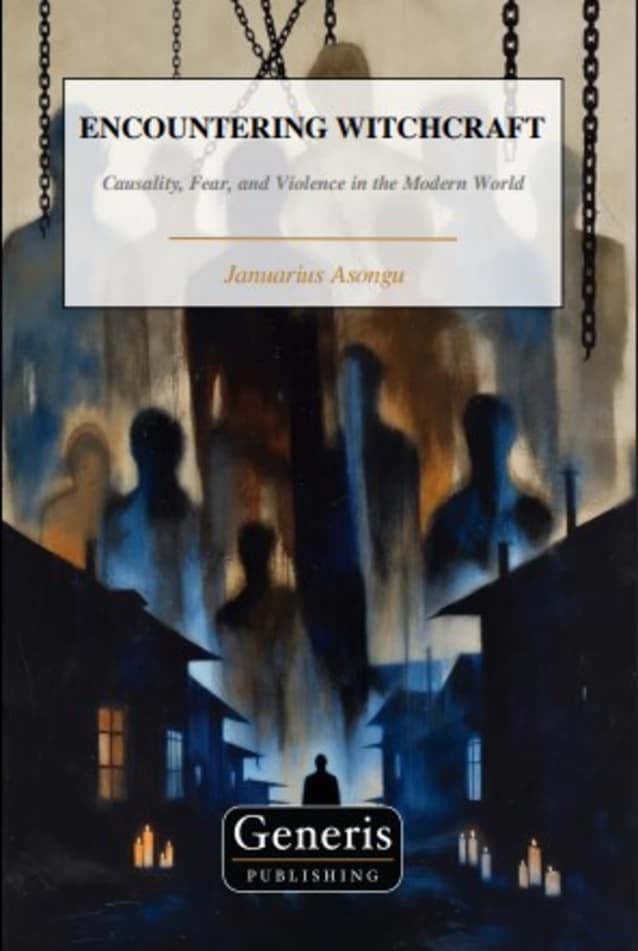
Encountering Witchcraft
About
Encountering Witchcraft : Causality, Fear, and Violence in the Modern World is a bold and interdisciplinary examination of one of humanity’s most persistent and harmful belief systems. In this provocative and compassionate work, Januarius Jingwa (JJ) Asongu, PhD, dismantles the intellectual foundations of witchcraft belief and exposes the profound damage it inflicts on individuals, families, churches, and nations.
Across Africa, Asia, Latin America, and even Western communities, countless people still interpret misfortune—illness, poverty, conflict, or death—as the work of occult enemies. Children are accused, widows are stigmatized, the mentally ill are demonized, and entire communities fracture under the weight of suspicion. Dr. Asongu argues that these beliefs persist not because they have any metaphysical validity, but because they offer psychologically comforting explanations in moments of fear, uncertainty, and trauma.
Drawing on metaphysics, theology, psychology, anthropology, law, and political theory, he demonstrates that witchcraft is philosophically impossible, scientifically unsupported, and theologically incompatible with mature Christian faith. Through his epistemological framework, Critical Synthetic Realism (CSR), he shows how cognitive biases, fear conditioning, and projection create the illusion of supernatural causality.
This book goes beyond critique. It reveals how political leaders, religious entrepreneurs, and traditional authorities exploit witchcraft narratives to manipulate populations and suppress dissent. It calls for legal reforms that protect victims, promote psychological literacy, and dismantle harmful cultural practices that masquerade as spirituality.
Both scholarly and personal, Encountering Witchcraft blends rigorous analysis with the author’s own childhood experience of surviving a witchcraft accusation. It is a powerful appeal for a renewed imagination—one in which communities confront suffering with reason, compassion, and structural understanding rather than fear.
This is essential reading for theologians, philosophers, social scientists, policymakers, pastors, and all who seek a world where truth liberates and fear no longer governs human lives.