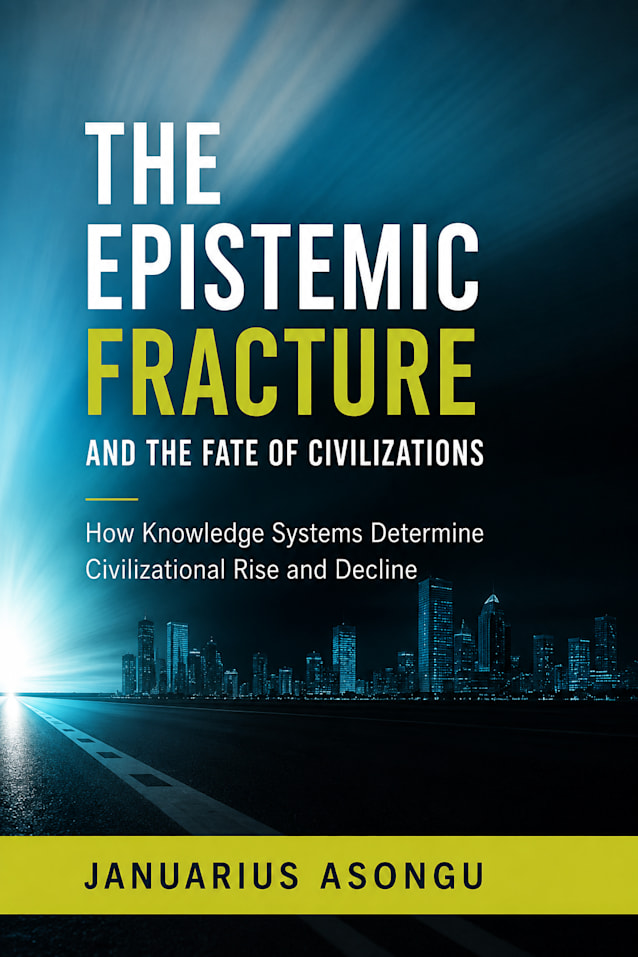
The Epistemic Fracture and the Fate of Civilizations
About
Why do civilizations rise, flourish, and ultimately decline? Why do some societies adapt, innovate, and endure while others stagnate, fragment, or disappear? In The Epistemic Fracture and the Fate of Civilizations, philosopher and public intellectual Januarius Asongu advances a bold and original answer: the destiny of civilizations is determined not primarily by wealth, geography, military power, or political institutions, but by the integrity of their knowledge systems.
Drawing on philosophy, history, sociology, civilizational studies, cybersecurity governance, and his groundbreaking framework of Critical Synthetic Realism, Asongu introduces the concept of Epistemic Fracture—the breakdown of a society’s ability to align belief with reality. When civilizations lose the capacity to question assumptions, correct errors, and learn from experience, decline becomes inevitable.
Through a sweeping comparative analysis of Africa, Greece, Europe, Islamic civilization, Asia, the Americas, and the modern digital world, Asongu reveals a recurring pattern underlying both civilizational success and collapse. He argues that epistemic sovereignty—the ability to generate, test, and revise knowledge independently—is the hidden foundation of human flourishing.
Provocative, interdisciplinary, and timely, this book offers a new theory of civilization and a compelling vision for humanity’s future in an age of misinformation, polarization, and global uncertainty.
"A tour de force of philosophical imagination and civilizational analysis. Asongu's concept of Epistemic Fracture has the potential to reshape debates about development, decline, democracy, and the future of humanity. This is an important and unforgettable book."
— George Alberto Gonzalez, PhD
"This book asks one of the oldest questions in history—why civilizations rise and fall—and offers one of the most compelling answers I have encountered. Asongu's theory of Epistemic Fracture is ambitious, provocative, and intellectually transformative. Whether one ultimately agrees with every conclusion, no serious reader will finish this book without seeing the world differently."
— George C. N. Lekelefac, PhD