The Triple Heritage of the Nweh
About
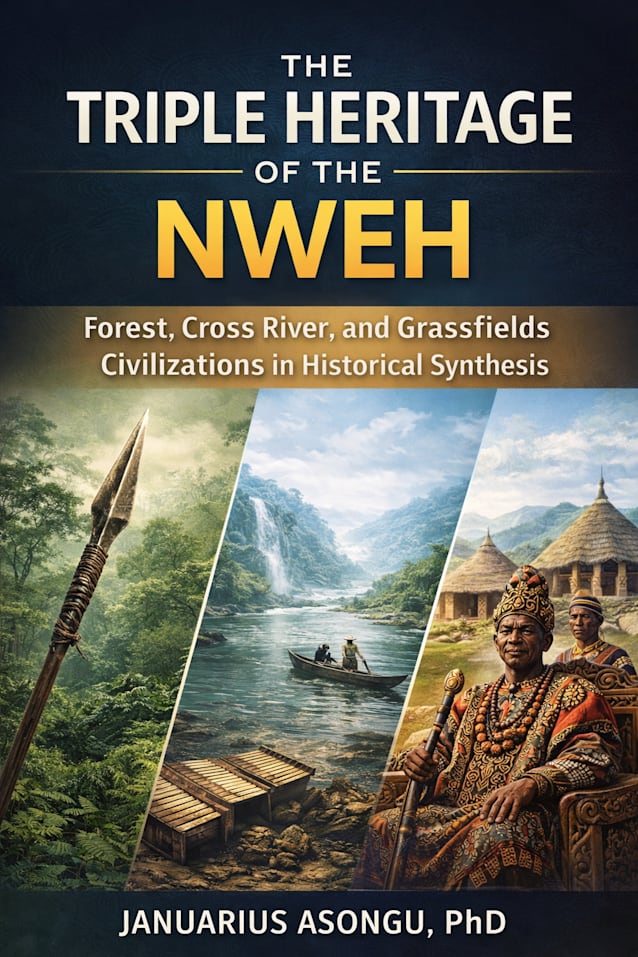
The Triple Heritage of the Nweh: Forest, Cross River, and Grassfields Civilizations in Historical Synthesis offers a groundbreaking reinterpretation of Nweh (Bangwa/Nwah) history, identity, and political culture. Rejecting simplistic origin narratives and colonial-era classifications, Januarius Asongu, PhD, presents the Nweh as a people formed through historical synthesis at a civilizational crossroads—where forest societies, Cross River institutions, and Grassfields cultures met, interacted, and recombined over centuries.
Drawing on ethnography, oral history, colonial archives, political analysis, and lived community memory, the book advances the Triple Heritage framework to explain enduring features of Nweh society: restrained authority rather than absolutism, a strong judicial ethic, exceptional valuation of education, and a recurrent inclination toward intellectual critique and opposition politics. Geography, ecology, language, kinship, ritual institutions, and education are treated not as isolated domains but as interlocking systems shaping social resilience and political rationality.
The book traces Nweh history from precolonial foundations through colonial disruption, post-independence centralization, multiparty politics, and the Anglophone (Ambazonia) struggle for independence. It examines the rise and decline of traditional authority (lefua), the role of missionary and state education in producing a distinct intellectual culture, and the disproportionate contribution of Nweh scholars, writers, administrators, and activists to Cameroonian and global public life. Particular attention is given to education as a civilizational strategy—both a pathway out of marginalization and, in times of conflict, a primary casualty of violence.
Written with analytical rigor and moral clarity, The Triple Heritage of the Nweh is both a work of historical reconstruction and a meditation on identity, memory, and survival in plural societies. It will be of interest to scholars of African history, anthropology, politics, and education, as well as readers seeking to understand how small societies navigate power, crisis, and continuity in an unsettled world.